
Alex Da Corte
Connecting Pop Culture and High Art
Alex Da Corte
Connecting Pop Culture and High Art
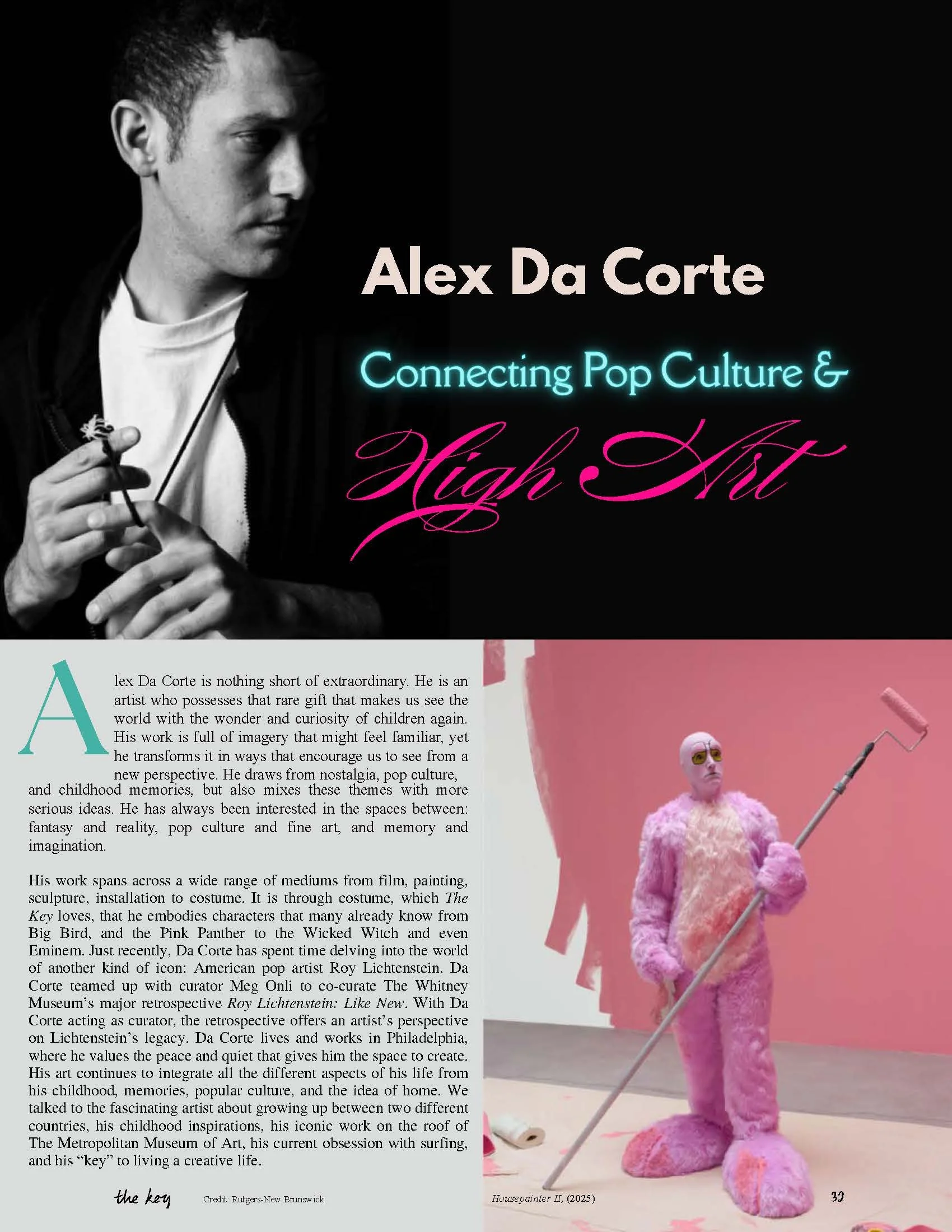
Alex Da Corte is nothing short of extraordinary. He is an artist who possesses that rare gift that makes us see the world with the wonder and curiosity of children again. His work is full of imagery that might feel familiar, yet he transforms it in ways that encourage us to see from a new perspective. He draws from nostalgia, pop culture, and childhood memories, but also mixes these themes with more serious ideas. He has always been interested in the spaces between: fantasy and reality, pop culture and fine art, and memory and imagination.
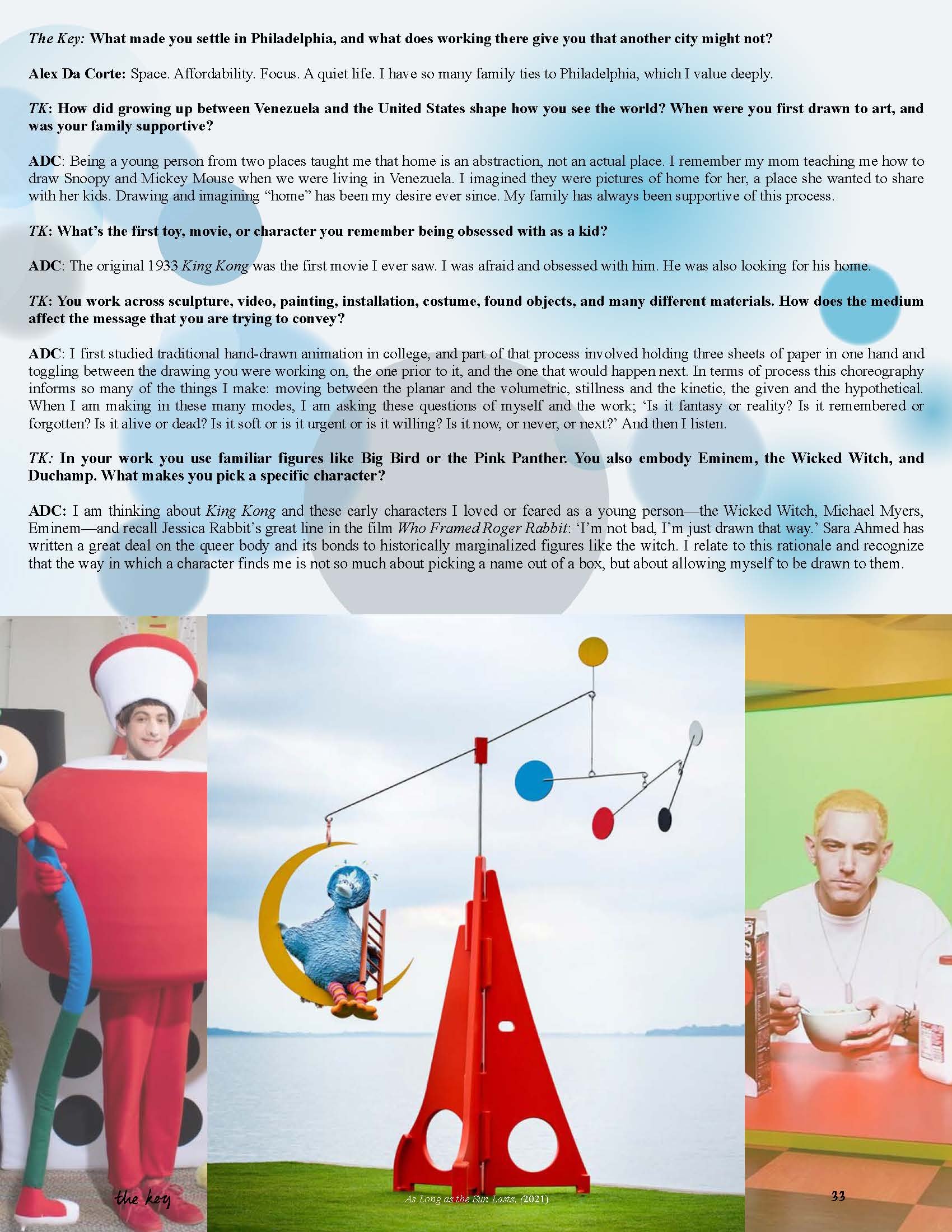
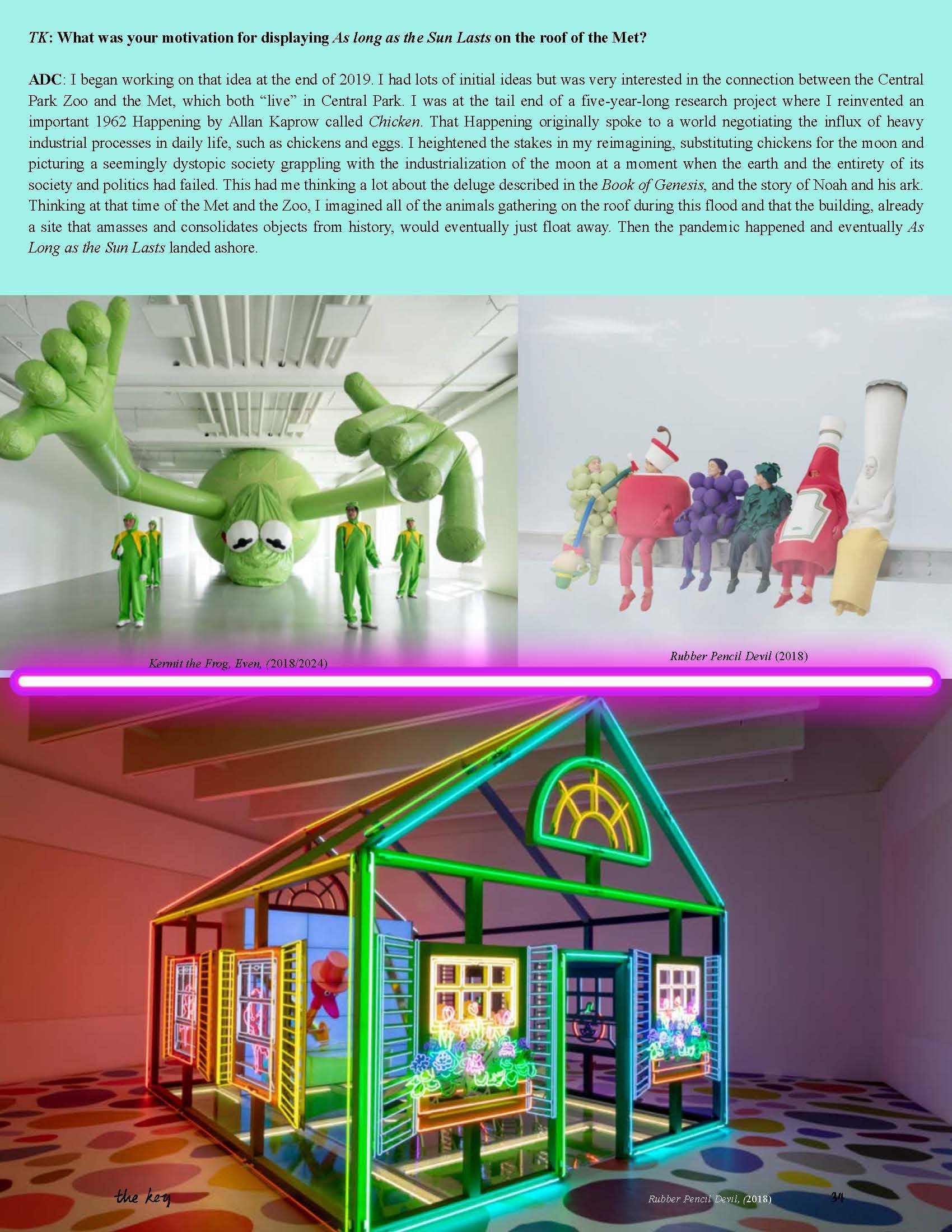
His work spans across a wide range of mediums from film, painting, sculpture, installation to costume. It is through costume, which The Key loves, that he embodies characters that many already know from Big Bird, and the Pink Panther to the Wicked Witch and even Eminem. Just recently, Da Corte has spent time delving into the world of another kind of icon: American pop artist Roy Lichtenstein. Da Corte teamed up with curator Meg Onli to co-curate The Whitney Museum’s major retrospective Roy Lichtenstein: Like New. With Da Corte acting as curator, the retrospective offers an artist’s perspective on Lichtenstein’s legacy. Da Corte lives and works in Philadelphia, where he values the peace and quiet that gives him the space to create. His art continues to integrate all the different aspects of his life from his childhood, memories, popular culture, and the idea of home. We talked to the fascinating artist about growing up between two different countries, his childhood inspirations, his iconic work on the roof of The Metropolitan Museum of Art, his current obsession with surfing, and his “key” to living a creative life.
The Key: What made you settle in Philadelphia, and what does working there give you that another city might not?
Alex Da Corte: Space. Affordability. Focus. A quiet life. I have so many family ties to Philadelphia, which I value deeply.
TK: How did growing up between Venezuela and the United States shape how you see the world? When were you first drawn to art, and was your family supportive?
ADC: Being a young person from two places taught me that home is an abstraction, not an actual place. I remember my mom teaching me how to draw Snoopy and Mickey Mouse when we were living in Venezuela. I imagined they were pictures of home for her, a place she wanted to share with her kids. Drawing and imagining “home” has been my desire ever since. My family has always been supportive of this process.
TK: What’s the first toy, movie, or character you remember being obsessed with as a kid?
ADC: The original 1933 King Kong was the first movie I ever saw. I was afraid and obsessed with him. He was also looking for his home.
TK: You work across sculpture, video, painting, installation, costume, found objects, and many different materials. How does the medium affect the message that you are trying to convey?
ADC: I first studied traditional hand-drawn animation in college, and part of that process involved holding three sheets of paper in one hand and toggling between the drawing you were working on, the one prior to it, and the one that would happen next. In terms of process this choreography informs so many of the things I make: moving between the planar and the volumetric, stillness and the kinetic, the given and the hypothetical. When I am making in these many modes, I am asking these questions of myself and the work; ‘Is it fantasy or reality? Is it remembered or forgotten? Is it alive or dead? Is it soft or is it urgent or is it willing? Is it now, or never, or next?’ And then I listen.
TK: In your work you use familiar figures like Big Bird or the Pink Panther. You also embody Eminem, the Wicked Witch, and Duchamp. What makes you pick a specific character?
ADC: I am thinking about King Kong and these early characters I loved or feared as a young person—the Wicked Witch, Michael Myers, Eminem—and recall Jessica Rabbit’s great line in the film Who Framed Roger Rabbit: ‘I’m not bad, I’m just drawn that way.’ Sara Ahmed has written a great deal on the queer body and its bonds to historically marginalized figures like the witch. I relate to this rationale and recognize that the way in which a character finds me is not so much about picking a name out of a box, but about allowing myself to be drawn to them.
TK: What was your motivation for displaying As long as the Sun Lasts on the roof of the Met?
ADC: I began working on that idea at the end of 2019. I had lots of initial ideas but was very interested in the connection between the Central Park Zoo and the Met, which both “live” in Central Park. I was at the tail end of a five-year-long research project where I reinvented an important 1962 Happening by Allan Kaprow called Chicken. That Happening originally spoke to a world negotiating the influx of heavy industrial processes in daily life, such as chickens and eggs. I heightened the stakes in my reimagining, substituting chickens for the moon and picturing a seemingly dystopic society grappling with the industrialization of the moon at a moment when the earth and the entirety of its society and politics had failed. This had me thinking a lot about the deluge described in the Book of Genesis, and the story of Noah and his ark. Thinking at that time of the Met and the Zoo, I imagined all of the animals gathering on the roof during this flood and that the building, already a site that amasses and consolidates objects from history, would eventually just float away. Then the pandemic happened and eventually As Long as the Sun Lasts landed ashore.
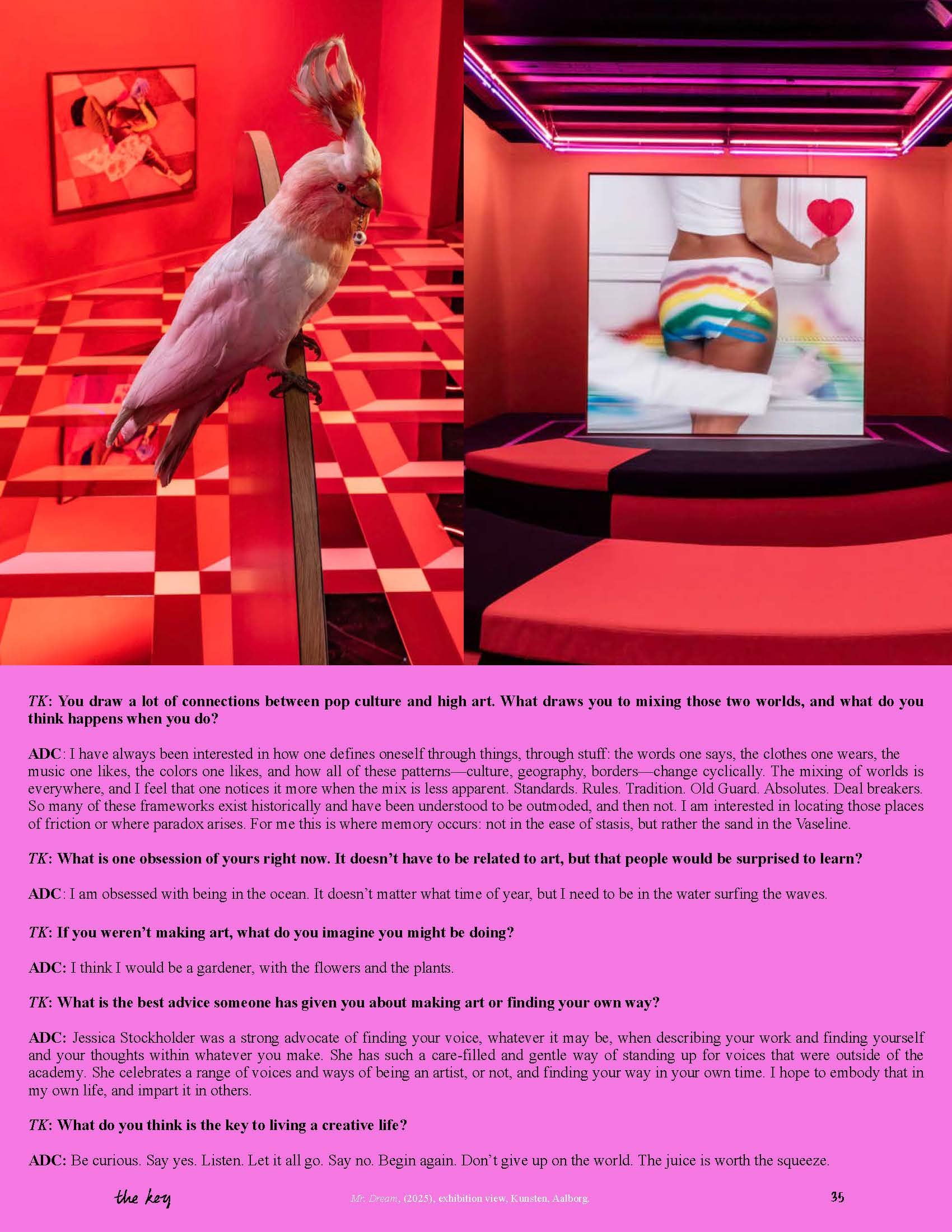
TK: You draw a lot of connections between pop culture and high art. What draws you to mixing those two worlds, and what do you think happens when you do?
ADC: I have always been interested in how one defines oneself through things, through stuff: the words one says, the clothes one wears, the
music one likes, the colors one likes, and how all of these patterns—culture, geography, borders—change cyclically. The mixing of worlds is everywhere, and I feel that one notices it more when the mix is less apparent. Standards. Rules. Tradition. Old Guard. Absolutes. Deal breakers. So many of these frameworks exist historically and have been understood to be outmoded, and then not. I am interested in locating those places of friction or where paradox arises. For me this is where memory occurs: not in the ease of stasis, but rather the sand in the Vaseline.
TK: What is one obsession of yours right now. It doesn’t have to be related to art, but that people would be surprised to learn?
ADC: I am obsessed with being in the ocean. It doesn’t matter what time of year, but I need to be in the water surfing the waves.
TK: If you weren’t making art, what do you imagine you might be doing?
ADC: I think I would be a gardener, with the flowers and the plants.
TK: What is the best advice someone has given you about making art or finding your own way?
ADC: Jessica Stockholder was a strong advocate of finding your voice, whatever it may be, when describing your work and finding yourself and your thoughts within whatever you make. She has such a care-filled and gentle way of standing up for voices that were outside of the academy. She celebrates a range of voices and ways of being an artist, or not, and finding your way in your own time. I hope to embody that in my own life, and impart it in others.
TK: What do you think is the “key” to living a creative life?
ADC: Be curious. Say yes. Listen. Let it all go. Say no. Begin again. Don’t give up on the world. The juice is worth the squeeze.