
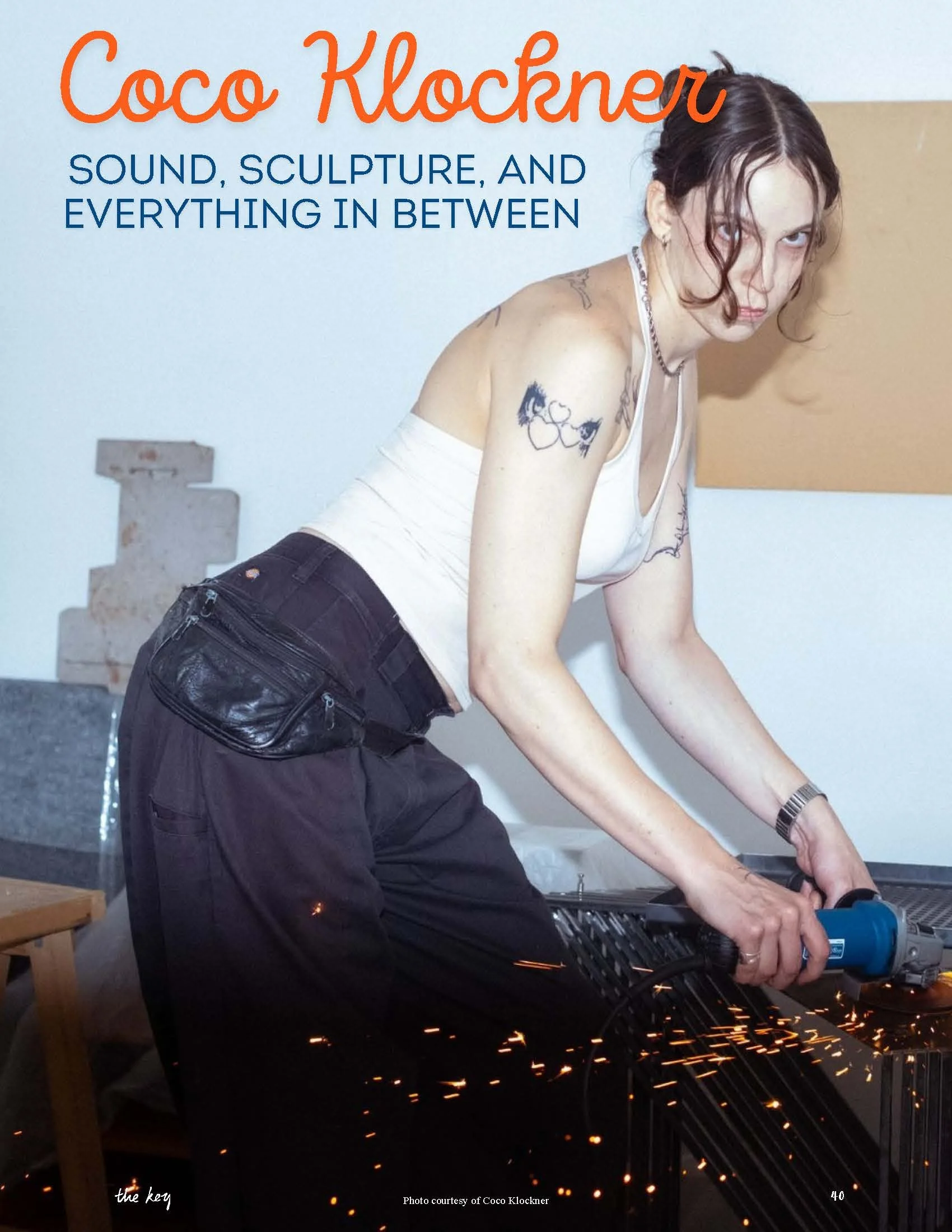
Coco Klockner
Sound, Sculpture, and Everything In Between
Coco Klockner
Sound, Sculpture, and Everything In Between
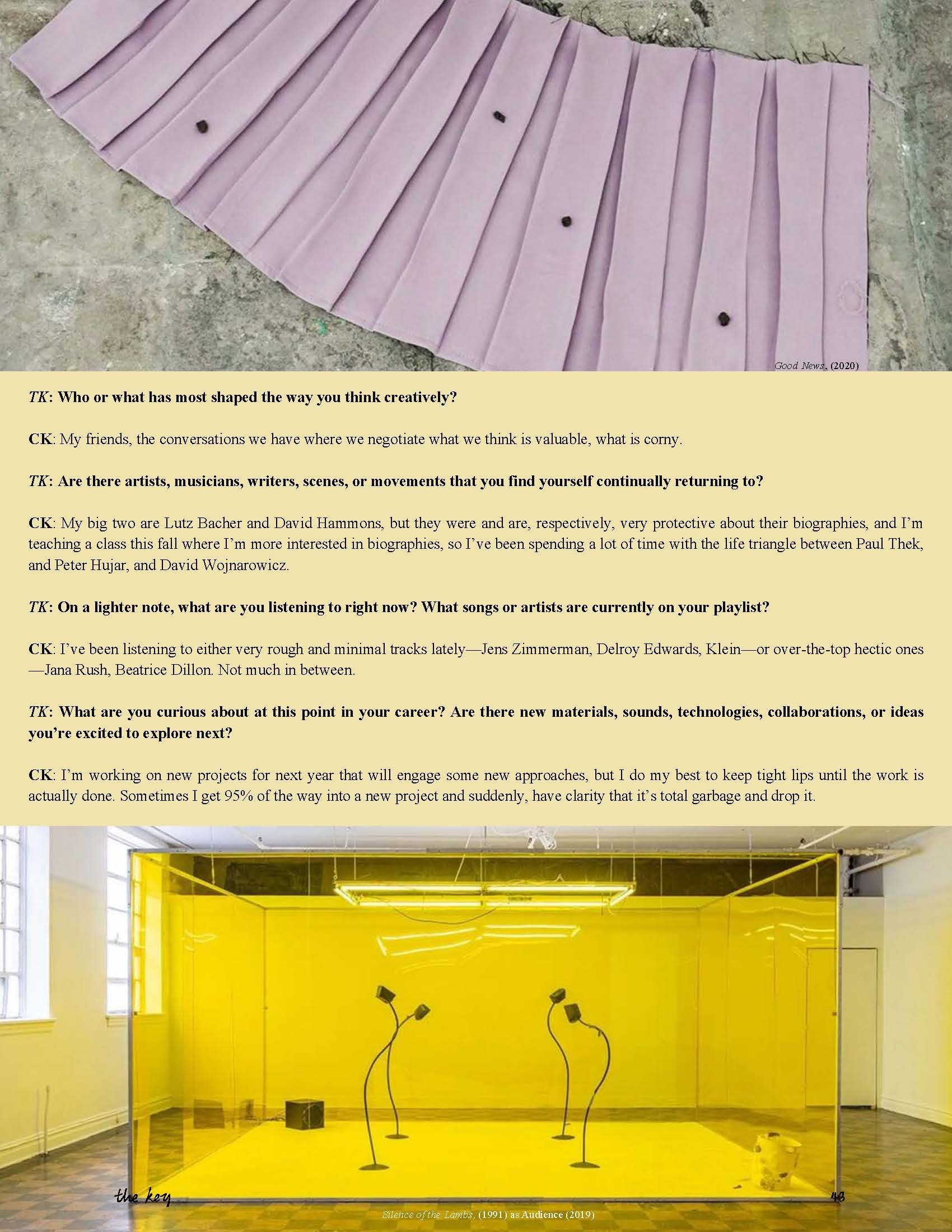
Coco Klockner defies artistic categorization. The 34-year-old multimedia artist works at the intersection between sound and sculpture. Step inside one of Klockner’s installations and you’ll find yourself immersed in a world constructed from everyday objects like speakers, fog machines, hardware, and even dirt, but somehow she finds a way to transform these interesting combinations into something otherworldly.
Sound operates as an extension of sculpture in much of her work, turning something intangible into an almost physical experience. She transforms sound into raw vibrations confronting the viewer with themes such as trans-femininity and human connection. Her art is intriguing, abstract, and uniquely her own, giving her viewers the chance to sensually experience their own mind, body. and the spaces around them in a way they may have never done before. We enjoyed learning about the Brooklyn-based artist as she offers a deeper look into her fascinating work.
The Key: Can you tell us a little about your childhood and the environment you grew up in? Were you always someone who wanted to make, build, experiment, or take things apart?
Coco Klockner: I played a lot of sports, but I was a huge nerd. I remember learning how to replace RAM on a computer by taking apart a laptop without mismatching or losing the screws on reassembly. I drew a lot and taught myself how to develop black and white film when I realized my schedule would never align with the photo classes. I went to art school for illustration originally because I loved the images in children’s books, but I switched to painting, and then ultimately sculpture after realizing how disinterested I was in the commercial orientation of that approach.
TK: You came of age artistically through DIY music and warehouse spaces. Can you tell us about that period and how those experiences shaped the way you think about sound, art, and community today?
CK: I, and a number of others, ended up gravitating to Baltimore primarily because of a certain music scene that was emergent in the 2000s and 2010s. The decision to do art school there felt almost entirely incidental to our interest in the city—the music and art history there is so significant. A lot of locals were also deciding to stay at that time and it felt like a moment.There was an incredible amount of access to space, which increased the number of ways a lot of us felt like we could play with form for each other. It felt like every audience member of every show had their own project—maybe even their own space down the block or down a floor or two. Some friends had a street-accessible storefront for like $250 a month.
Even if everyone had aesthetic differences (which they did), there was a certain ethic of lateralism, of mutual investment in each other and the city and in the volley of ideas that it seemed we were all engaged in, that ultimately shaped what I thought art could or should do. When I started focusing more on my studio practice, that sensibility is basically what led me to curate exhibitions of friends, acquaintances, and not-yet-acquaintances in the spaces I ended up having access to. At one point that meant doing art shows in a barn that was on the cusp of falling over, running its lights on a generator; a tailor shop that had become a rapid turnaround office for local political campaigns; or at the moment, my studio above a tool rental shop.
Every now and then I get the chance to organize music events again. We did a show in the basement of Sculpture Center this past fall, which was amazing. The contexts change but the impulses usually don’t. It’s mostly the realizations of what is important about making with others in mind that stays with you.
TK: Your work moves between sculpture, sound, technology, installation, and performance. How did you develop this and when did it begin to feel your own?
CK: I just try to be honest with myself when one medium is feeling like a drag and another is feeling more appropriate to where my head is. I applied to grad school in 2016 when I realized I wanted to make sculpture but didn’t know how to make anything. Some other impulses have demanded much less time investment than that one did.
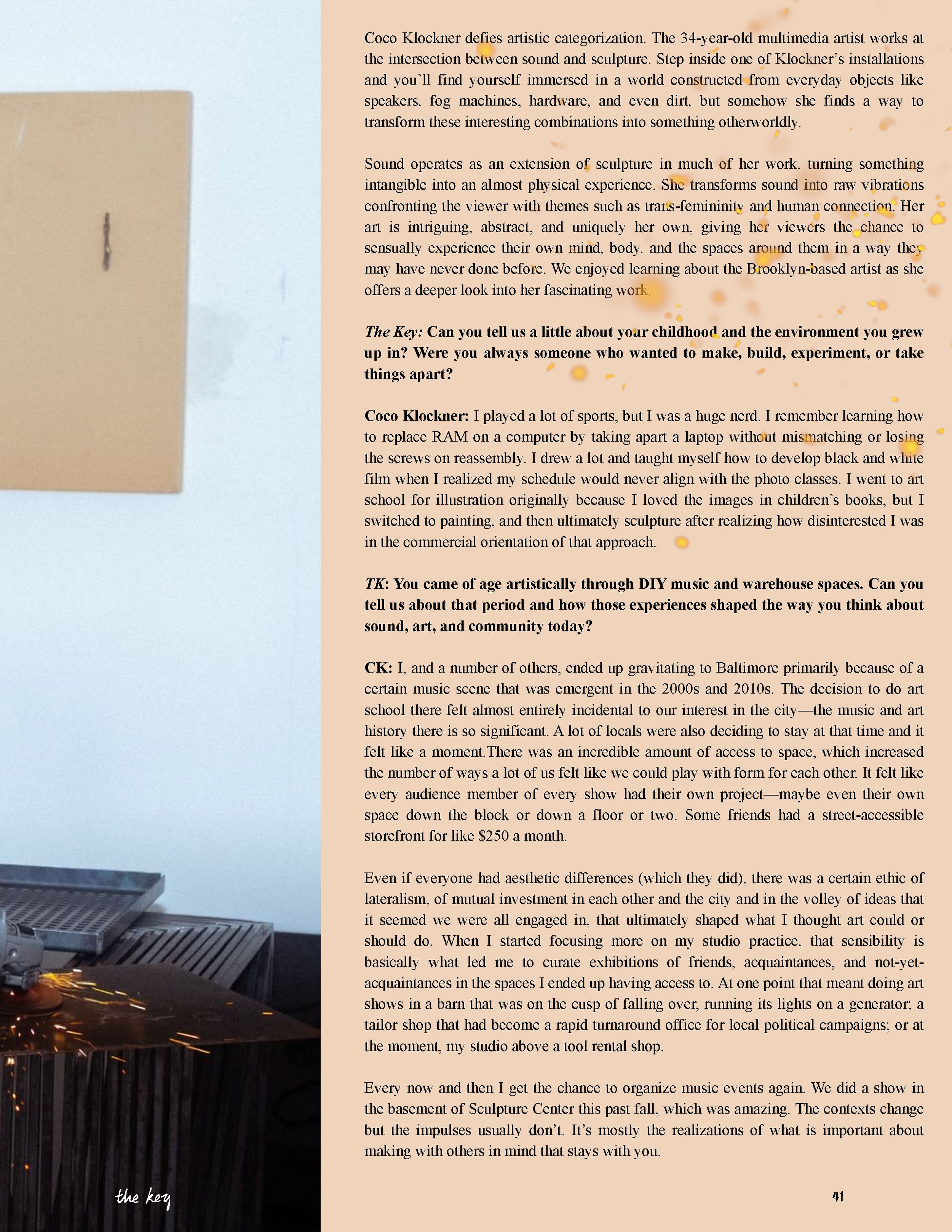
TK: Your work often transforms materials, machines, and everyday objects into something that feels unexpectedly alive or emotionally charged. What draws you to the materials and objects you choose to work with?
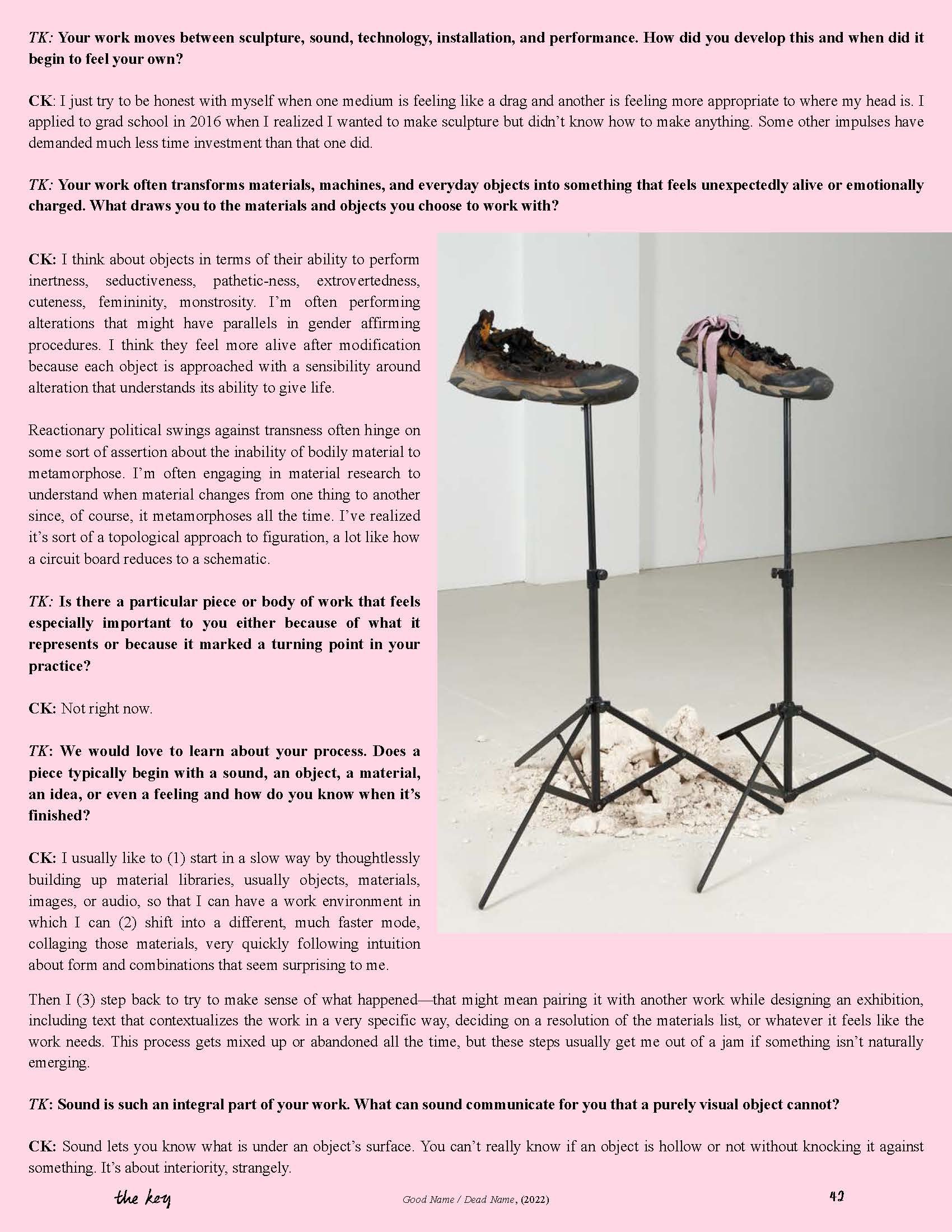
CK: I think about objects in terms of their ability to perform inertness, seductiveness, pathetic-ness, extrovertedness, cuteness, femininity, monstrosity. I’m often performing alterations that might have parallels in gender affirming procedures. I think they feel more alive after modification because each object is approached with a sensibility around alteration that understands its ability to give life.
Reactionary political swings against transness often hinge on some sort of assertion about the inability of bodily material to metamorphose. I’m often engaging in material research to understand when material changes from one thing to another since, of course, it metamorphoses all the time. I’ve realized it’s sort of a topological approach to figuration, a lot like how a circuit board reduces to a schematic.
TK: Is there a particular piece or body of work that feels especially important to you either because of what it represents or because it marked a turning point in your practice?
CK: Not right now.
TK: We would love to learn about your process. Does a piece typically begin with a sound, an object, a material, an idea, or even a feeling and how do you know when it’s finished?
CK: I usually like to (1) start in a slow way by thoughtlessly building up material libraries, usually objects, materials, images, or audio, so that I can have a work environment in which I can (2) shift into a different, much faster mode, collaging those materials, very quickly following intuition about form and combinations that seem surprising to me.
Then I (3) step back to try to make sense of what happened—that might mean pairing it with another work while designing an exhibition, including text that contextualizes the work in a very specific way, deciding on a resolution of the materials list, or whatever it feels like the work needs. This process gets mixed up or abandoned all the time, but these steps usually get me out of a jam if something isn’t naturally emerging.
TK: Sound is such an integral part of your work. What can sound communicate for you that a purely visual object cannot?
CK: Sound lets you know what is under an object’s surface. You can’t really know if an object is hollow or not without knocking it against something. It’s about interiority, strangely.
TK: Who or what has most shaped the way you think creatively?
CK: My friends, the conversations we have where we negotiate what we think is valuable, what is corny.
TK: Are there artists, musicians, writers, scenes, or movements that you find yourself continually returning to?
CK: My big two are Lutz Bacher and David Hammons, but they were and are, respectively, very protective about their biographies, and I’m teaching a class this fall where I’m more interested in biographies, so I’ve been spending a lot of time with the life triangle between Paul Thek, and Peter Hujar, and David Wojnarowicz.
TK: On a lighter note, what are you listening to right now? What songs or artists are currently on your playlist?
CK: I’ve been listening to either very rough and minimal tracks lately—Jens Zimmerman, Delroy Edwards, Klein—or over-the-top hectic ones—Jana Rush, Beatrice Dillon. Not much in between.
TK: What are you curious about at this point in your career? Are there new materials, sounds, technologies, collaborations, or ideas you’re excited to explore next?
CK: I’m working on new projects for next year that will engage some new approaches, but I do my best to keep tight lips until the work is actually done. Sometimes I get 95% of the way into a new project and suddenly, have clarity that it’s total garbage and drop it.