
Greg Ross
Style Evolution
Greg Ross
Style Evolution
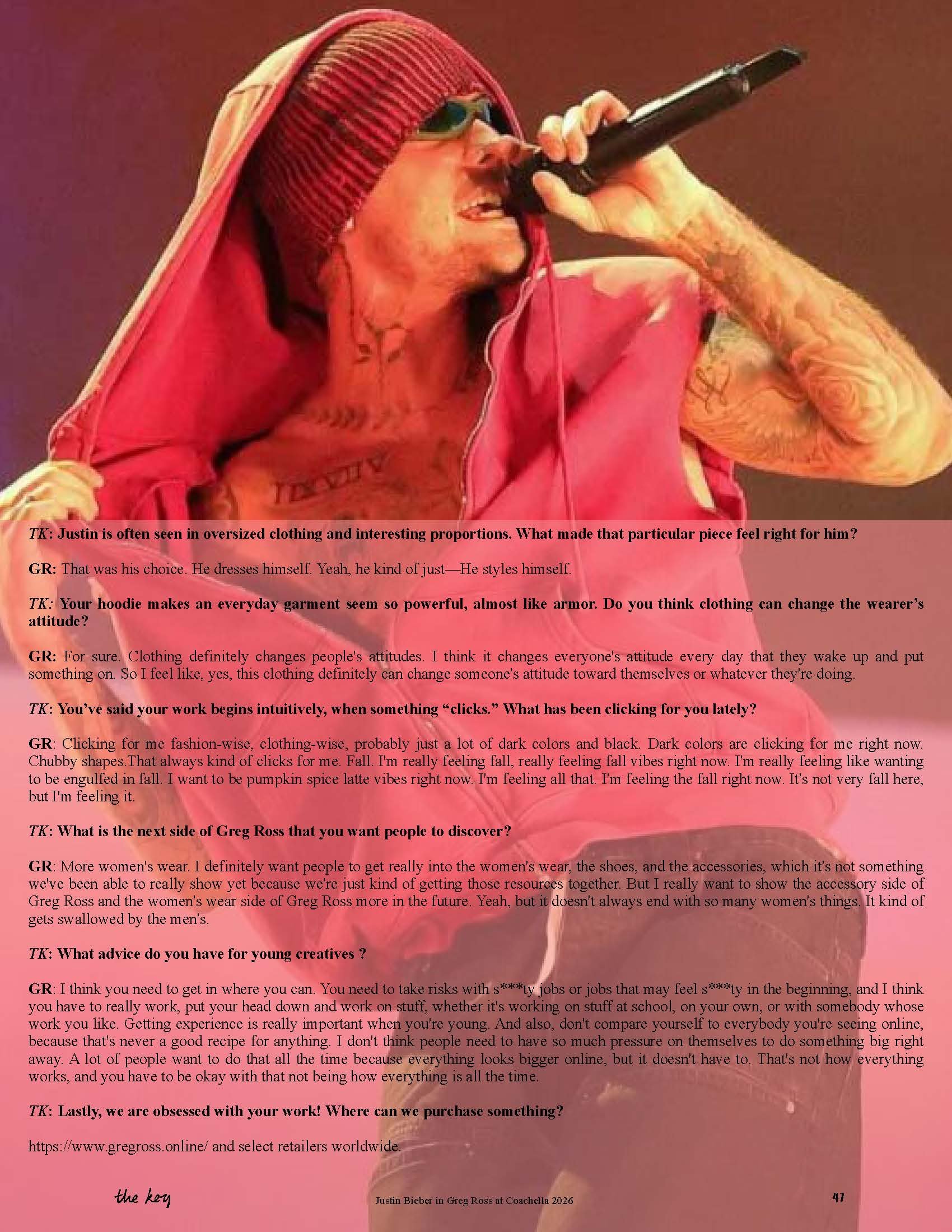
Los Angeles-based fashion designer Greg Ross doesn’t show his face very often. Almost every online photo of him is a profile shot or one in which his hands shield his features. The rationale is intentional. Ross believes in letting his designs speak for themselves. With a bold and distinctive vision and an entirely unique aesthetic, Ross is getting a lot of attention in the fashion world and beyond. Last year, Justin Bieber took the stage at Coachella wearing a sculptural Greg Ross red hoodie. Bieber joins Drake and Travis Scott, who have also embraced the designer’s creations.
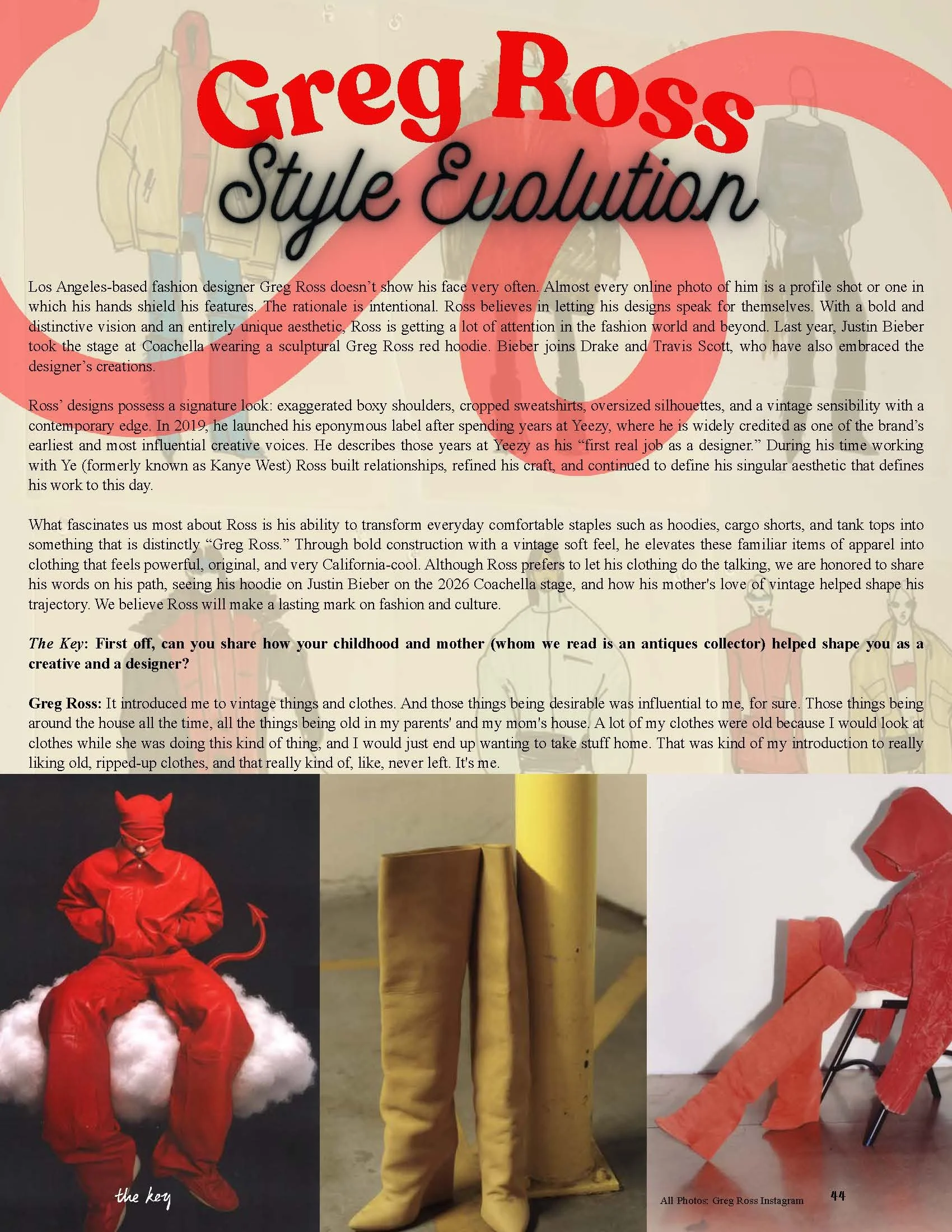
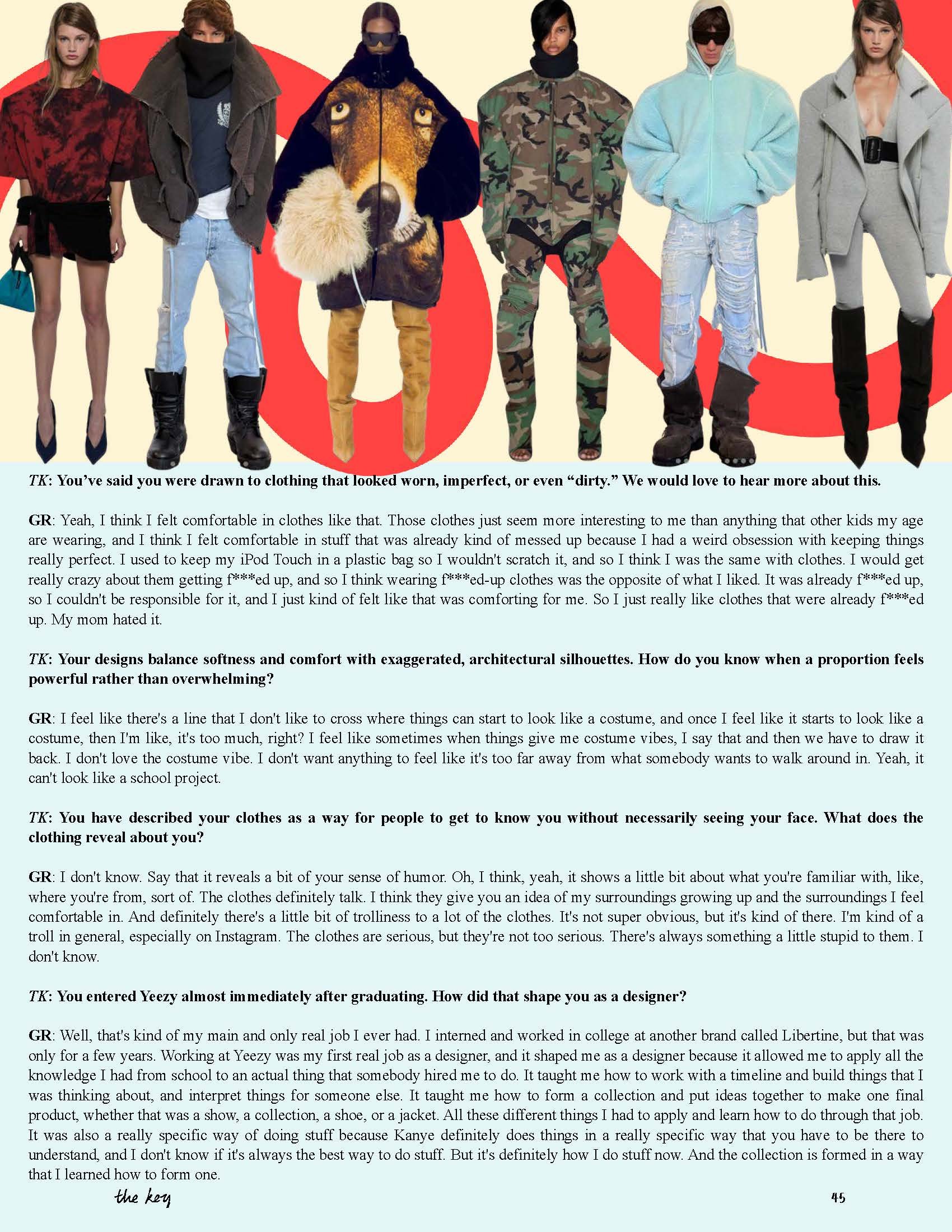
Ross’ designs possess a signature look: exaggerated boxy shoulders, cropped sweatshirts, oversized silhouettes, and a vintage sensibility with a contemporary edge. In 2019, he launched his eponymous label after spending years at Yeezy, where he is widely credited as one of the brand’s earliest and most influential creative voices. He describes those years at Yeezy as his “first real job as a designer.” During his time working with Ye (formerly known as Kanye West) Ross built relationships, refined his craft, and continued to define his singular aesthetic that defines his work to this day.
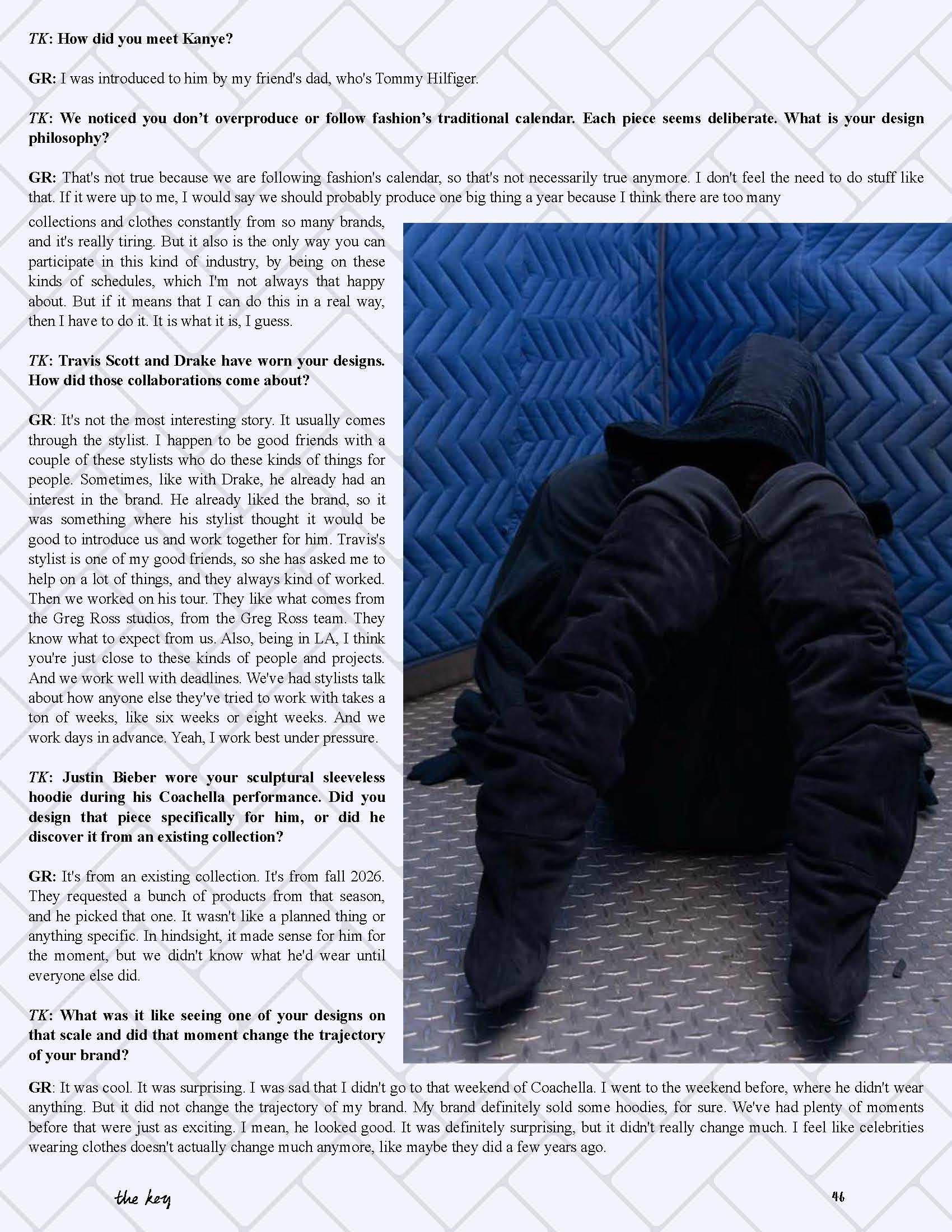
What fascinates us most about Ross is his ability to transform everyday comfortable staples such as hoodies, cargo shorts, and tank tops into something that is distinctly “Greg Ross.” Through bold construction with a vintage soft feel, he elevates these familiar items of apparel into clothing that feels powerful, original, and very California-cool. Although Ross prefers to let his clothing do the talking, we are honored to share his words on his path, seeing his hoodie on Justin Bieber on the 2026 Coachella stage, and how his mother's love of vintage helped shape his trajectory. We believe Ross will make a lasting mark on fashion and culture.
The Key: First off, can you share how your childhood and mother (whom we read is an antiques collector) helped shape you as a creative and a designer?
Greg Ross: It introduced me to vintage things and clothes. And those things being desirable was influential to me, for sure. Those things being around the house all the time, all the things being old in my parents' and my mom's house. A lot of my clothes were old because I would look at clothes while she was doing this kind of thing, and I would just end up wanting to take stuff home. That was kind of my introduction to really liking old, ripped-up clothes, and that really kind of, like, never left. It's me.
TK: You’ve said you were drawn to clothing that looked worn, imperfect, or even “dirty.” We would love to hear more about this.
GR: Yeah, I think I felt comfortable in clothes like that. Those clothes just seem more interesting to me than anything that other kids my age are wearing, and I think I felt comfortable in stuff that was already kind of messed up because I had a weird obsession with keeping things really perfect. I used to keep my iPod Touch in a plastic bag so I wouldn't scratch it, and so I think I was the same with clothes. I would get really crazy about them getting f***ed up, and so I think wearing f***ed-up clothes was the opposite of what I liked. It was already f***ed up, so I couldn't be responsible for it, and I just kind of felt like that was comforting for me. So I just really like clothes that were already f***ed up. My mom hated it.
TK: Your designs balance softness and comfort with exaggerated, architectural silhouettes. How do you know when a proportion feels powerful rather than overwhelming?
GR: I feel like there's a line that I don't like to cross where things can start to look like a costume, and once I feel like it starts to look like a costume, then I'm like, it's too much, right? I feel like sometimes when things give me costume vibes, I say that and then we have to draw it back. I don't love the costume vibe. I don't want anything to feel like it's too far away from what somebody wants to walk around in. Yeah, it can't look like a school project.
TK: You have described your clothes as a way for people to get to know you without necessarily seeing your face. What does the clothing reveal about you?
GR: I don't know. Say that it reveals a bit of your sense of humor. Oh, I think, yeah, it shows a little bit about what you're familiar with, like, where you're from, sort of. The clothes definitely talk. I think they give you an idea of my surroundings growing up and the surroundings I feel comfortable in. And definitely there's a little bit of trolliness to a lot of the clothes. It's not super obvious, but it's kind of there. I'm kind of a troll in general, especially on Instagram. The clothes are serious, but they're not too serious. There's always something a little stupid to them. I don't know.
TK: You entered Yeezy almost immediately after graduating. How did that shape you as a designer?
GR: Well, that's kind of my main and only real job I ever had. I interned and worked in college at another brand called Libertine, but that was only for a few years. Working at Yeezy was my first real job as a designer, and it shaped me as a designer because it allowed me to apply all the knowledge I had from school to an actual thing that somebody hired me to do. It taught me how to work with a timeline and build things that I was thinking about, and interpret things for someone else. It taught me how to form a collection and put ideas together to make one final product, whether that was a show, a collection, a shoe, or a jacket. All these different things I had to apply and learn how to do through that job. It was also a really specific way of doing stuff because Kanye definitely does things in a really specific way that you have to be there to understand, and I don't know if it's always the best way to do stuff. But it's definitely how I do stuff now. And the collection is formed in a way that I learned how to form one.
TK: How did you meet Kanye?
GR: I was introduced to him by my friend's dad, who's Tommy Hilfiger.
TK: We noticed you don’t overproduce or follow fashion’s traditional calendar. Each piece seems deliberate. What is your design philosophy?
GR: That's not true because we are following fashion's calendar, so that's not necessarily true anymore. I don't feel the need to do stuff like that. If it were up to me, I would say we should probably produce one big thing a year because I think there are too many collections and clothes constantly from so many brands, and it's really tiring. But it also is the only way you can participate in this kind of industry, by being on these kinds of schedules, which I'm not always that happy about. But if it means that I can do this in a real way, then I have to do it. It is what it is, I guess.
TK: Travis Scott and Drake have worn your designs. How did those collaborations come about?
GR: It's not the most interesting story. It usually comes through the stylist. I happen to be good friends with a couple of these stylists who do these kinds of things for people. Sometimes, like with Drake, he already had an interest in the brand. He already liked the brand, so it was something where his stylist thought it would be good to introduce us and work together for him. Travis's stylist is one of my good friends, so she has asked me to help on a lot of things, and they always kind of worked. Then we worked on his tour. They like what comes from the Greg Ross studios, from the Greg Ross team. They know what to expect from us. Also, being in LA, I think you're just close to these kinds of people and projects. And we work well with deadlines. We've had stylists talk about how anyone else they've tried to work with takes a ton of weeks, like six weeks or eight weeks. And we work days in advance. Yeah, I work best under pressure.
TK: Justin Bieber wore your sculptural sleeveless hoodie during his Coachella performance. Did you design that piece specifically for him, or did he discover it from an existing collection?
GR: It's from an existing collection. It's from fall 2026. They requested a bunch of products from that season, and he picked that one. It wasn't like a planned thing or anything specific. In hindsight, it made sense for him for the moment, but we didn't know what he'd wear until everyone else did.
TK: What was it like seeing one of your designs on that scale and did that moment change the trajectory of your brand?
GR: It was cool. It was surprising. I was sad that I didn't go to that weekend of Coachella. I went to the weekend before, where he didn't wear anything. But it did not change the trajectory of my brand. My brand definitely sold some hoodies, for sure. We've had plenty of moments before that were just as exciting. I mean, he looked good. It was definitely surprising, but it didn't really change much. I feel like celebrities wearing clothes doesn't actually change much anymore, like maybe they did a few years ago.
TK: Justin is often seen in oversized clothing and interesting proportions. What made that particular piece feel right for him?
GR: That was his choice. He dresses himself. Yeah, he kind of just—He styles himself.
TK: Your hoodie makes an everyday garment seem so powerful, almost like armor. Do you think clothing can change the wearer’s attitude?
GR: For sure. Clothing definitely changes people's attitudes. I think it changes everyone's attitude every day that they wake up and put something on. So I feel like, yes, this clothing definitely can change someone's attitude toward themselves or whatever they're doing.
TK: You’ve said your work begins intuitively, when something “clicks.” What has been clicking for you lately?
GR: Clicking for me fashion-wise, clothing-wise, probably just a lot of dark colors and black. Dark colors are clicking for me right now. Chubby shapes.That always kind of clicks for me. Fall. I'm really feeling fall, really feeling fall vibes right now. I'm really feeling like wanting to be engulfed in fall. I want to be pumpkin spice latte vibes right now. I'm feeling all that. I'm feeling the fall right now. It's not very fall here, but I'm feeling it.
TK: What is the next side of Greg Ross that you want people to discover?
GR: More women's wear. I definitely want people to get really into the women's wear, the shoes, and the accessories, which it's not something we've been able to really show yet because we're just kind of getting those resources together. But I really want to show the accessory side of Greg Ross and the women's wear side of Greg Ross more in the future. Yeah, but it doesn't always end with so many women's things. It kind of gets swallowed by the men's.
TK: What advice do you have for young creatives ?
GR: I think you need to get in where you can. You need to take risks with s***ty jobs or jobs that may feel s***ty in the beginning, and I think you have to really work, put your head down and work on stuff, whether it's working on stuff at school, on your own, or with somebody whose work you like. Getting experience is really important when you're young. And also, don't compare yourself to everybody you're seeing online, because that's never a good recipe for anything. I don't think people need to have so much pressure on themselves to do something big right away. A lot of people want to do that all the time because everything looks bigger online, but it doesn't have to. That's not how everything works, and you have to be okay with that not being how everything is all the time.
TK: Lastly, we are obsessed with your work! Where can we purchase something?
https://www.gregross.online/ and select retailers worldwide.