
Serena Nickson
The Art of Girlhood & the Woman Who Captures It Best
Serena Nickson
The Art of Girlhood & the Woman Who Captures It Best
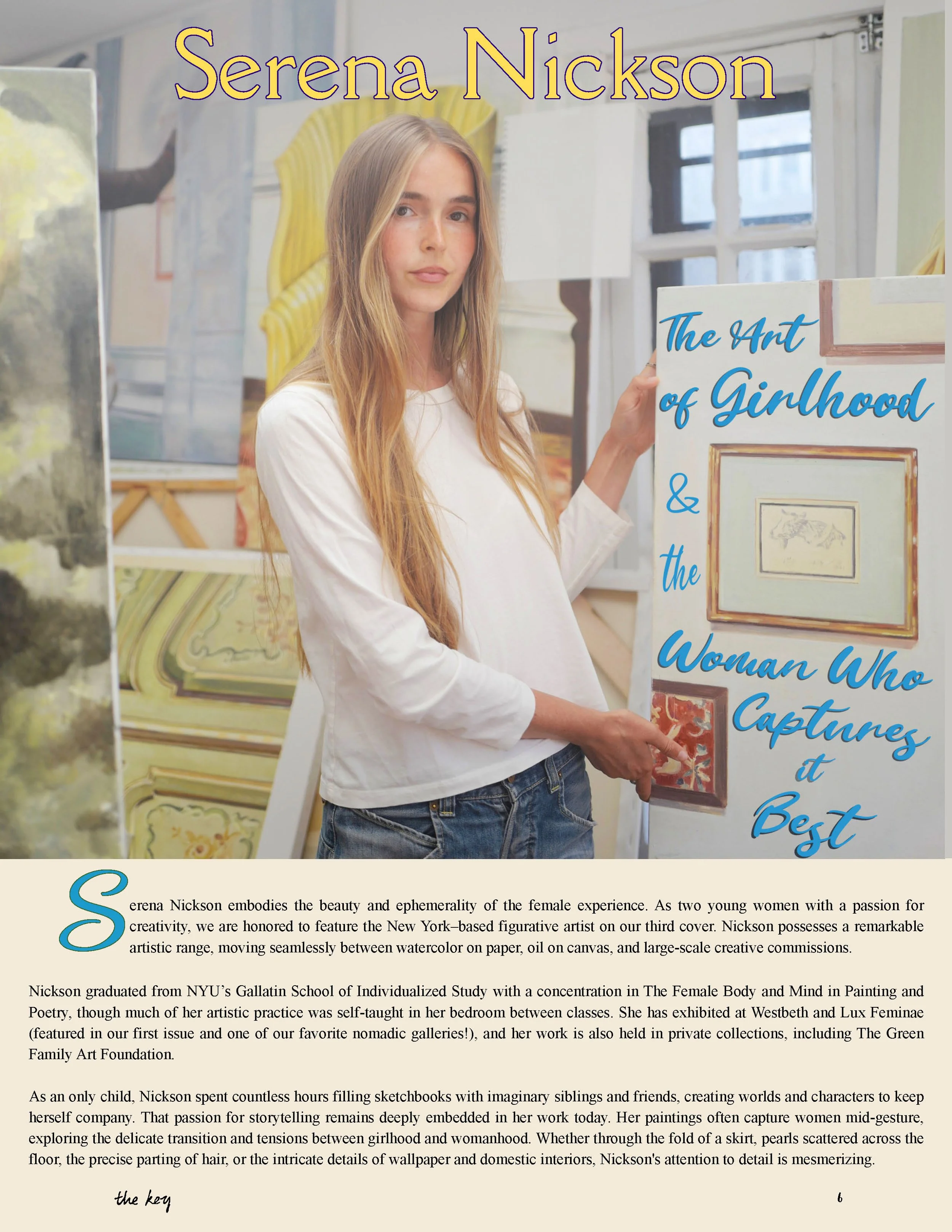
Serena Nickson embodies the beauty and ephemerality of the female experience. As two young women with a passion for creativity, we are honored to feature the New York–based figurative artist on our third cover. Nickson possesses a remarkable artistic range, moving seamlessly between watercolor on paper, oil on canvas, and large-scale creative commissions.
Nickson graduated from NYU’s Gallatin School of Individualized Study with a concentration in The Female Body and Mind in Painting and Poetry, though much of her artistic practice was self-taught in her bedroom between classes. She has exhibited at Westbeth and Lux Feminae (featured in our first issue and one of our favorite nomadic galleries!), and her work is also held in private collections, including The Green Family Art Foundation.
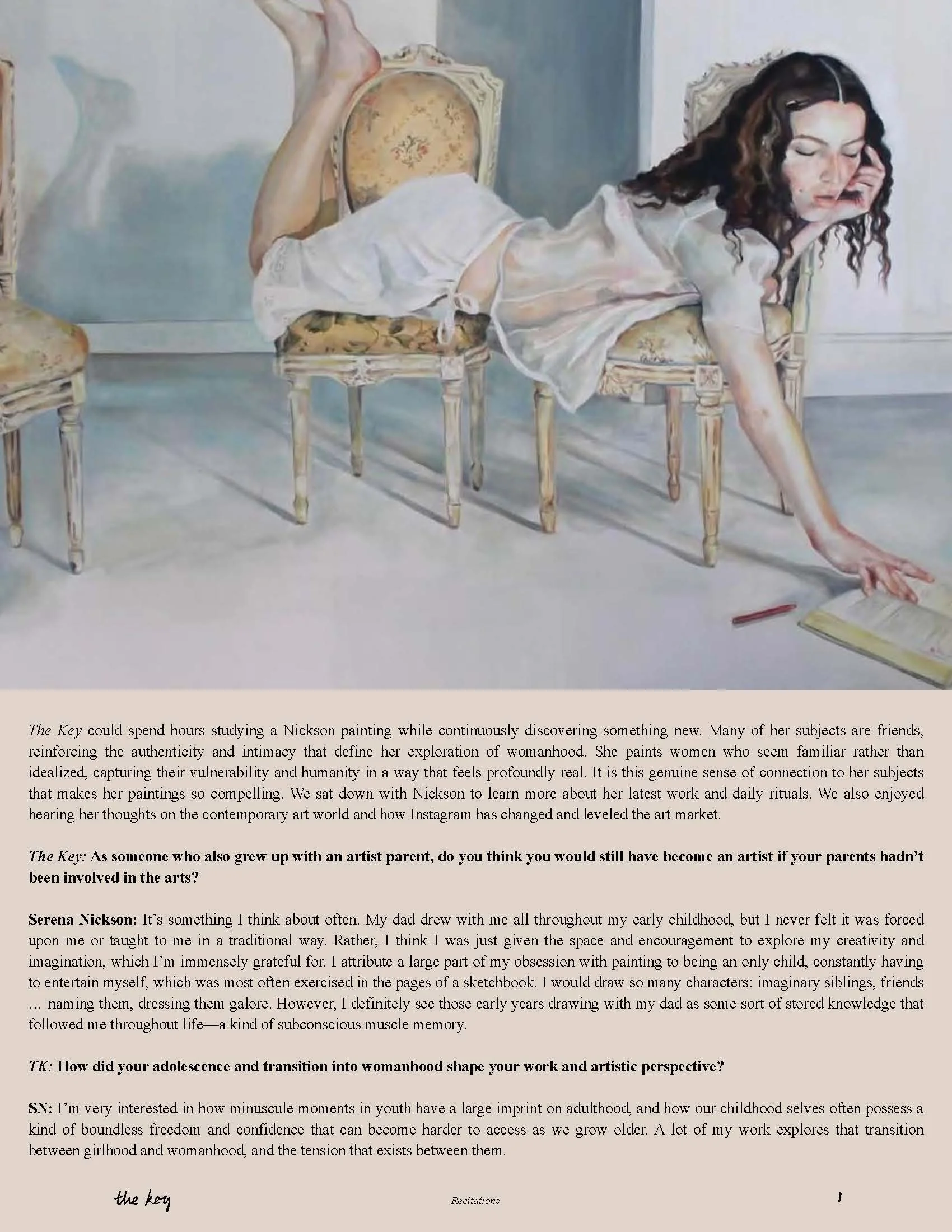
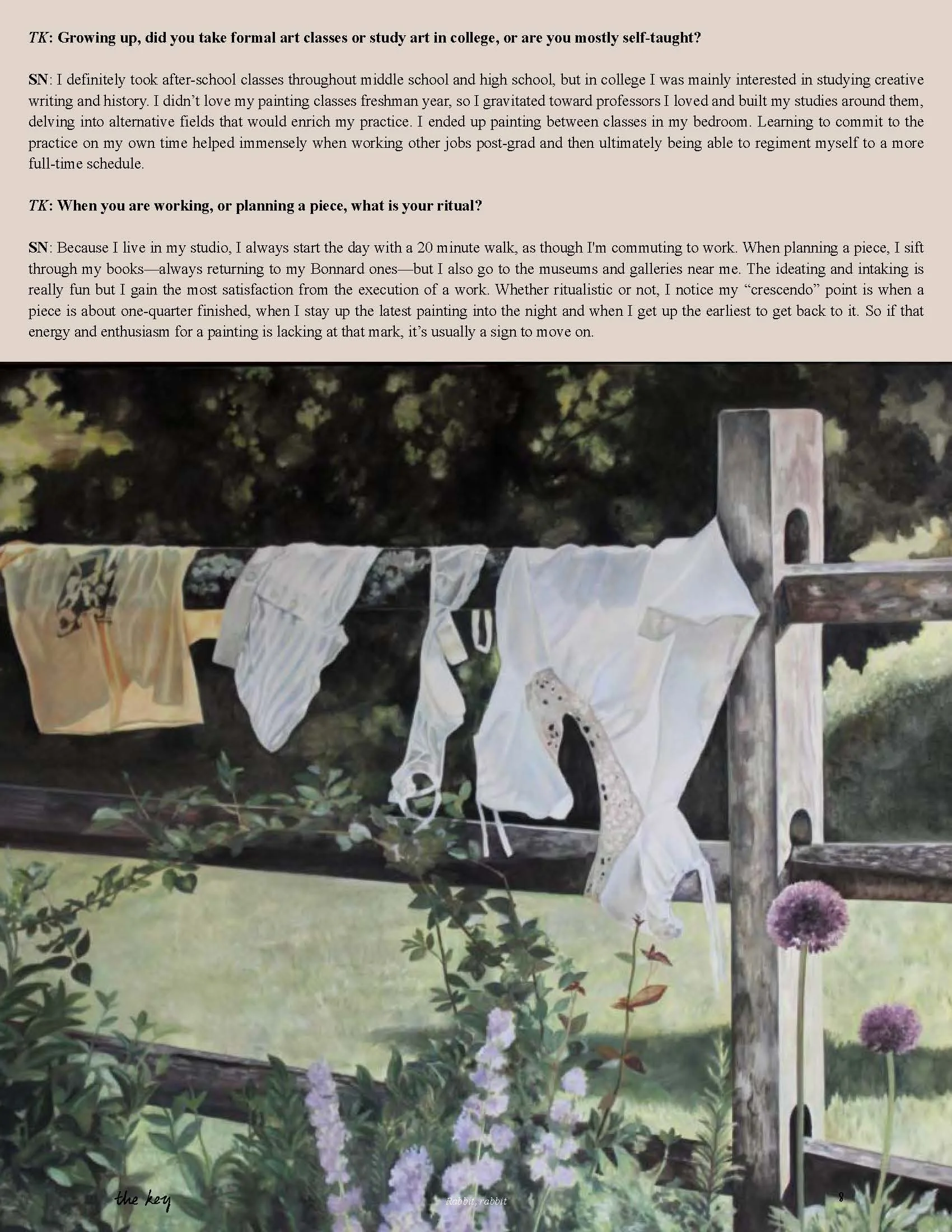
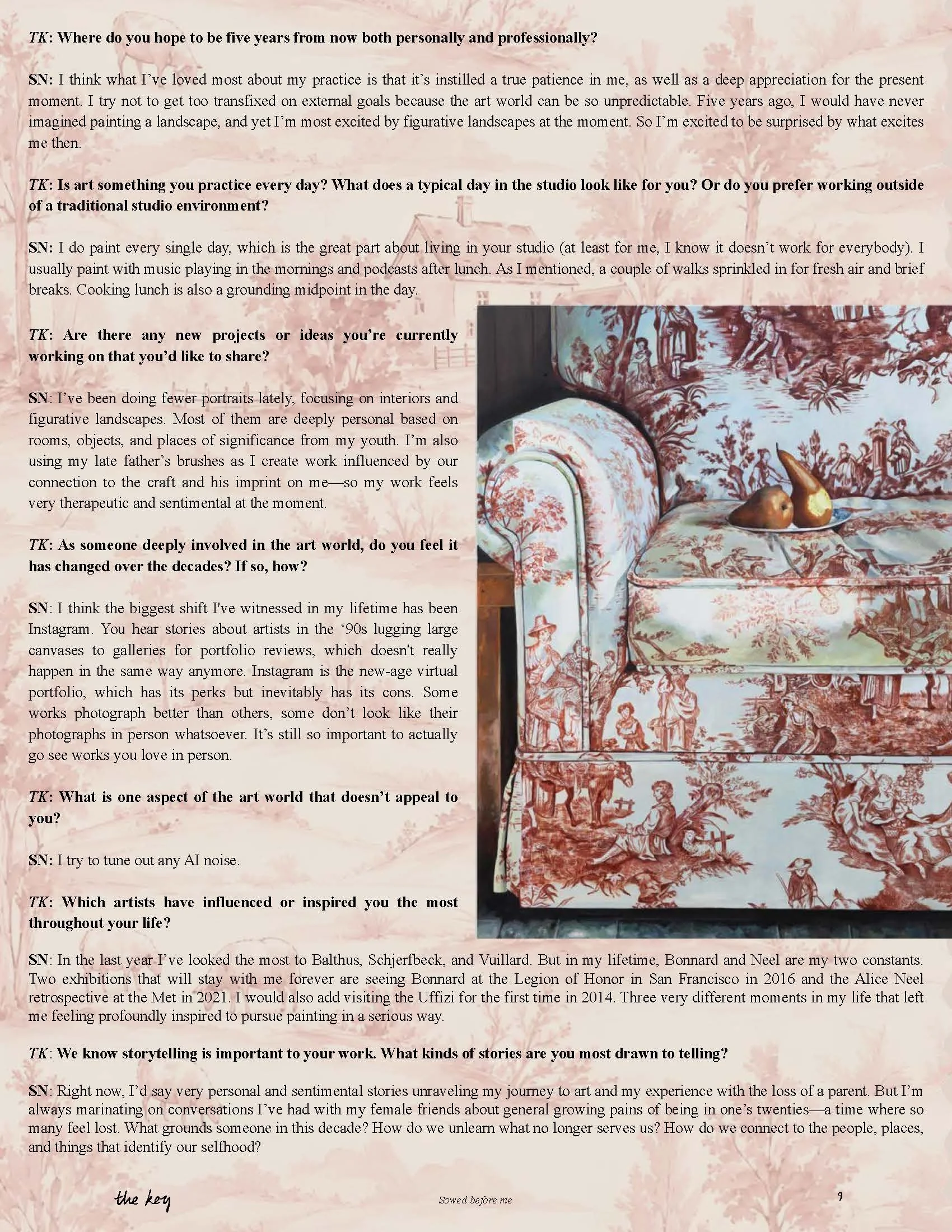
As an only child, Nickson spent countless hours filling sketchbooks with imaginary siblings and friends, creating worlds and characters to keep herself company. That passion for storytelling remains deeply embedded in her work today. Her paintings often capture women mid-gesture, exploring the delicate transition and tensions between girlhood and womanhood. Whether through the fold of a skirt, pearls scattered across the floor, the precise parting of hair, or the intricate details of wallpaper and domestic interiors, Nickson's attention to detail is mesmerizing.
The Key could spend hours studying a Nickson painting while continuously discovering something new. Many of her subjects are friends, reinforcing the authenticity and intimacy that define her exploration of womanhood. She paints women who seem familiar rather than idealized, capturing their vulnerability and humanity in a way that feels profoundly real. It is this genuine sense of connection to her subjects that makes her paintings so compelling. We sat down with Nickson to learn more about her latest work and daily rituals. We also enjoyed hearing her thoughts on the contemporary art world and how Instagram has changed and leveled the art market.
The Key: As someone who also grew up with an artist parent, do you think you would still have become an artist if your parents hadn’t been involved in the arts?
Serena Nickson: It’s something I think about often. My dad drew with me all throughout my early childhood, but I never felt it was forced upon me or taught to me in a traditional way. Rather, I think I was just given the space and encouragement to explore my creativity and imagination, which I’m immensely grateful for. I attribute a large part of my obsession with painting to being an only child, constantly having to entertain myself, which was most often exercised in the pages of a sketchbook. I would draw so many characters: imaginary siblings, friends … naming them, dressing them galore. However, I definitely see those early years drawing with my dad as some sort of stored knowledge that followed me throughout life—a kind of subconscious muscle memory.
TK: How did your adolescence and transition into womanhood shape your work and artistic perspective?
SN: I’m very interested in how minuscule moments in youth have a large imprint on adulthood, and how our childhood selves often possess a kind of boundless freedom and confidence that can become harder to access as we grow older. A lot of my work explores that transition between girlhood and womanhood, and the tension that exists between them.
TK: Growing up, did you take formal art classes or study art in college, or are you mostly self-taught?
SN: I definitely took after-school classes throughout middle school and high school, but in college I was mainly interested in studying creative writing and history. I didn’t love my painting classes freshman year, so I gravitated toward professors I loved and built my studies around them, delving into alternative fields that would enrich my practice. I ended up painting between classes in my bedroom. Learning to commit to the practice on my own time helped immensely when working other jobs post-grad and then ultimately being able to regiment myself to a more full-time schedule.
TK: When you are working, or planning a piece, what is your ritual?
SN: Because I live in my studio, I always start the day with a 20 minute walk, as though I'm commuting to work. When planning a piece, I sift through my books—always returning to my Bonnard ones—but I also go to the museums and galleries near me. The ideating and intaking is really fun but I gain the most satisfaction from the execution of a work. Whether ritualistic or not, I notice my “crescendo” point is when a piece is about one-quarter finished, when I stay up the latest painting into the night and when I get up the earliest to get back to it. So if that energy and enthusiasm for a painting is lacking at that mark, it’s usually a sign to move on.
TK: Where do you hope to be five years from now both personally and professionally?
SN: I think what I’ve loved most about my practice is that it’s instilled a true patience in me, as well as a deep appreciation for the present moment. I try not to get too transfixed on external goals because the art world can be so unpredictable. Five years ago, I would have never imagined painting a landscape, and yet I’m most excited by figurative landscapes at the moment. So I’m excited to be surprised by what excites me then.
TK: Is art something you practice every day? What does a typical day in the studio look like for you? Or do you prefer working outside of a traditional studio environment?
SN: I do paint every single day, which is the great part about living in your studio (at least for me, I know it doesn’t work for everybody). I usually paint with music playing in the mornings and podcasts after lunch. As I mentioned, a couple of walks sprinkled in for fresh air and brief breaks. Cooking lunch is also a grounding midpoint in the day.
TK: Are there any new projects or ideas you’re currently working on that you’d like to share?
SN: I’ve been doing fewer portraits lately, focusing on interiors and figurative landscapes. Most of them are deeply personal based on rooms, objects, and places of significance from my youth. I’m also using my late father’s brushes as I create work influenced by our connection to the craft and his imprint on me—so my work feels very therapeutic and sentimental at the moment.
TK: As someone deeply involved in the art world, do you feel it has changed over the decades? If so, how?
SN: I think the biggest shift I've witnessed in my lifetime has been Instagram. You hear stories about artists in the ‘90s lugging large canvases to galleries for portfolio reviews, which doesn't really happen in the same way anymore. Instagram is the new-age virtual portfolio, which has its perks but inevitably has its cons. Some works photograph better than others, some don’t look like their photographs in person whatsoever. It’s still so important to actually go see works you love in person.
TK: What is one aspect of the art world that doesn’t appeal to you?
SN: I try to tune out any AI noise.
TK: Which artists have influenced or inspired you the most throughout your life?
SN: In the last year I’ve looked the most to Balthus, Schjerfbeck, and Vuillard. But in my lifetime, Bonnard and Neel are my two constants. Two exhibitions that will stay with me forever are seeing Bonnard at the Legion of Honor in San Francisco in 2016 and the Alice Neel retrospective at the Met in 2021. I would also add visiting the Uffizi for the first time in 2014. Three very different moments in my life that left me feeling profoundly inspired to pursue painting in a serious way.
TK: We know storytelling is important to your work. What kinds of stories are you most drawn to telling?
SN: Right now, I’d say very personal and sentimental stories unraveling my journey to art and my experience with the loss of a parent. But I’m always marinating on conversations I’ve had with my female friends about general growing pains of being in one’s twenties—a time where so many feel lost. What grounds someone in this decade? How do we unlearn what no longer serves us? How do we connect to the people, places, and things that identify our selfhood?