
Steve Aoki
On Community, Creating, and Caking
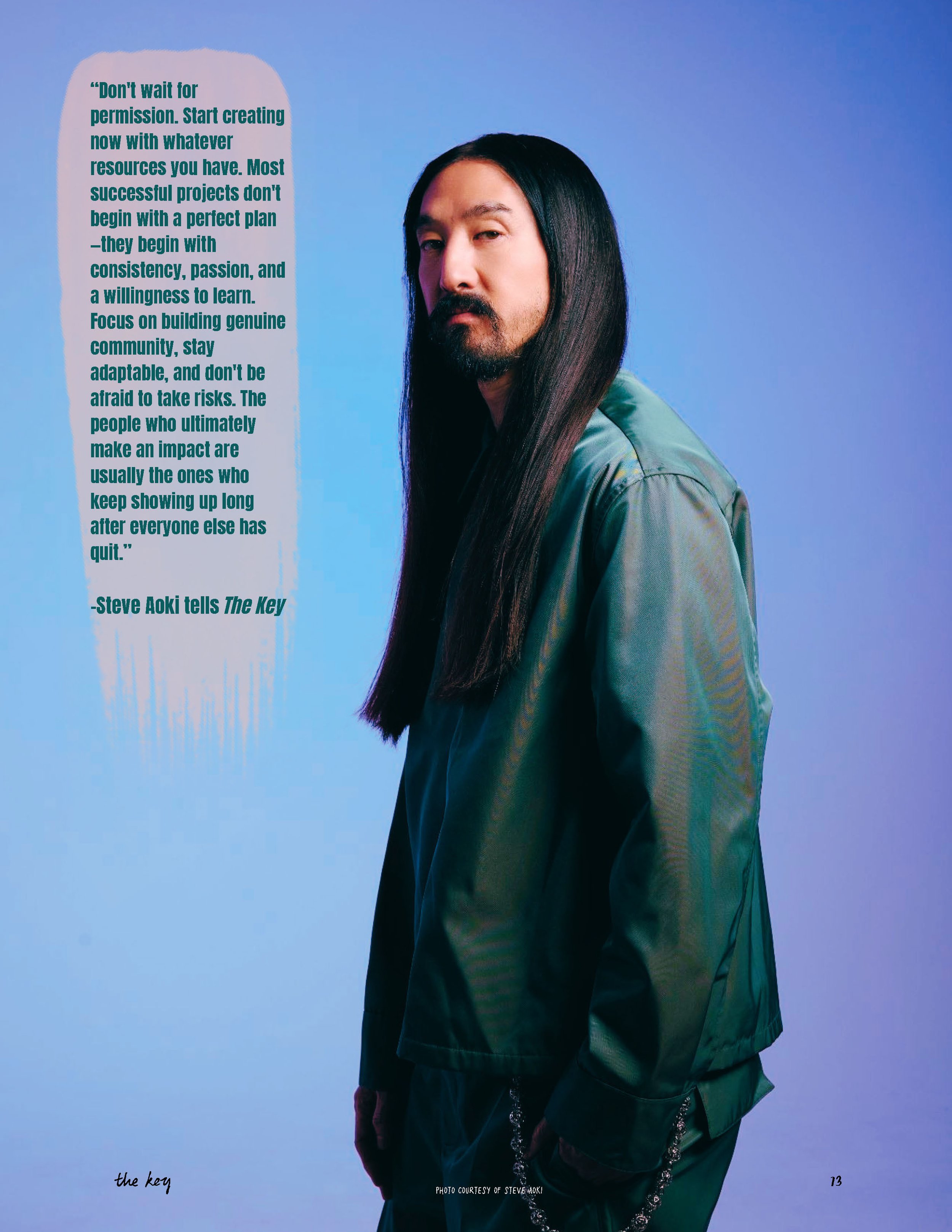
Steve Aoki
On Community, Creating, and Caking
Steve Aoki has built his career on bringing people together. Today, he is one of the most recognizable and influential DJs and producers in the world, the founder of the legendary record label Dim Mak, an entrepreneur (not surprising, as he is the son of Benihana founder Rocky Aoki), and even a Guinness World title holder for the “Most-travelled musician in one year” (clocking 241,850.7 miles while touring globally in a single year for those of you who are counting.) Somehow, he even manages to have perfect hair.
Long before he was headlining sold-out festivals, traveling the world, and perfecting his now-iconic cake throws (for those of you who are unfamiliar with this phenomenon, keep reading), Aoki was growing up in Newport Beach, California searching for where he belonged. Like many of us, Aoki grew up not really fitting into a box. Raised in a predominantly white Southern California community while immersed in Japanese culture at home, he often found himself navigating between different worlds. What some might look at as a challenge, ultimately became one of his greatest strengths. Aoki tells The Key, “Music became a place where I could connect people regardless of background.”
The story of Steve Aoki does not begin on the stages of Coachella, Lollapalooza or Tomorrowland. It begins in a hectic college apartment in Santa Barbara where he hosted parties and bands late into the night. Creative young people came together and Aoki discovered the power of community. It was there, at just eighteen years old, that he found Dim Mak. Nearly three decades later, that same tireless work ethic continues to propel him forward and define all that he does.
What makes Aoki remarkable is not simply the scale of his success, but also the philosophy behind it. Whether he’s in the studios, building businesses, or performing for fans around the world, he approaches everything with passion, enthusiasm, and conviction. He reminds us that the most impactful careers begin not with permission, but persistence. What an incredible journey Aoki has had and he tells The Key about it all: his upbringing, the origins of Dim Mak, what life is like on the road, and, of course, how that infamous cake-throwing tradition first began.
The Key: What was it like growing up in Newport Beach, and who were some of your biggest influences early on?
Steve Aoki: Growing up in Newport Beach was an interesting mix of worlds. At home, I was surrounded by Japanese culture and my family's entrepreneurial mindset, especially through my dad. Outside of that, I was immersed in skateboarding, punk rock, and straight edge culture. Those scenes taught me that you didn’t need permission to create something. Bands like Gorilla Biscuits, Minor Threat, and Youth of Today had a huge impact on me because they showed me what DIY culture could look like.
TK: As the child of Japanese parents growing up in a predominantly white community, how did that experience shape your identity and creative journey?
SA: When you're different, you become very aware of it at a young age. For me, that pushed me toward communities where individuality was celebrated rather than questioned. Music became a place where I could connect with people regardless of background. Looking back, being an outsider helped shape the way I build communities today. Dim Mak was always about bringing together people who felt like they didn't quite fit into one box.
TK: While attending college in Santa Barbara, you were producing DIY records and hosting underground parties out of your apartment. What do you remember most about those early days?
SA: The energy. Everything felt possible. We weren't thinking about careers or business plans—we were just obsessed with music and creating experiences. My apartment became this hub where bands could play, artists could connect, and people could discover something new. Those nights were chaotic, loud, and completely unforgettable. A lot of what Dim Mak became was born in that environment.
TK: You founded Dim Mak in 1996. How old were you at the time, and what inspired you to start your own label?
SA: I was 18 years old. At the time, I was deeply involved in the underground music scene, and I wanted to help amplify artists I believed in. Starting a label felt like the natural extension of everything I was already doing—putting on shows, building communities, and creating opportunities. I wasn't thinking about building a global brand. I just wanted to support great music.
TK: Why was building and owning your own label so important to you creatively?
SA: Ownership creates freedom. I never wanted to wait for someone else to validate an idea before I could pursue it. Having my own label meant I could take risks on artists, sounds, and projects that might not fit into traditional industry expectations. Dim Mak has always been a home for innovation, and maintaining that independence has been incredibly important to me.
TK: You initially made your mark as a tastemaker before transitioning into DJing. When did you first step behind the decks, and what sparked that shift?
SA: I started DJing in 2002. Before that, I was primarily focused on being in bands myself, releasing records, and building Dim Mak. As electronic music started evolving, I became fascinated by the ability to blend genres and create a completely unique experience in real time. DJing gave me another creative outlet and a direct connection with audiences around the world.
TK: For someone attending a Steve Aoki set for the first time, what can they expect from the experience?
SA: Expect complete chaos—in the best possible way. It's high energy from start to finish. You'll hear music that crosses genres and generations, you'll see visuals, surprises, and hopefully moments that you'll remember for years. My goal is always to create a shared experience where everyone in the room feels connected and fully present.
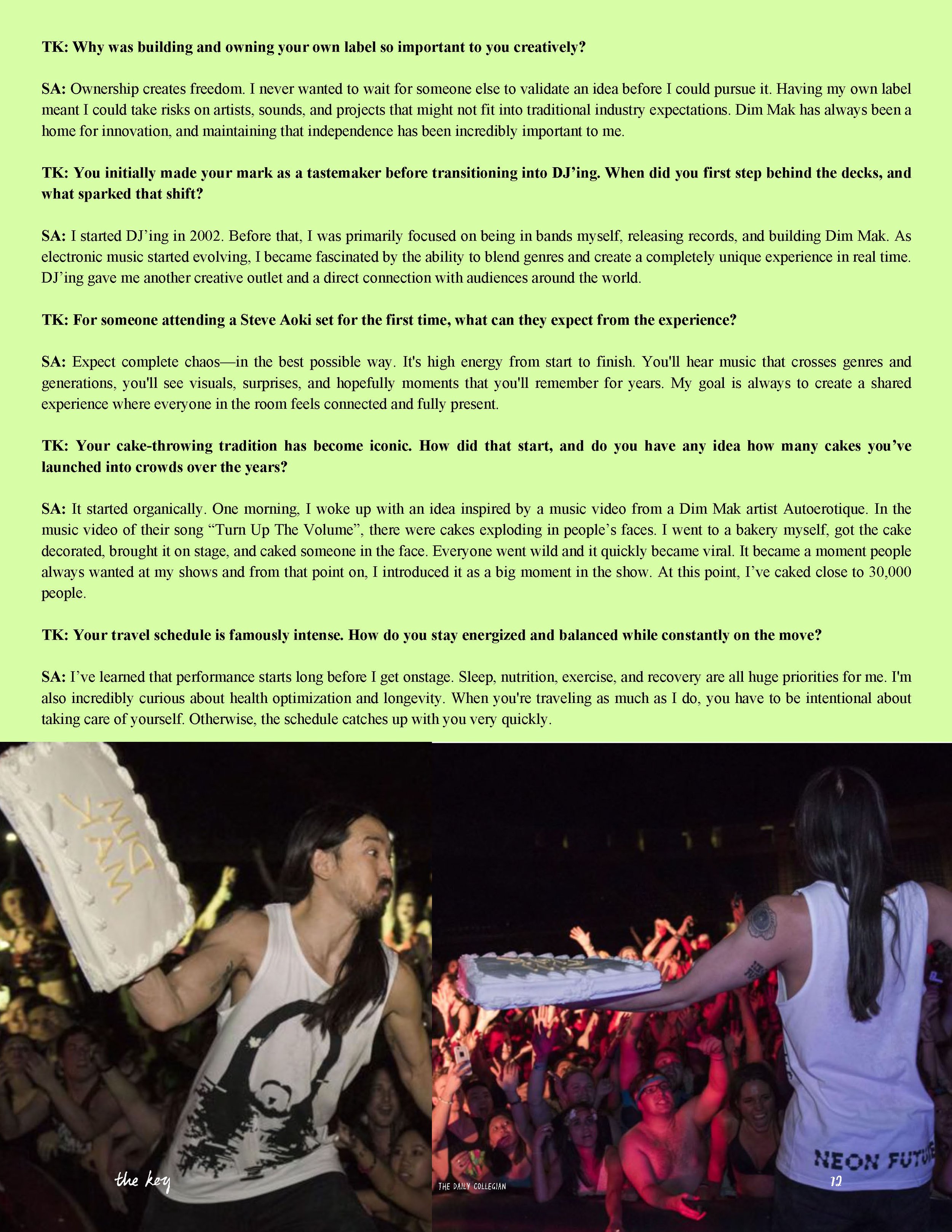
TK: Your cake-throwing tradition has become iconic. How did that start, and do you have any idea how many cakes you’ve launched into crowds over the years?
SA: It started organically. One morning, I woke up with an idea inspired by a music video from a Dim Mak artist Autoerotique. In the music video of their song “Turn Up The Volume”, there were cakes exploding in people’s faces. I went to a bakery myself, got the cake decorated, brought it on stage, and caked someone in the face. Everyone went wild and it quickly became viral. It became a moment people always wanted at my shows and from that point on, I introduced it as a big moment in the show. At this point, I’ve caked close to 30,000 people.
TK: Your travel schedule is famously intense. How do you stay energized and balanced while constantly on the move?
SA: I’ve learned that performance starts long before I get onstage. Sleep, nutrition, exercise, and recovery are all huge priorities for me. I'm also incredibly curious about health optimization and longevity. When you're traveling as much as I do, you have to be intentional about taking care of yourself. Otherwise, the schedule catches up with you very quickly.
TK: At one point, you held a Guinness World Record for being one of the most traveled musicians in a single year. On average, how many shows do you perform annually?
SA: It varies from year to year, but I've consistently performed around 200 shows annually for much of my career. Some years have been even busier. I love being onstage, and I love connecting with fans around the world, so despite the travel demands, it's something I genuinely enjoy.
TK: Looking back, which performances or festival moments stand out as the most memorable of your career so far?
SA: There are so many, but playing major festivals like Tomorrowland, Ultra, Coachella, and Lollapalooza will always be special. At the same time, some of the most meaningful moments happen in places where you don't expect it—seeing fans connect with the music in countries and cities all over the world. Those shared experiences are what stay with me.
TK: You’ve collaborated with artists across so many genres — from BTS to Lil Uzi Vert to Linkin Park. How do those collaborations usually come together?
SA: It always starts with genuine respect. I'm a fan first. Sometimes the collaboration grows from a conversation, sometimes it's through mutual friends, and sometimes it's as simple as hearing a voice or idea that sparks inspiration. The best collaborations happen when everyone involved is excited to create something that none of us could make alone.
TK: Is there a dream artist or collaborator you haven’t worked with yet that you’d still love to create music with?
SA: There are still so many artists I'd love to work with. I’m always inspired by people who push boundaries and redefine what's possible. Whether it's someone from electronic music, hip-hop, rock, pop, or even outside of music entirely, I'm always looking for collaborators who bring a unique perspective to the table.
TK: Your stage style is instantly recognizable. How would you describe your fashion aesthetic when performing?
SA: I think of it as functional futurism. I want pieces that feel expressive and forward-thinking but also allow me to move freely onstage. My performances are physical, so comfort matters just as much as style. Ultimately, I want what I wear to reflect the same energy and creativity that's happening in the music.
TK: Your energy onstage is nonstop. What’s your secret to bringing that same intensity night after night?
SA: The fans. Every crowd brings a different energy, and I feed off that connection. I also genuinely love what I do. When you've spent decades building something you're passionate about, stepping onstage never feels like a routine. It still feels exciting. That excitement fuels everything.
TK: What songs or artists are currently dominating your playlist?
SA: My playlist is all over the place. I'm constantly listening to new demos, discovering emerging artists, and exploring sounds from around the world. One day it might be underground electronic music, the next day it could be hip-hop, K-pop, rock, or Latin music. Staying curious is a huge part of my creative process.
TK: Beyond music, you’re involved in fashion, philanthropy, and supporting research into degenerative brain disease. How do you balance so many different passions and projects?
SA: For me, they're all connected by curiosity and purpose. Music may be the foundation, but I've always been interested in innovation, creativity, and making a positive impact. The key is surrounding yourself with great people and building strong teams. That allows me to focus my energy where I can contribute the most while continuing to explore new ideas.
TK: What advice would you give to young creatives or entrepreneurs who are just starting out and trying to build something meaningful?
SA: Don't wait for permission. Start creating now with whatever resources you have. Most successful projects don't begin with a perfect plan—they begin with consistency, passion, and a willingness to learn. Focus on building genuine community, stay adaptable, and don't be afraid to take risks. The people who ultimately make an impact are usually the ones who keep showing up long after everyone else has quit.