
The Seasoned Collector
Michael Kardamakis
The Seasoned Collector
Michael Kardamakis
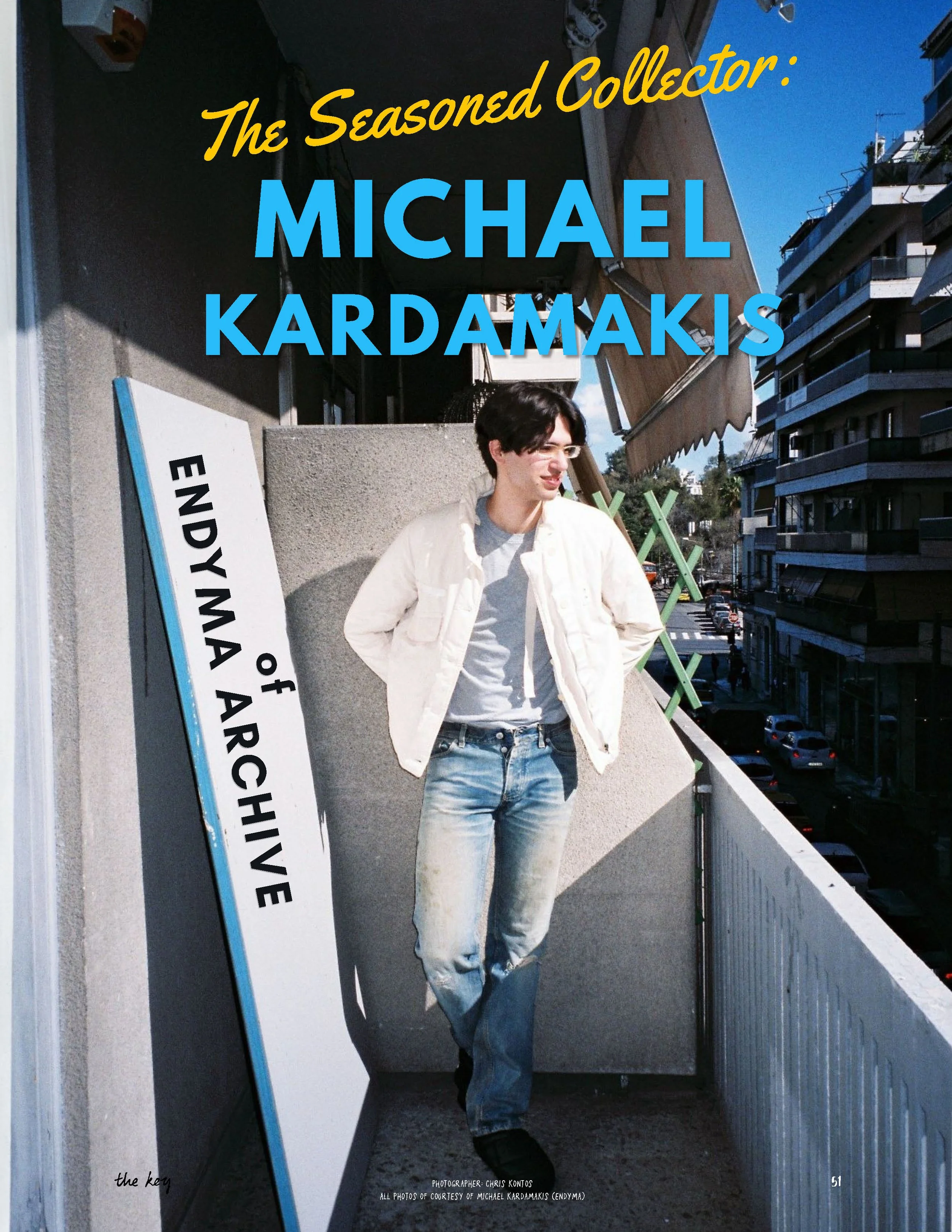
When 33-year-old Michael Kardamakis appears on our computer screen, he is on the move, explaining that he decided to enjoy the Spring weather in Berlin by taking a brisk walk. Because of the time difference, The Key is in a quiet classroom during our school lunch hour. We have been anxiously anticipating our meeting. When we told our fashion friends, new and old, that we would be featuring Berlin-based ENDYMA (Greek for garment), their eyes grew wide as If to say, “Well done!” Time with Kardamakis, ENDYMA’s founder, is a rare treat. For nearly an hour (we were late to class, but it was well worth it), Kardamakis indulged our questions about his fashion journey, how he became the world’s largest collector of vintage Helmut Lang, and how his archive operates. As he tells us, it all began with what he calls a “side hustle.”
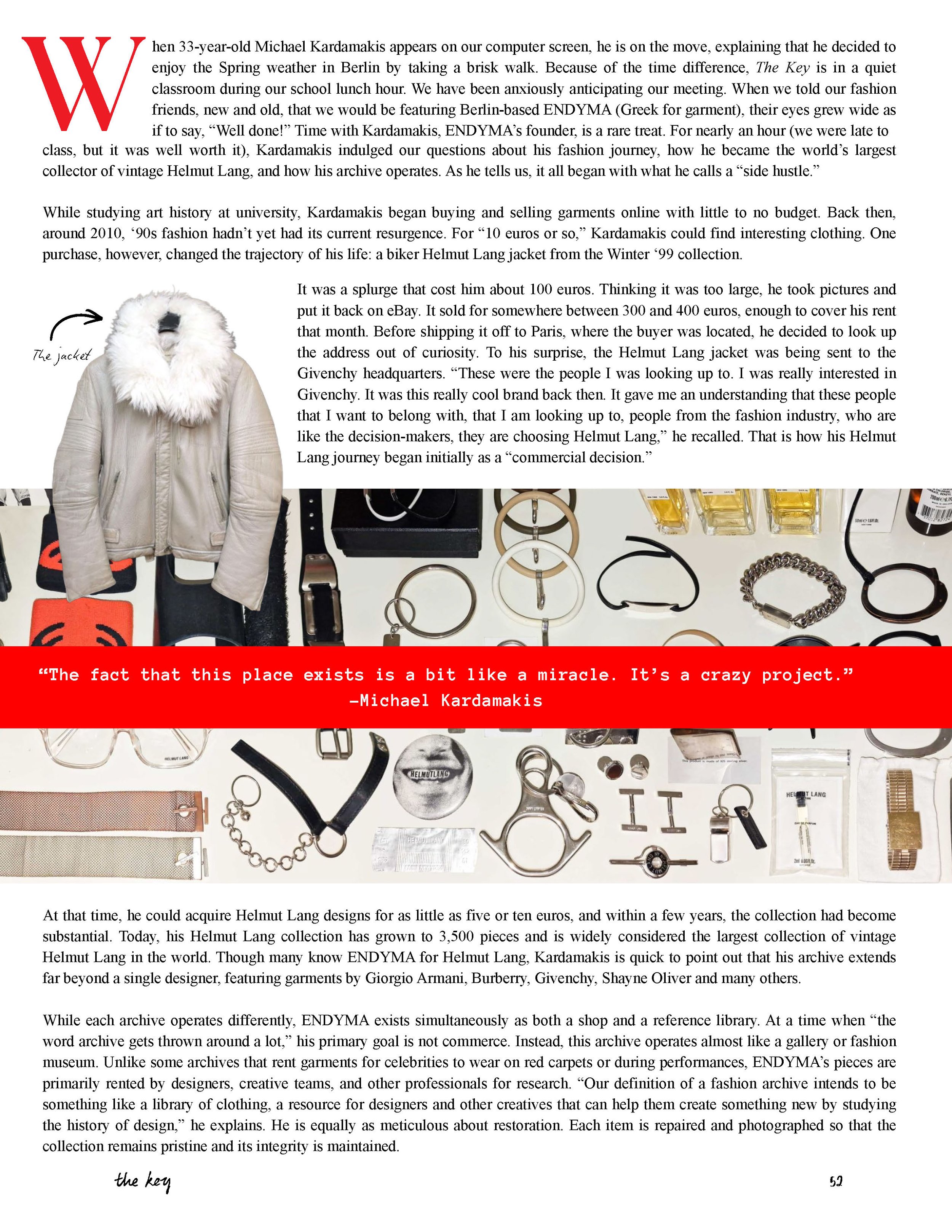
While studying art history at university, Kardamakis began buying and selling garments online with little to no budget. Back then, around 2010, ‘90s fashion hadn’t yet had its current resurgence. For “10 euros or so,” Kardamakis could find interesting clothing. One purchase, however, changed the trajectory of his life: a biker Helmut Lang jacket from the Winter ‘99 collection.
It was a splurge that cost him about 100 euros. Thinking it was too large, he took pictures and put it back on eBay. It sold for somewhere between 300 and 400 euros, enough to cover his rent that month. Before shipping it off to Paris, where the buyer was located, he decided to look up the address out of curiosity. To his surprise, the Helmut Lang jacket was being sent to the Givenchy headquarters. “These were the people I was looking up to. I was really interested in Givenchy. It was this really cool brand back then. It gave me an understanding that these people that I want to belong with, that I am looking up to, people from the fashion industry, who are like the decision-makers, they are choosing Helmut Lang,” he recalled. That is how his Helmut Lang journey began initially as a “commercial decision.”
At that time, he could acquire Helmut Lang designs for as little as five or ten euros, and within a few years, the collection had become substantial. Today, his Helmut Lang collection has grown to 3,500 pieces and is widely considered the largest collection of vintage Helmut Lang in the world. Though many know ENDYMA for Helmut Lang, Kardamakis is quick to point out that his archive extends far beyond a single designer, featuring garments by Giorgio Armani, Burberry, Givenchy, Shayne Oliver and many others.
While each archive operates differently, ENDYMA exists simultaneously as both a shop and a reference library. At a time when “the word archive gets thrown around a lot,” his primary goal is not commerce. Instead, this archive operates almost like a gallery or fashion museum. Unlike some archives that rent garments for celebrities to wear on red carpets or during performances, ENDYMA’s pieces are primarily rented by designers, creative teams, and other professionals for research. “Our definition of a fashion archive intends to be something like a library of clothing, a resource for designers and other creatives that can help them create something new by studying the history of design,” he explains. He is equally as meticulous about restoration. Each item is repaired and photographed so that the collection remains pristine and its integrity is maintained.
Always ahead of trends, Kardamakis became interested in ‘80s Giorgio Armani’s roughly three years ago. Much like his early fascination with Helmut Lang, he was able to acquire significant early Armani pieces for very little money before the market caught on. Today, many of those same Armani pieces are in museums and selling for thousands.
Although ENDYMA primarily rents clothing for designer research, it also sells select garments. Kardamakis is careful about what leaves the archive, or, perhaps more importantly, what does not. He will only sell an item if he has multiples, sharing, “one to rock, one to stock.” Just before our interview, a Berlin rapper visited and bought three pairs of black pants. Kardamakis was willing to part with those since they were neither one-offs nor essential to preserving the archive’s core identity.
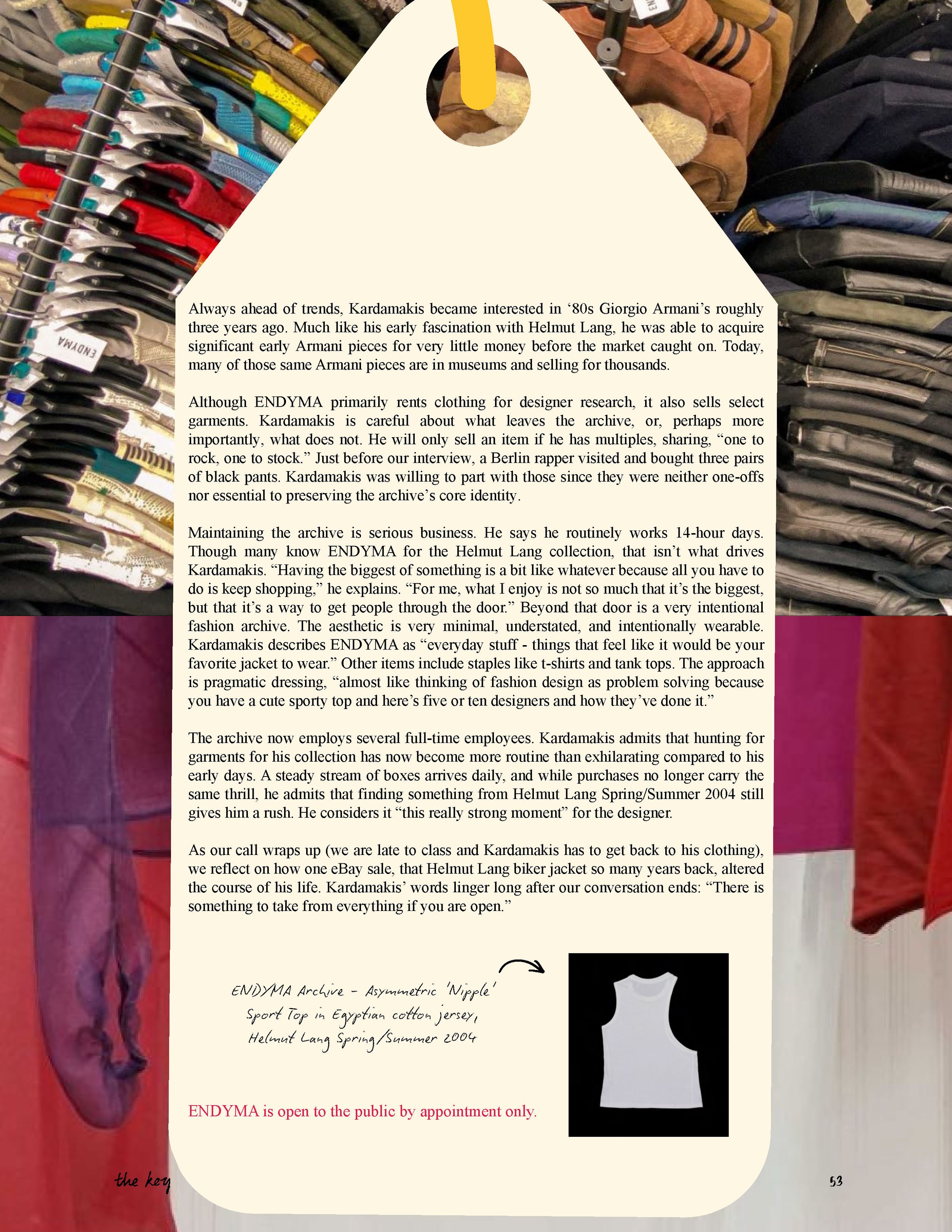
Maintaining the archive is serious business. He says he routinely works 14-hour days. Though many know ENDYMA for the Helmut Lang collection, that isn’t what drives Kardamakis. “Having the biggest of something is a bit like whatever because all you have to do is keep shopping,” he explains. “For me, what I enjoy is not so much that it’s the biggest, but that it’s a way to get people through the door.” Beyond that door is a very intentional fashion archive. The aesthetic is very minimal, understated, and intentionally wearable. Kardamakis describes ENDYMA as “everyday stuff - things that feel like it would be your favorite jacket to wear.” Other items include staples like t-shirts and tank tops. The approach is pragmatic dressing, “almost like thinking of fashion design as problem solving because you have a cute sporty top and here’s five or ten designers and how they’ve done it.”
The archive now employs several full-time employees. Kardamakis admits that hunting for garments for his collection has now become more routine than exhilarating compared to his early days. A steady stream of boxes arrives daily, and while purchases no longer carry the same thrill, he admits that finding something from Helmut Lang Spring/Summer 2004 still gives him a rush. He considers it “this really strong moment” for the designer.
As our call wraps up (we are late to class and Kardamakis has to get back to his clothing), we reflect on how one eBay sale, that Helmut Lang biker jacket so many years back, altered the course of his life. Kardamakis’ words linger long after our conversation ends: “There is something to take from everything if you are open.”
ENDYMA is open to the public by appointment only.