
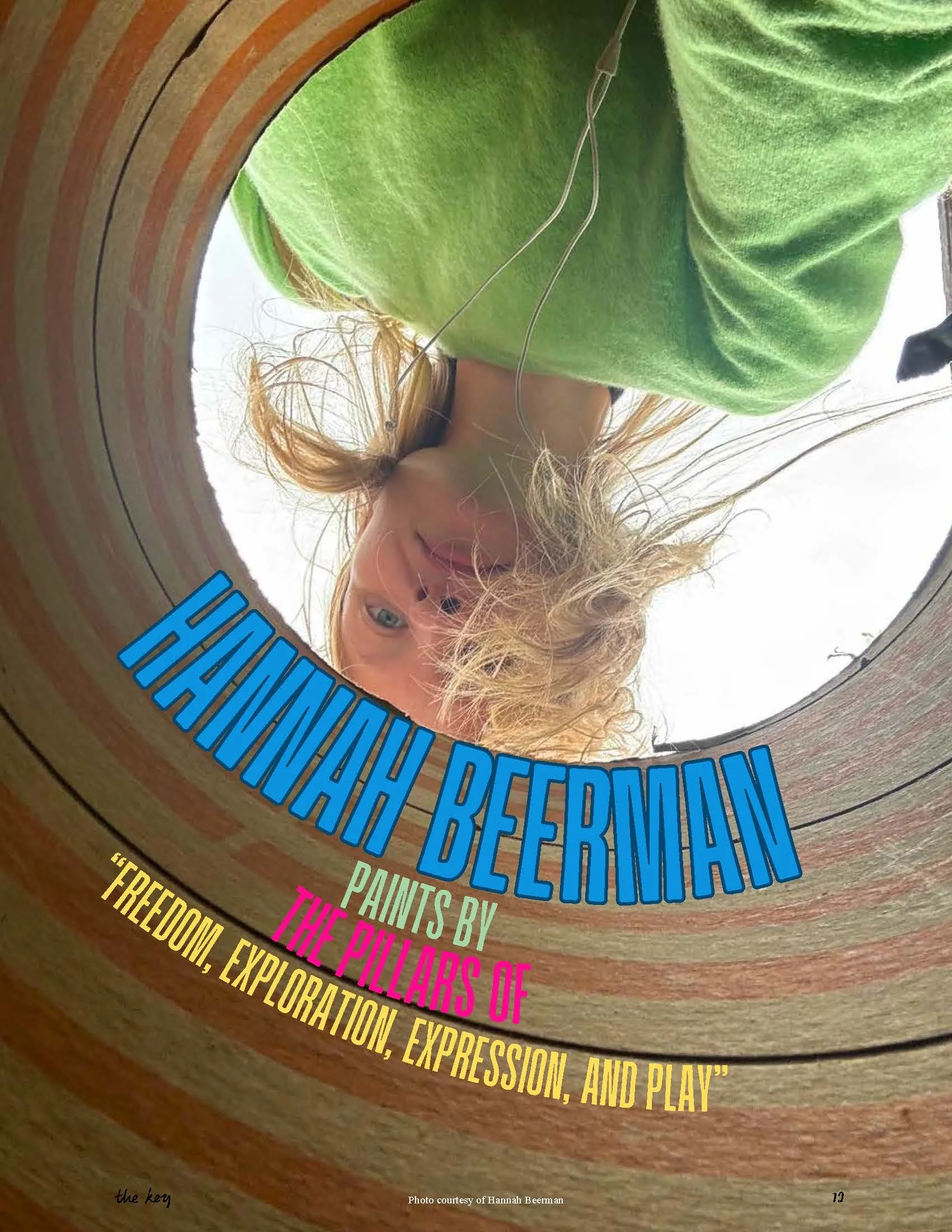
Hannah Beerman
Paints By The Pillars of “Freedom, Expression, Exploration, and Play”
Hannah Beerman
Paints By The Pillars of “Freedom, Expression, Exploration, and Play”
For as long as the 34-year-old artist can remember, Hannah Beerman has eaten, slept, and breathed art. Between growing up in artist Joseph Cornell’s childhood home and having two artist parents, Beerman was always encouraged to paint, use her imagination, and to freely embrace her inner creative spirit. The Key had the honor of chatting with Beerman as she walked her dog at 10 p.m. on a Wednesday night. Between learning about her experimental artistic process and hearing about the pendulum-scale book she happened to be reading that day, she gave us a glimpse into her brilliance. After chatting with her, we have a better idea of where the beautiful irreverence and youthfulness evident in her work comes from. We came to realize that not only is our world in desperate need of more Beermans, but that there is also nobody quite like her … we mean this in the absolute best way possible. To quote Eileen Myles’s essay, The General Calendar (with accents) of Hannah Beerman, Beerman “owns the world.”
The Key: Can you tell us a little bit about your childhood. Have you always enjoyed creating?
Hannah Beerman: I am from Noyack, New York and I come from a family of artists. My parents met at Skowhegan, an artist residency in Maine, in the ’80s. My mom was an artist for many years and is now a psychiatrist, and my brother is a musician. My dad and my grandma shared a studio in the house that I grew up in. Art making was always going on around me. Since I was a baby, to keep me occupied while they were in the studio, they would set me up to paint myself, as soon as I could hold a brush. They would set me up next to them making stuff.
TK: Can you please add a bit about growing up in Joseph Cornell’s childhood home and also what it was like to grow up in a family of artists?
HB: Growing up with a family of artists was definitely specific and particular. Our family had its own ways of existing in the world, that I cherish, and at the same time didn’t always feel compatible with how the rest of the world operates. Freedom, exploration, expression, and play were total foundations of them raising me, and I can never thank them enough for giving me tools to create a life I love.
TK: What formal training have you had and how has that shaped you?
HB: I went to Bard College and I went to the New York Studio School and I got my MFA at Hunter College. Being able to commit and devote my life to my work, institutions helped provide some structure for that. I met some great people, who are like my family―that’s the best part of going through school―the people you meet along the way―who are like your comrades and you get to be family forever.
TK: Could you walk me through your creative process―how do you know when a piece is finished?
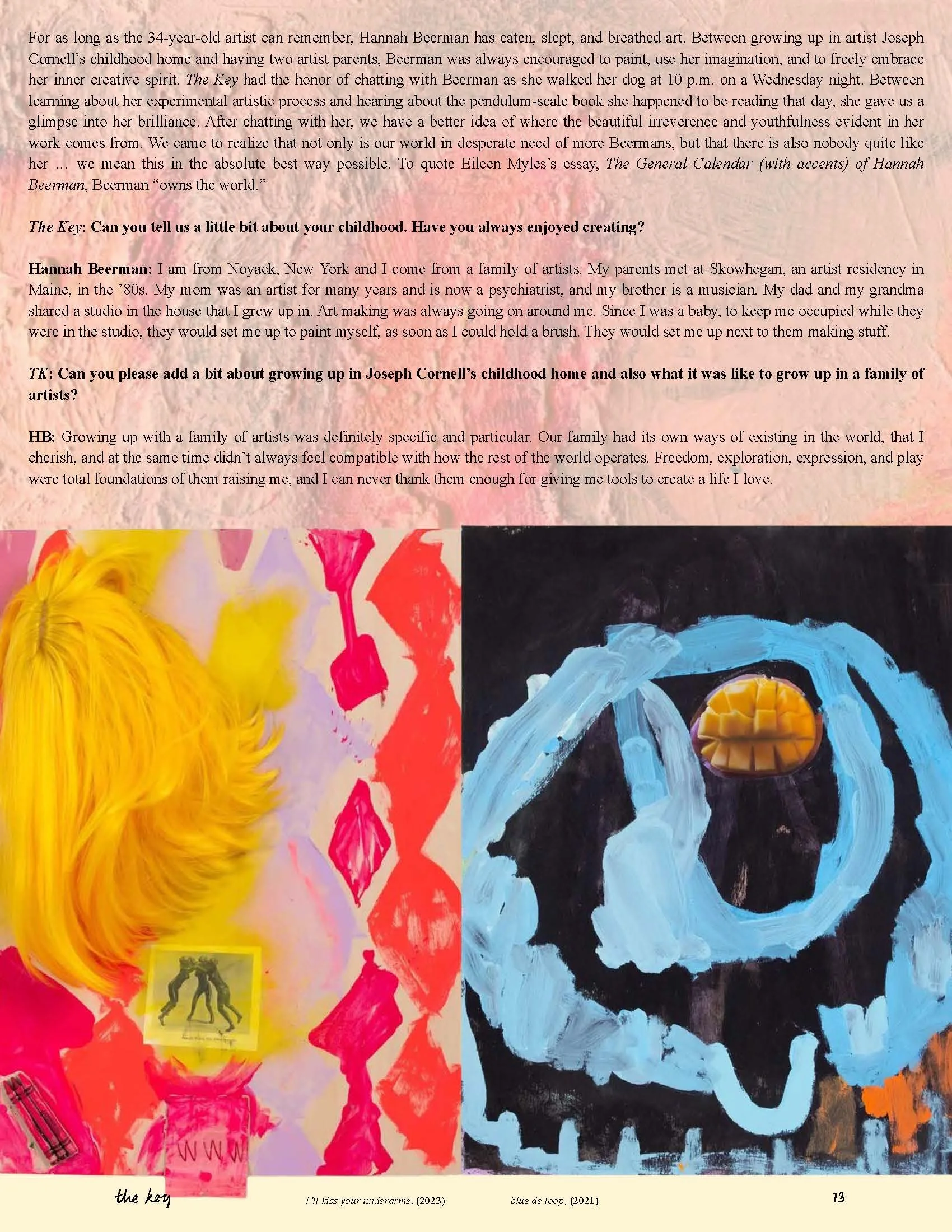
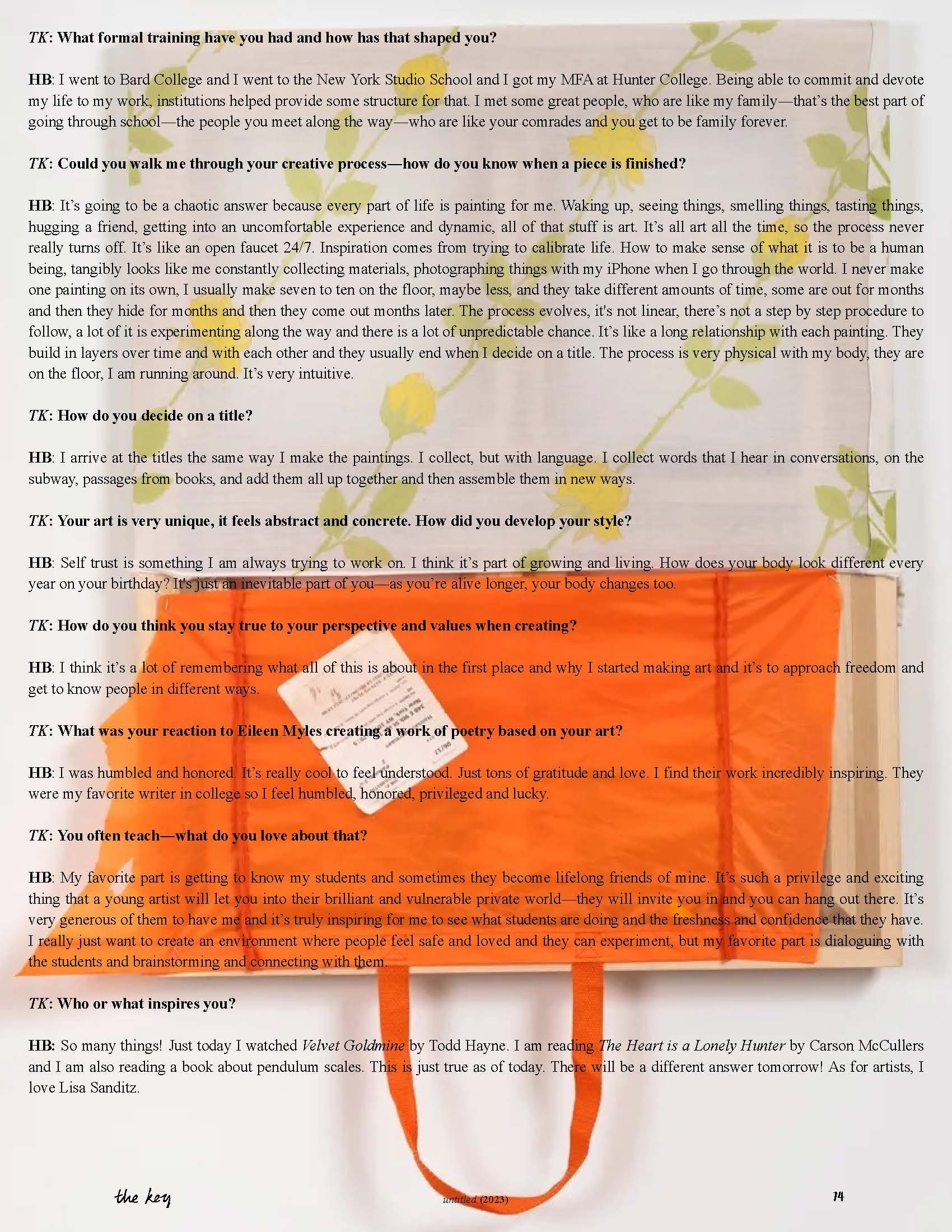
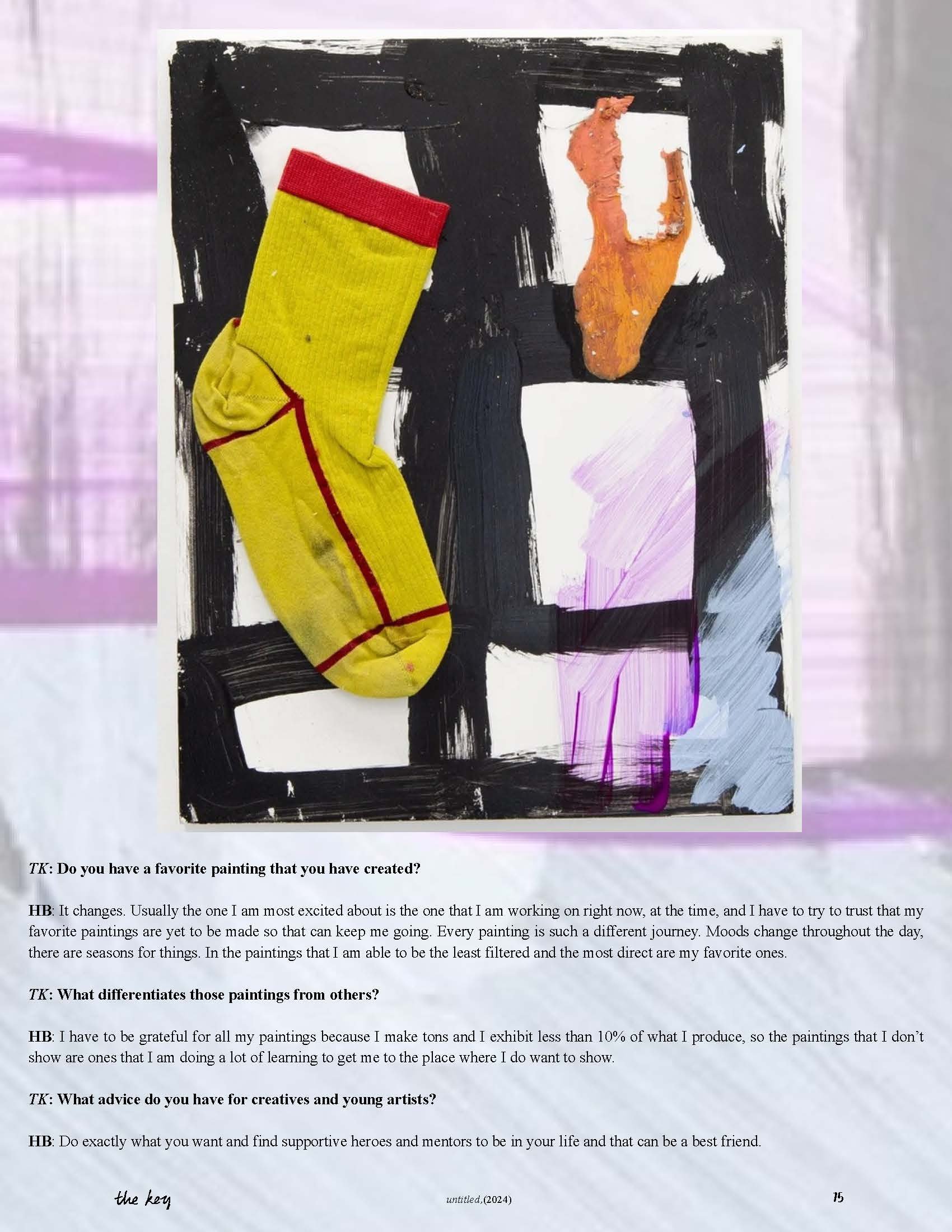
HB: It’s going to be a chaotic answer because every part of life is painting for me. Waking up, seeing things, smelling things, tasting things, hugging a friend, getting into an uncomfortable experience and dynamic, all of that stuff is art. It’s all art all the time, so the process never really turns off. It’s like an open faucet 24/7. Inspiration comes from trying to calibrate life. How to make sense of what it is to be a human being, tangibly looks like me constantly collecting materials, photographing things with my iPhone when I go through the world. I never make one painting on its own, I usually make seven to ten on the floor, maybe less, and they take different amounts of time, some are out for months and then they hide for months and then they come out months later. The process evolves, it's not linear, there’s not a step by step procedure to follow, a lot of it is experimenting along the way and there is a lot of unpredictable chance. It’s like a long relationship with each painting. They build in layers over time and with each other and they usually end when I decide on a title. The process is very physical with my body, they are on the floor, I am running around. It’s very intuitive.
TK: How do you decide on a title?
HB: I arrive at the titles the same way I make the paintings. I collect, but with language. I collect words that I hear in conversations, on the subway, passages from books, and add them all up together and then assemble them in new ways.
TK: Your art is very unique, it feels abstract and concrete. How did you develop your style?
HB: Self trust is something I am always trying to work on. I think it’s part of growing and living. How does your body look different every year on your birthday? It's just an inevitable part of you―as you’re alive longer, your body changes too.
TK: How do you think you stay true to your perspective and values when creating?
HB: I think it’s a lot of remembering what all of this is about in the first place and why I started making art and it’s to approach freedom and get to know people in different ways.
TK: What was your reaction to Eileen Myles creating a work of poetry based on your art?
HB: I was humbled and honored. It’s really cool to feel understood. Just tons of gratitude and love. I find their work incredibly inspiring. They were my favorite writer in college so I feel humbled, honored, privileged and lucky.
TK: You often teach―what do you love about that?
HB: My favorite part is getting to know my students and sometimes they become lifelong friends of mine. It’s such a privilege and exciting thing that a young artist will let you into their brilliant and vulnerable private world―they will invite you in and you can hang out there. It’s very generous of them to have me and it’s truly inspiring for me to see what students are doing and the freshness and confidence that they have. I really just want to create an environment where people feel safe and loved and they can experiment, but my favorite part is dialoguing with the students and brainstorming and connecting with them.
TK: Who or what inspires you?
HB: So many things! Just today I watched Velvet Goldmine by Todd Hayne. I am reading The Heart is a Lonely Hunter by Carson McCullers and I am also reading a book about pendulum scales. This is just true as of today. There will be a different answer tomorrow! As for artists, I love Lisa Sanditz.
TK: Do you have a favorite painting that you have created?
HB: It changes. Usually the one I am most excited about is the one that I am working on right now, at the time, and I have to try to trust that my favorite paintings are yet to be made so that can keep me going. Every painting is such a different journey. Moods change throughout the day, there are seasons for things. In the paintings that I am able to be the least filtered and the most direct are my favorite ones.
TK: What differentiates those paintings from others?
HB: I have to be grateful for all my paintings because I make tons and I exhibit less than 10% of what I produce, so the paintings that I don’t show are ones that I am doing a lot of learning to get me to the place where I do want to show.
TK: What advice do you have for creatives and young artists?
HB: Do exactly what you want and find supportive heroes and mentors to be in your life and that can be a best friend.