
June Ambrose
The Authentic Style Architect

June Ambrose
The Authentic Style Architect
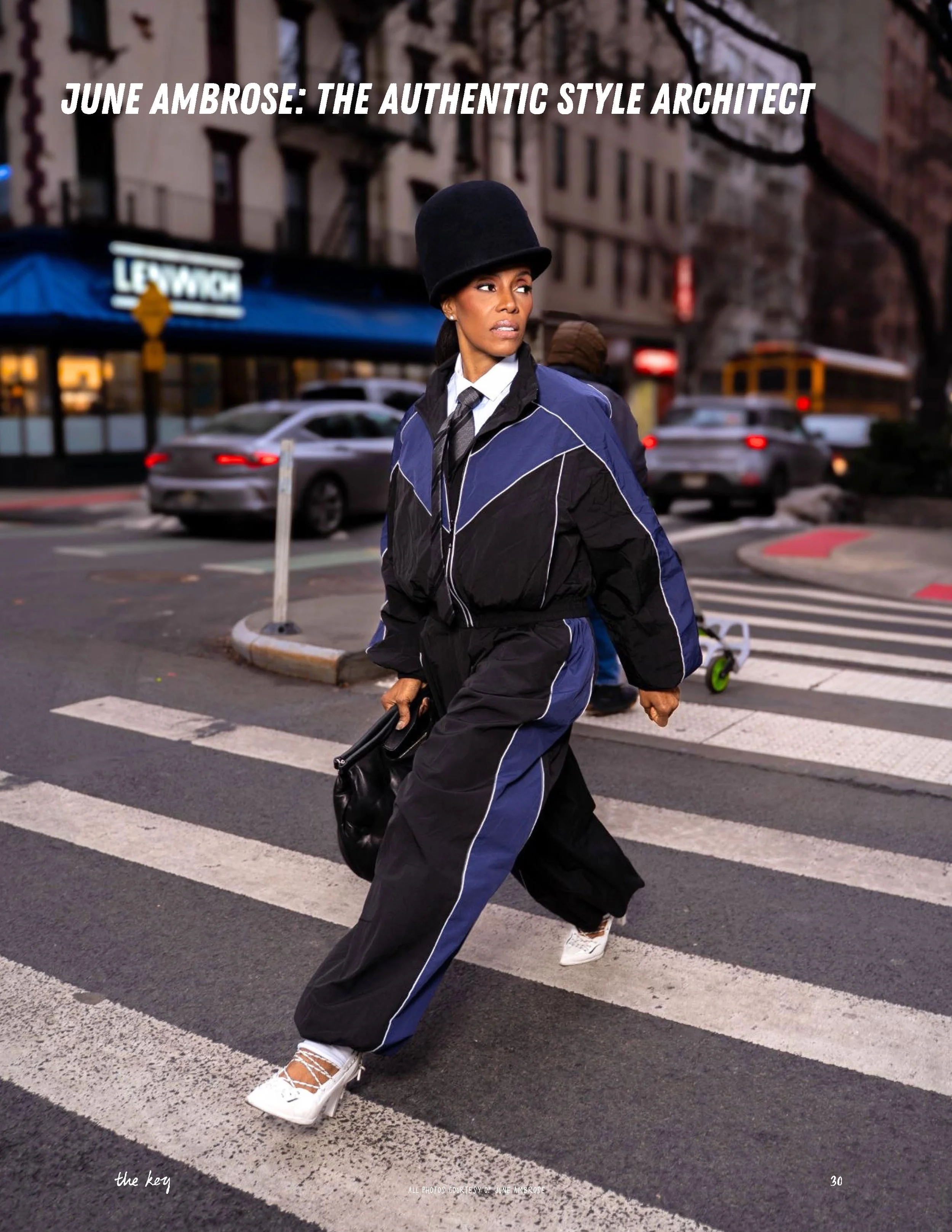
We first met June Ambrose at Coachella 2025. In a sea of people seeming to say, “Look at Me!” our eyes were glued to Ambrose, who carries herself with authenticity, integrity, and kindness. Nothing about her Coachella look felt forced. At the time, we had no idea that she was a fashion powerhouse. We simply knew we wanted to know more about this magnetic human. Maybe it was her distinctive hat, her perfect Adidas shorts paired with a bra top, or her warm smile that initially caught our eye. Somehow we struck up a conversation, and as luck would have it, discovered we had a mutual friend: our longtime fashion teacher and mentor Rob Younkers. We soon realized that Ambrose was also a New Yorker (neighbors!) and we vowed to keep in touch.
We learned that Ambrose was at Coachella as Missy Elliott’s longtime creative director and the visionary behind Elliot’s looks for her Coachella set. We would later discover that our down-to-earth new friend is one of the most influential style icons working today, with a decades-long history of shaping the images of artists such as Jay-Z and Mariah Carey. (We were elated to recently see Jay-Z ascend the 2026 Met Gala steps impeccably styled by Ambrose in custom Louis Vuitton). Though today fashion houses eagerly lend or design specifically for celebrities, that was not always the case. Ambrose often created the designs her clients wore herself. She is also widely credited with bringing high fashion to hip-hop.
Ambrose has worn so many hats, and not just the signature ones that have become a regular part of her wardrobe. In addition to her work as a creative director, designer, TV host, and stylist, Ambrose has also served as the creative director at PUMA, recently designing a capsule shoe collection for Naturalizer in a partnership called Style-Letics, and even hosts a lively fashion and pop-culture recap series called The Morning After, covering major red-carpet events such as The Met Gala and The Grammys.
In addition to being one of the busiest people we know, Ambrose is also one of the kindest creatives we’ve met. She always shows up for her friends and is fueled by an ever-present curiosity. Her story will resonate not only with creatives but anyone pursuing a dream. She has remained a trailblazer in the fickle fashion industry for three decades. As she says, “Trends fade, Authenticity endures.”
The Key: You were born in Antigua but raised in the Bronx - and you have such an NYC vibe. How did your upbringing shape you as a creative?
June Ambrose: Being born in Antigua gave me soul, rhythm, color, and a deep understanding of joy. The Bronx gave me edge, ambition, resilience, and style. I grew up between cultures, between textures, between sound systems and subway platforms. New York taught me how to remix worlds together. I was watching women turn sidewalks into runways with very little, and I learned early that style wasn’t about money — it was about imagination and identity. Hip hop was being born around me, so creativity felt urgent, alive, and unapologetic. That combination shaped everything I am. I move with Caribbean warmth and New York velocity.
TK: When you were our age, in high school, what did you think you would be?
JA: Honestly? I thought I’d be some kind of powerhouse businesswoman. I always knew I wanted impact. I loved fashion, but at the time I didn’t even fully understand that styling or creative direction could be careers. Those jobs didn’t really exist in the way they do now. I just knew I was obsessed with transformation — how clothes, music, and visuals could completely shift energy. Even as a teenager, I was curating moments before I had language for it.
TK: After high school, you briefly worked in investment banking. What made you make the switch from investment banking to the fashion industry, and how did you make that switch?
JA: Investment banking taught me discipline, structure, and the language of business — and I still use those tools every single day. But creatively, I was starving. I’d leave work and immediately go downtown, uptown, anywhere culture was happening. Fashion and music were calling me louder than spreadsheets ever could.
The switch happened because I stopped ignoring what made me feel alive. I started assisting, networking, volunteering, pulling clothes, being present in rooms where creativity lived. There wasn’t some glamorous overnight leap. It was hustle. I always tell young people: sometimes your first job isn’t your destiny — it’s just funding the dream and teaching you skills you’ll later weaponize.
TK: You are known as a style architect for the likes of Jay-Z, Missy Elliott, Mary J. Blige, Mariah Carey, Alicia Keys, Busta Rhymes, and so many others - what does the term “style architect” mean to you and can you tell us a little bit about working with such icons from their early days until now? You are credited with bringing high fashion to the hip-hop world. Can you tell us about your early days and what is it like to really be a pioneer?
JA: A stylist dresses people. A style architect builds worlds. I was never interested in just clothes — I was interested in storytelling, identity, silhouette, legacy, and cultural positioning. Every artist had a different frequency. With Mariah, especially during The Emancipation of Mimi era, it was about reinvention, confidence, sensuality, and reclaiming her narrative in a way that felt glamorous yet deeply powerful. With Missy, it was futurism and disruption. With Jay, it was evolution — from Marcy to mogul.
In those early days, hip hop wasn’t embraced by luxury fashion the way it is now. We were creating culture while simultaneously being excluded from certain rooms. So I decided we wouldn’t wait for permission. I brought high fashion into hip hop because I believed our artistry deserved that level of visual sophistication. We mixed luxury with streetwear before the world had language for it. We made oversized silhouettes editorial. We made the hood aspirational without losing authenticity.
Being a pioneer means seeing the future before everyone else catches up — and having the courage to stand in that vision when people don’t yet understand it.
TK: Your kindness is so striking. When we met you at Coachella 2025, what we recall wasn’t only your amazing outfit, but also an innate kindness and curiosity. What role do you think being an open and warm human has played in your trajectory?
JA: That means a lot to me because kindness is intentional. I think people underestimate how far humanity can take you. Talent may get you in the room, but energy determines whether people want to build with you long term. I’ve worked across decades, industries, and generations, and relationships matter deeply.
Curiosity has also been my superpower. I genuinely love people. I love learning how someone thinks, what inspires them, what scares them, what they dream about. Creativity grows when you stay open. The moment you think you know everything, you stop evolving.
TK: When you are putting together an outfit, where do you get inspiration from? If you could pick anyone from any time period, dead or alive, who would be your dream guest to host on The Morning After, and what do you enjoy about hosting The Morning After?
JA: Inspiration comes from everywhere — the rhythm of opera, the precision of tailoring, old photographs, Black dandies, sports iconography, Japanese anime, cinema, travel, fabrics, movement, and human energy. Sometimes it’s as simple as seeing a woman walking through Harlem with incredible posture and suddenly reimagining proportion or silhouette. Inspiration can come from elegance, but it can also come from tension, chaos, or contradiction. I’m always observing. Creativity lives in curiosity.
If I could host anyone on The Morning After, my dream guests would absolutely be Diana Ross and Diana Vreeland. Diana Ross represents glamour, reinvention, softness, power — she is pure star energy. And Diana Vreeland — she completely transformed the way we think about fashion, fantasy, and storytelling. I know those conversations would be rich with wisdom, style, humor, and truth.
What I love most about hosting The Morning After is the chemistry with my cohost and the relaxed atmosphere we create for our guests. We make people feel comfortable enough to exhale. That’s when the magic happens. The conversations become honest, layered, and unexpectedly intimate. People start lifting the veil on what really happens behind the scenes — the triumphs, the chaos, the untold stories, the real humanity behind success. That’s the sweet spot for me.
TK: What are some career highlights, and what have been some of your most memorable projects to work on?
JA: There have been so many beautiful moments throughout my career, but the projects that stay with me most are the ones that shifted culture and expanded the visual language of music, fashion, and identity. Some of the most memorable work challenged traditional ideas of femininity, futurism, and performance in ways that felt fearless and ahead of their time. Other collaborations were powerful because we were documenting evolution in real time — watching an artist grow from ambition into legacy, while using style as part of that storytelling.
TK: You have also been a creative director at Puma. What is it like to infuse your creativity with a major brand?
JA: Working with a global brand like Puma is exciting because you’re balancing innovation with heritage. I love translating culture into product and experience. A major brand has scale, which means your ideas can touch people all over the world. For me, it’s never just about designing something cool. It’s about emotional connection. How does this product make someone feel? How does it empower movement, confidence, individuality? That’s the real work of creative direction.
TK: Hats are, of course, one of your signature accessories. Have you always worn hats? Approximately how many hats do you own? Do you have a favorite?
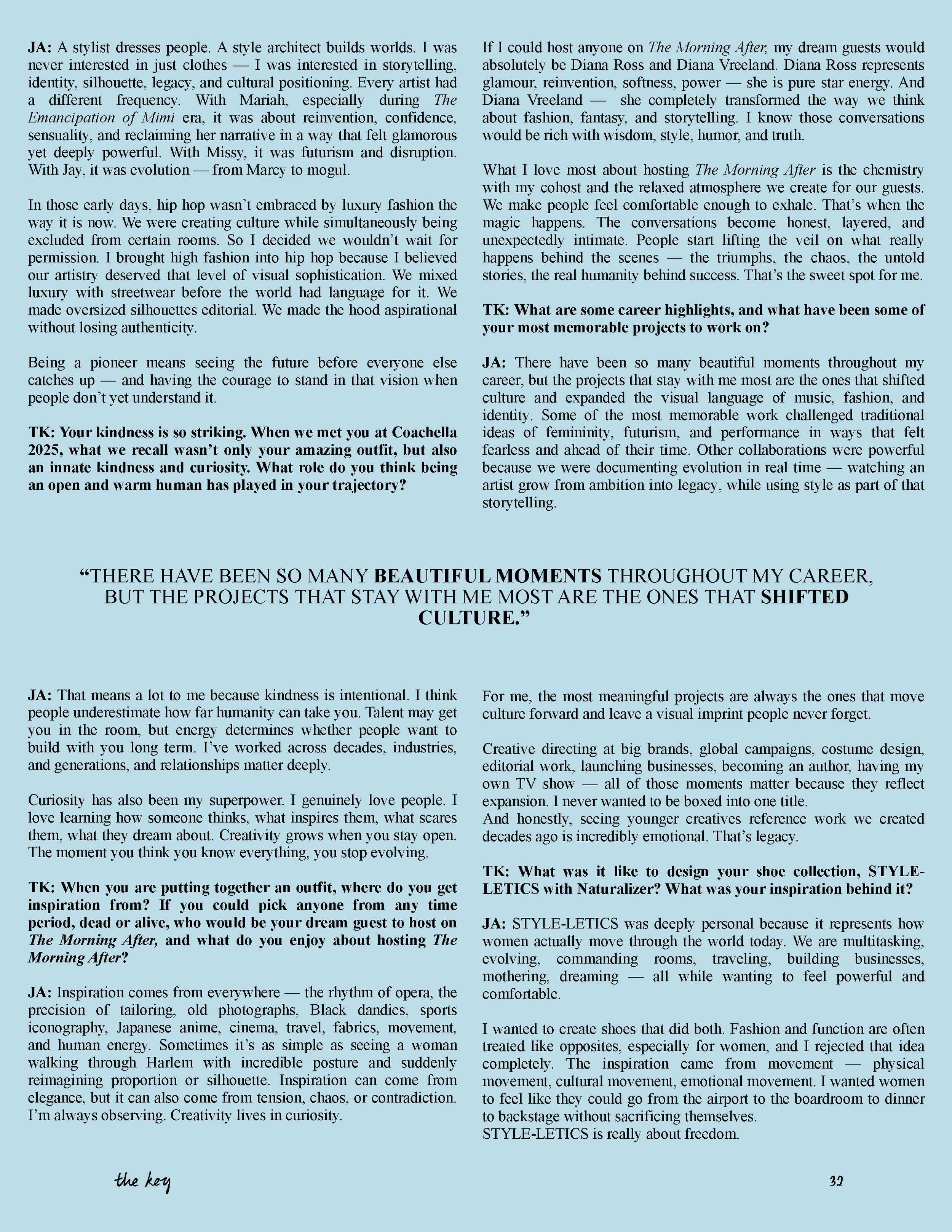
JA: Yes! Hats have always been part of my language. They’re cinematic. They frame emotion. A hat can completely shift posture and energy. Sometimes a hat is armor. Sometimes it’s glamour. And honestly? I’ve stopped counting. I probably own hundreds. Maybe more! Some are vintage treasures, some are custom pieces, some are emotional souvenirs from different eras of my life. Picking a favorite would be impossible — that’s like asking someone to choose a favorite memory.
TK: Speaking of hats, you’ve worn many from designer, to stylist, to creative director, to entrepreneur and we could keep going - it seems you can do anything and have done everything. What is the key to doing it all?
JA: The key is understanding that you cannot do everything alone. Community, collaboration, delegation, and discipline matter. I also believe in evolution. A lot of people stay trapped in old versions of themselves because they’re afraid of change. I’ve never been afraid to pivot. I also protect my imagination fiercely. Rest matters. Inspiration matters. Spiritual alignment matters. Success without joy is a very empty accomplishment.
TK: There are so many aspects of your professional life that are truly extraordinary. You are a true trailblazer. Have you always been bold, and what advice can you offer to someone trying to gain footing in a creative field?
JA: I think courage is something you build. People see confidence now, but confidence comes from surviving uncertainty over and over again. I’ve had moments of fear, doubt, rejection — all creatives do. The difference is that I didn’t let fear make my decisions for me. My advice is: develop your point of view. Don’t spend your life trying to replicate someone else’s aesthetic or path. Study deeply. Be curious. Protect your originality. Learn business. Learn communication. Learn how to collaborate. And most importantly, understand that longevity matters more than virality. Trends fade. Authenticity endures.
TK: Whose personal style do you admire?
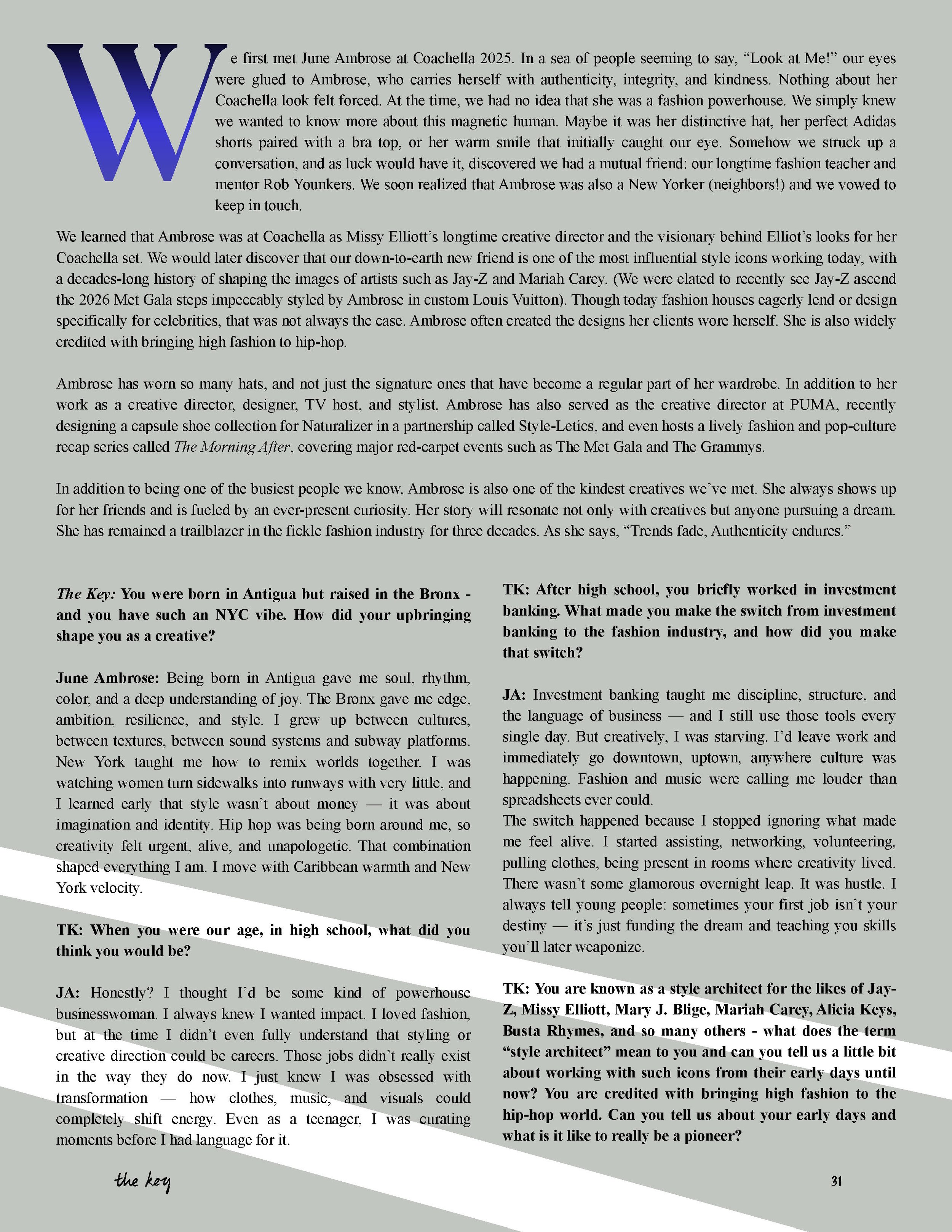
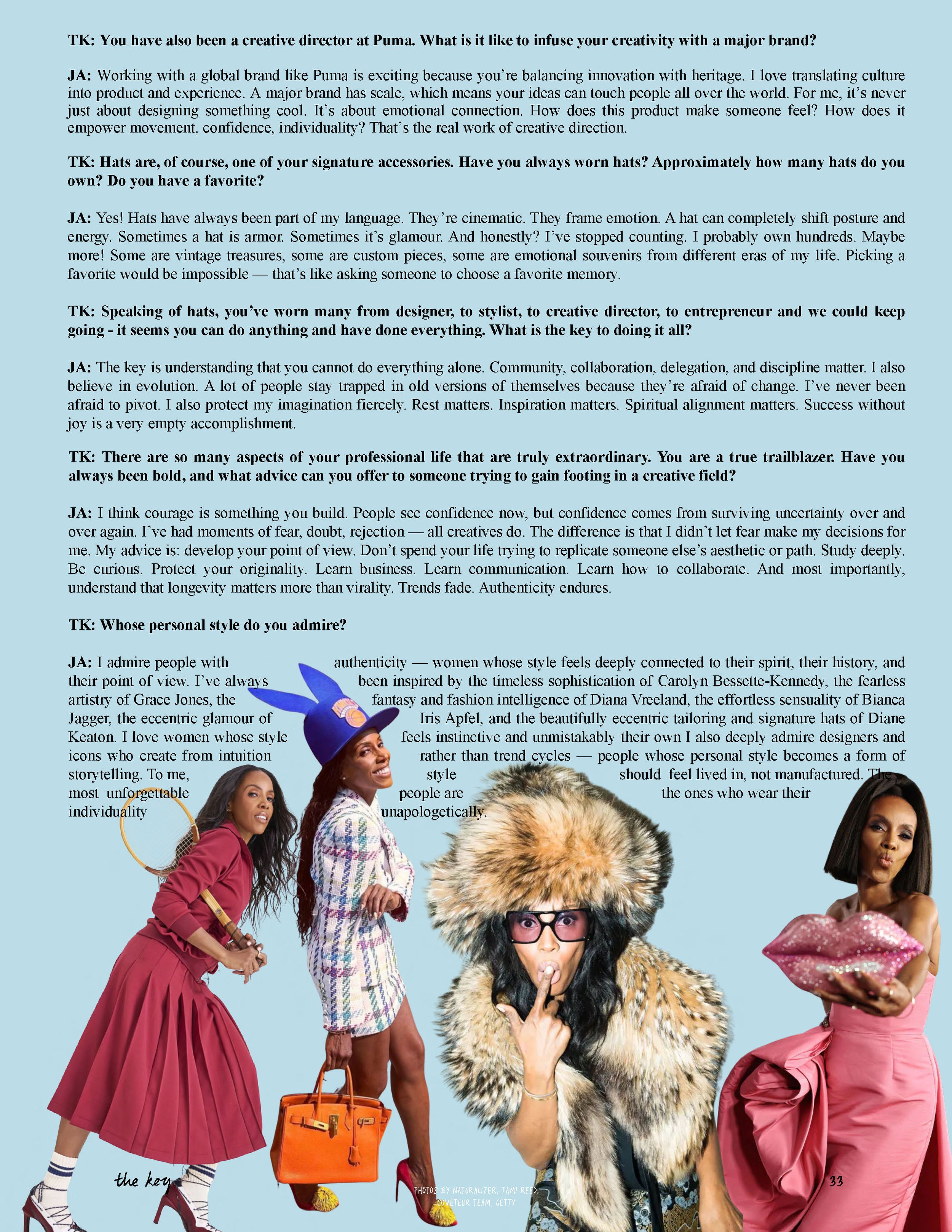
JA: I admire people with authenticity — women whose style feels deeply connected to their spirit, their history, and their point of view. I’ve always been inspired by the timeless sophistication of Carolyn Bessette-Kennedy, the fearless artistry of Grace Jones, the fantasy and fashion intelligence of Diana Vreeland, the effortless sensuality of Bianca Jagger, the eccentric glamour of Iris Apfel, and the beautifully. eccentric tailoring and signature hats of Diane Keaton. I love women whose style feels instinctive and unmistakably their own. I also deeply admire designers and icons who create from intuition rather than trend cycles — people whose personal style becomes a form of storytelling. To me, style should feel lived in, not manufactured. The most unforgettable people are the ones who wear their individuality unapologetically.