
Karina Nasywa
Bringing Discarded Fabric to Life
Karina Nasywa
Bringing Discarded Fabric to Life
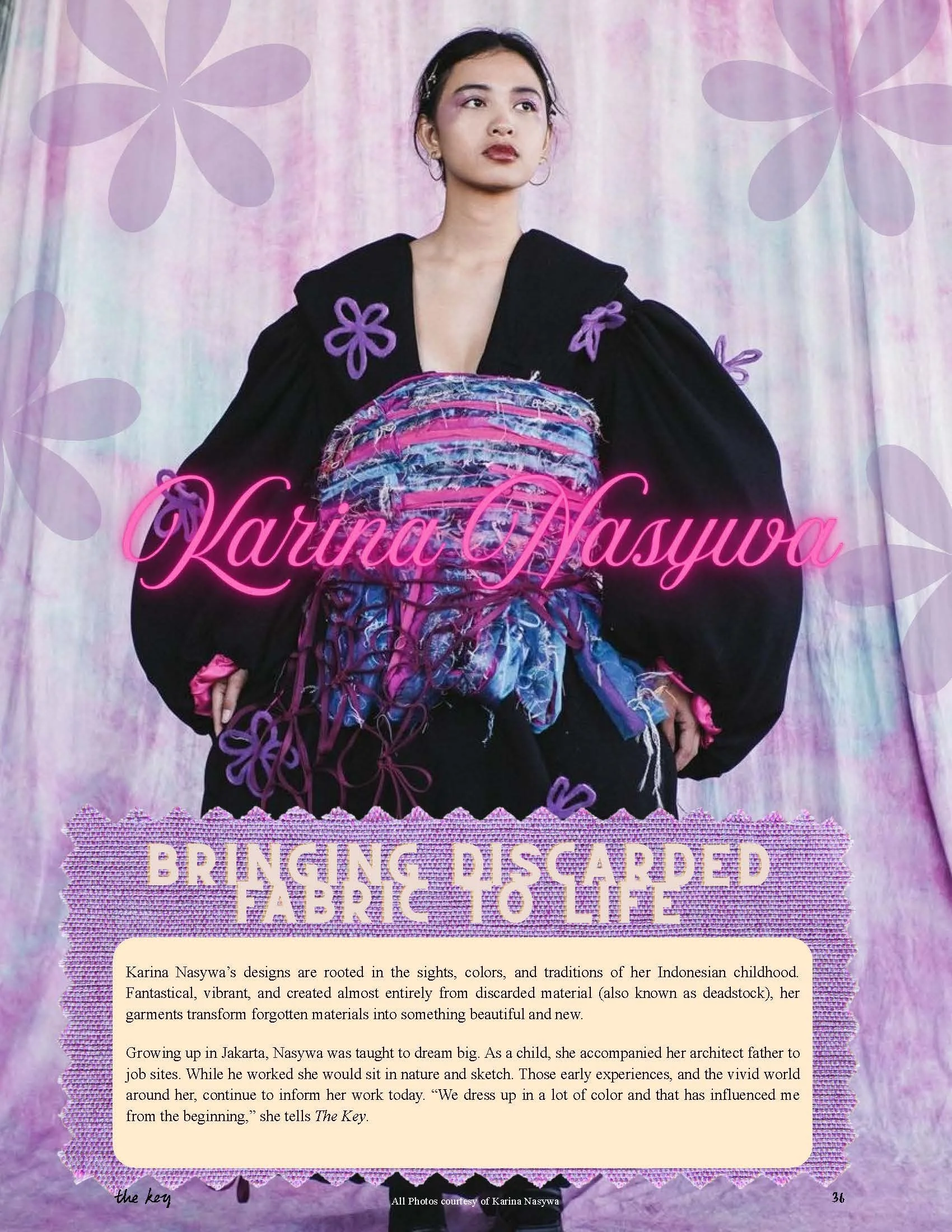
Karina Nasywa’s designs are rooted in the sights, colors, and traditions of her Indonesian childhood. Fantastical, vibrant, and created almost entirely from discarded material (also known as deadstock), her garments transform forgotten materials into something beautiful and new.
Growing up in Jakarta, Nasywa was taught to dream big. As a child, she accompanied her architect father to job sites. While he worked she would sit in nature and sketch. Those early experiences, and the vivid world around her, continue to inform her work today. “We dress up in a lot of color and that has influenced me from the beginning,” she tells The Key.
Her parents, both of whom had pursued their own education abroad, encouraged their daughter to do the same. Nasywa initially set her sights on Central Saint Martins in London, but her mother urged her to cast a wider net. When she looked into Parsons School of Design in New York, she discovered the application was due the very next day.
“I stayed up until 3 a.m. or 4 a.m., tidying up my portfolio. I was a little late for work the other day and everyone was like, ‘What happened?’ and I said, ‘I just applied to Parsons the day before the deadline’,” Nasywa recalls.
The sleepless night paid off. Nasywa was accepted, with a full scholarship. She still remembers exactly where she was when she received the news: on the back of a motorbike in Jakarta. She cried from happiness.
She had never been to the East Coast, but when she arrived in New York, the city felt familiar. Its crowds, energy, and vibrancy reminded her of Jakarta. Nasywa credits her parents with instilling a sense of possibility in her from a very young age and encouraging her to seek schooling abroad. “Someday you will get this chance,” Nasywa’s father would say.
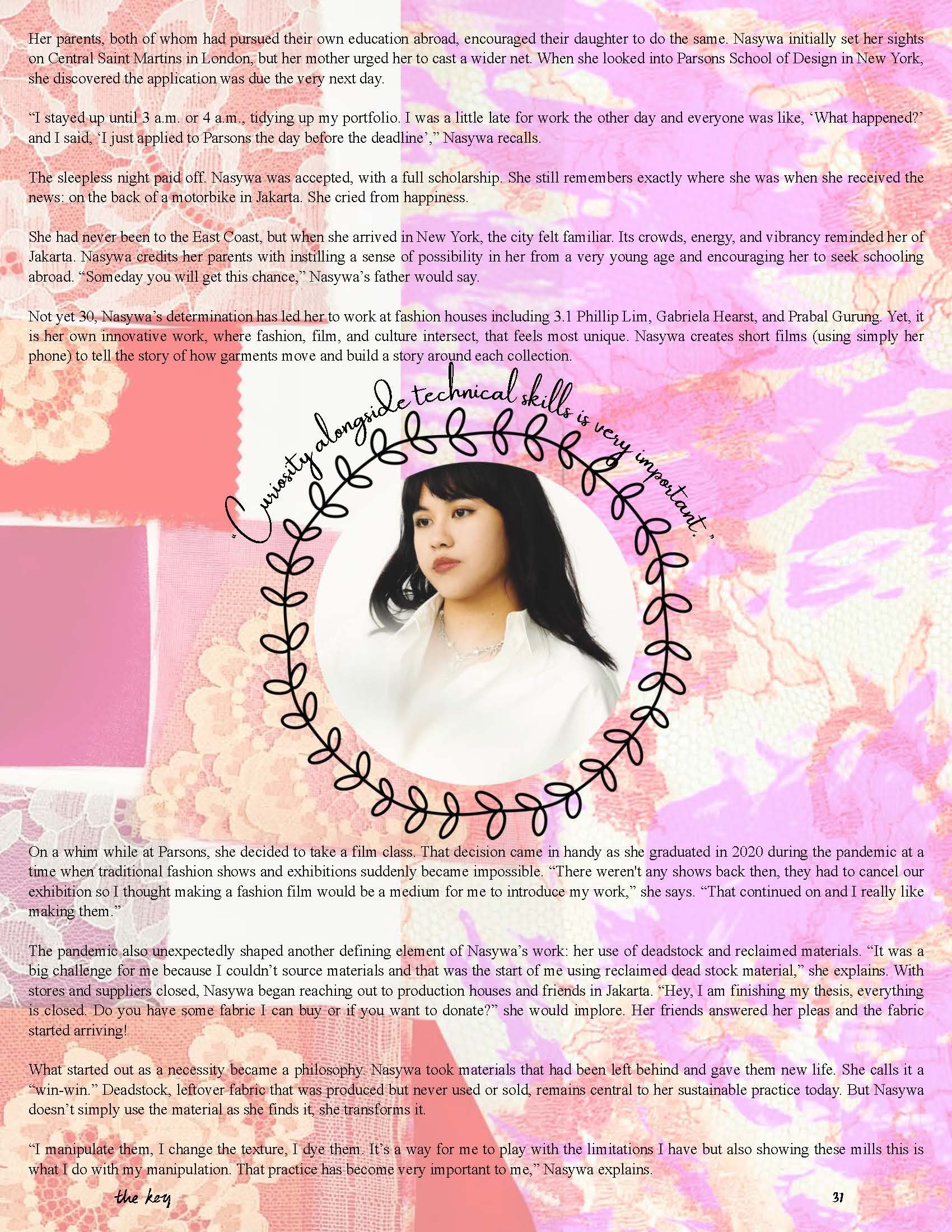
Not yet 30, Nasywa’s determination has led her to work at fashion houses including 3.1 Phillip Lim, Gabriela Hearst, and Prabal Gurung. Yet, it is her own innovative work, where fashion, film, and culture intersect, that feels most unique. Nasywa creates short films (using simply her phone) to tell the story of how garments move and build a story around each collection.
On a whim while at Parsons, she decided to take a film class. That decision came in handy as she graduated in 2020 during the pandemic at a time when traditional fashion shows and exhibitions suddenly became impossible. “There weren't any shows back then, they had to cancel our exhibition so I thought making a fashion film would be a medium for me to introduce my work,” she says. “That continued on and I really like making them.”
The pandemic also unexpectedly shaped another defining element of Nasywa’s work: her use of deadstock and reclaimed materials. “It was a big challenge for me because I couldn’t source materials and that was the start of me using reclaimed dead stock material,” she explains. With stores and suppliers closed, Nasywa began reaching out to production houses and friends in Jakarta. “Hey, I am finishing my thesis, everything is closed. Do you have some fabric I can buy or if you want to donate?” she would implore. Her friends answered her pleas and the fabric started arriving!
What started out as a necessity became a philosophy. Nasywa took materials that had been left behind and gave them new life. She calls it a “win-win.” Deadstock, leftover fabric that was produced but never used or sold, remains central to her sustainable practice today. But Nasywa doesn’t simply use the material as she finds it, she transforms it.
“I manipulate them, I change the texture, I dye them. It’s a way for me to play with the limitations I have but also showing these mills this is what I do with my manipulation. That practice has become very important to me,” Nasywa explains.
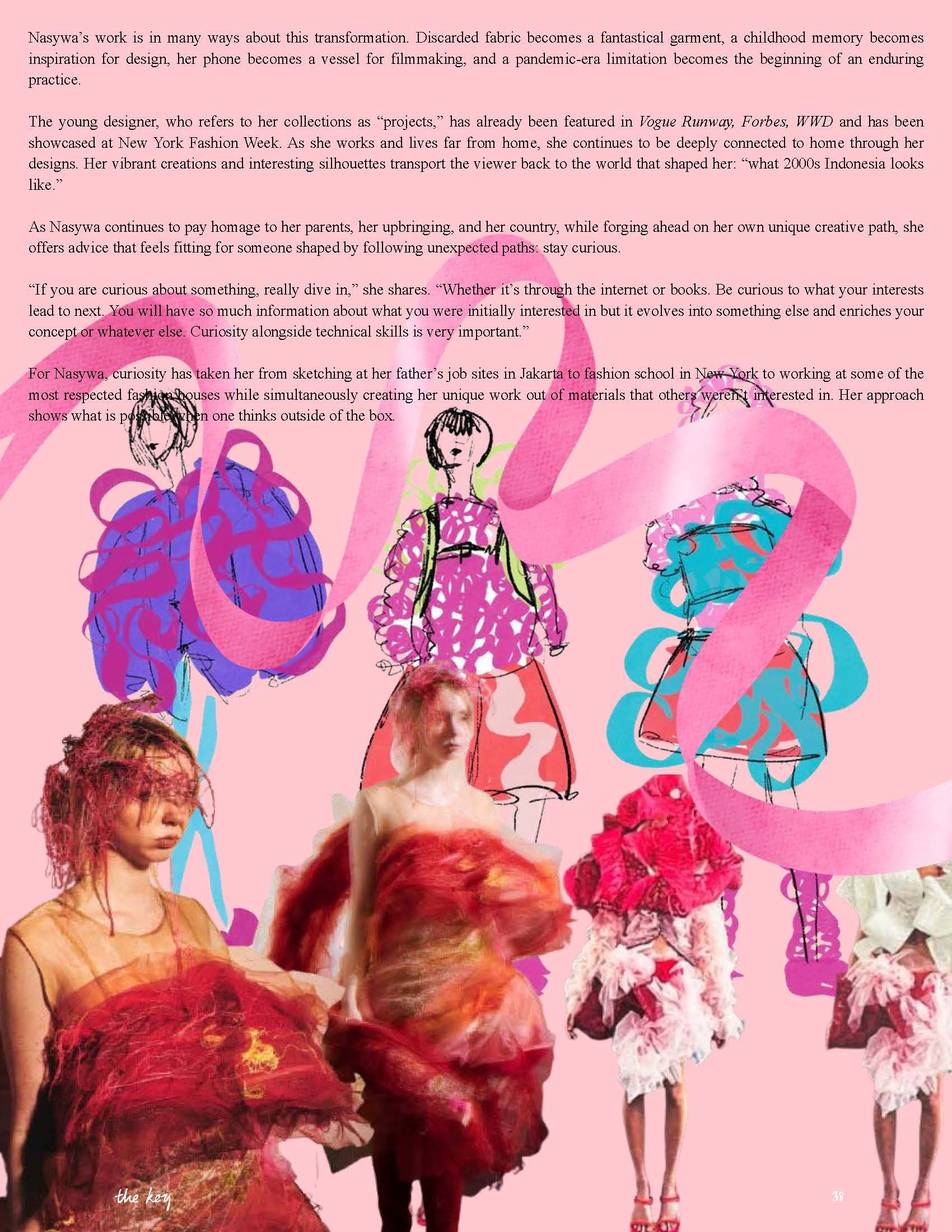
Nasywa’s work is in many ways about this transformation. Discarded fabric becomes a fantastical garment, a childhood memory becomes inspiration for design, her phone becomes a vessel for filmmaking, and a pandemic-era limitation becomes the beginning of an enduring practice.
The young designer, who refers to her collections as “projects,” has already been featured in Vogue Runway, Forbes, WWD and has been showcased at New York Fashion Week. As she works and lives far from home, she continues to be deeply connected to home through her designs. Her vibrant creations and interesting silhouettes transport the viewer back to the world that shaped her: “what 2000s Indonesia looks like.”
As Nasywa continues to pay homage to her parents, her upbringing, and her country, while forging ahead on her own unique creative path, she offers advice that feels fitting for someone shaped by following unexpected paths: stay curious.
“If you are curious about something, really dive in,” she shares. “Whether it’s through the internet or books. Be curious to what your interests lead to next. You will have so much information about what you were initially interested in but it evolves into something else and enriches your concept or whatever else. Curiosity alongside technical skills is very important.”
For Nasywa, curiosity has taken her from sketching at her father’s job sites in Jakarta to fashion school in New York to working at some of the most respected fashion houses while simultaneously creating her unique work out of materials that others weren’t interested in. Her approach shows what is possible when one thinks outside of the box.