
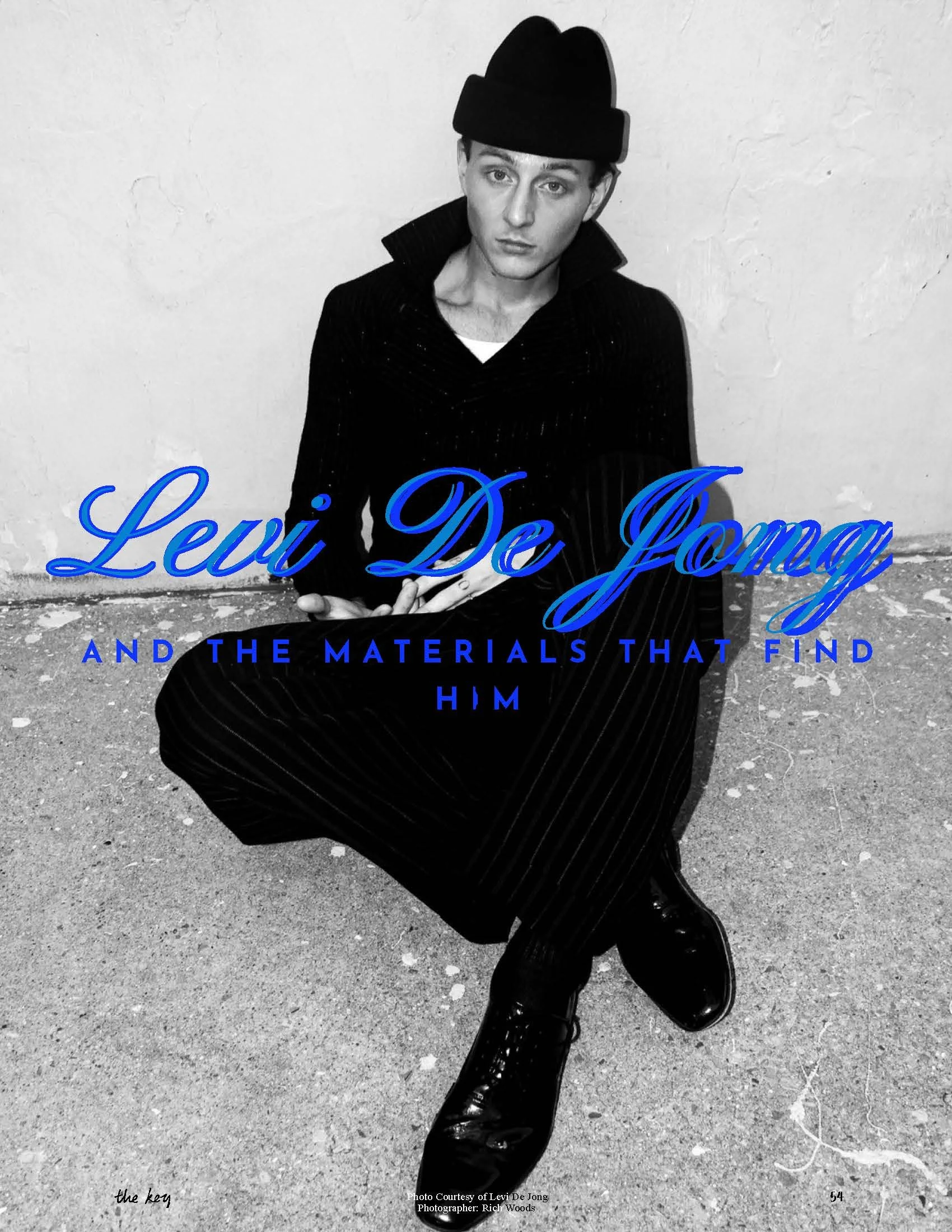
Levi De Jong
And The Materials That Find Him
Levi De Jong
And The Materials That Find Him
“I’m ultimately at the service of something greater than I can fully explain,” Levi De Jong shares when asked where he sources his materials. He doesn’t necessarily seek out materials; rather, they seem to find him. After spending time talking with De Jong, it became clear that this idea extends beyond the materials themselves. We get the sense that he is a conduit for something bigger, communicating through his work.
De Jong was born in Dallas, Texas, in 1997, but spent much of his childhood running around his grandparents’ farm in Iowa. His time there is one of the biggest influences on his work. Every Saturday, whether he was chopping wood, trimming trees, or pulling weeds, he was always given something to do with his hands. But somewhere between the work and exploring the farm, he began to wonder if there was something else he could do with his hands: something he could give to the world. That curiosity eventually led him to art.
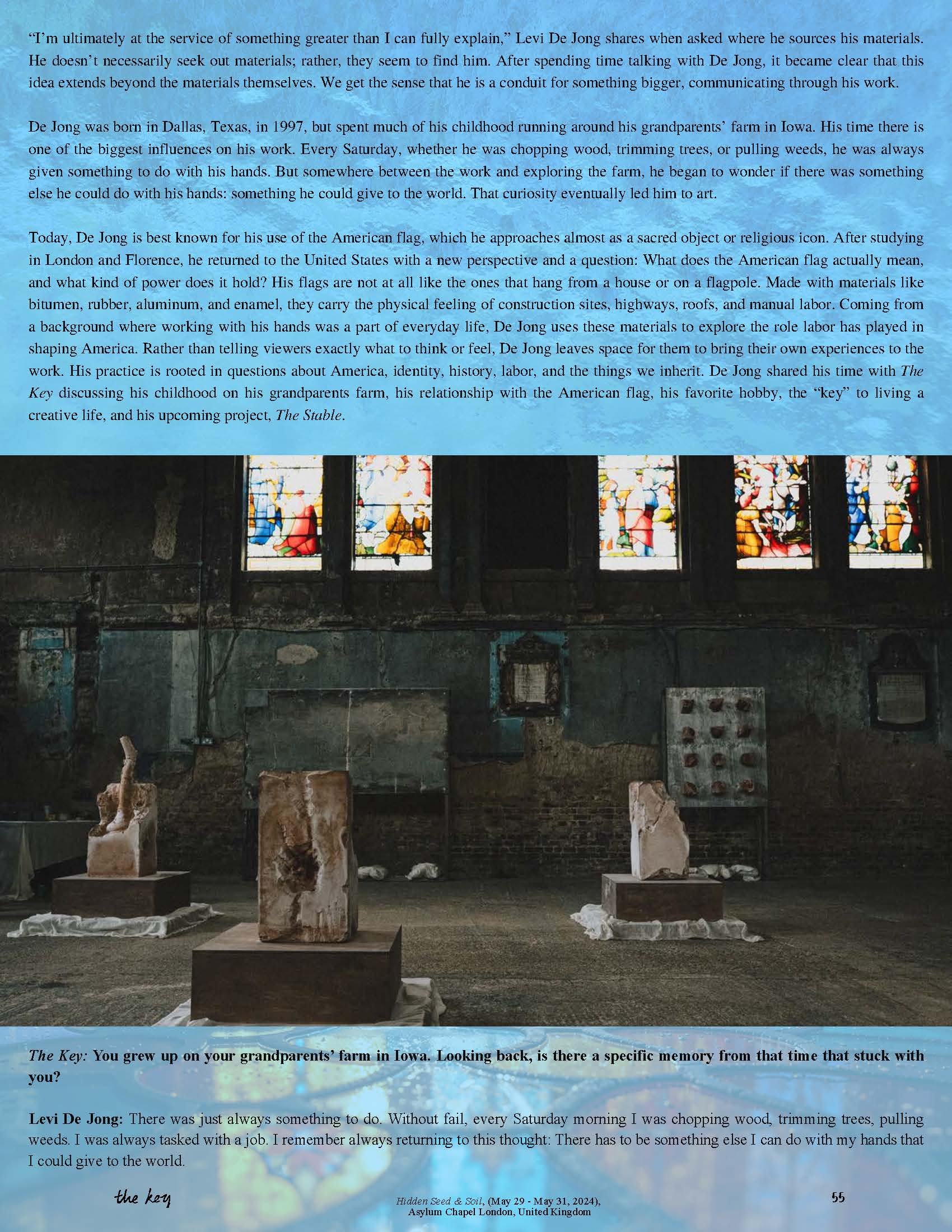
Today, De Jong is best known for his use of the American flag, which he approaches almost as a sacred object or religious icon. After studying in London and Florence, he returned to the United States with a new perspective and a question: What does the American flag actually mean, and what kind of power does it hold? His flags are not at all like the ones that hang from a house or on a flagpole. Made with materials like bitumen, rubber, aluminum, and enamel, they carry the physical feeling of construction sites, highways, roofs, and manual labor. Coming from a background where working with his hands was a part of everyday life, De Jong uses these materials to explore the role labor has played in shaping America. Rather than telling viewers exactly what to think or feel, De Jong leaves space for them to bring their own experiences to the work. His practice is rooted in questions about America, identity, history, labor, and the things we inherit. De Jong shared his time with The Key discussing his childhood on his grandparents farm, his relationship with the American flag, his favorite hobby, the “key” to living a creative life, and his upcoming project, The Stable.
The Key: You grew up on your grandparents’ farm in Iowa. Looking back, is there a specific memory from that time that stuck with you?
Levi De Jong: There was just always something to do. Without fail, every Saturday morning I was chopping wood, trimming trees, pulling weeds. I was always tasked with a job. I remember always returning to this thought: There has to be something else I can do with my hands that I could give to the world.
TK: Were there specific artists, images or objects around you growing up that first sparked your impulse to make things?
LDJ: Artists, no. Images, not really either. At that age I wasn’t “looking” in that way yet. But objects, absolutely. My grandparents had this grove of old trees out back, and I would spend hours walking through it, digging around and looking for things. I’d find a rusted hammer, a railroad spike, a beaded necklace, pieces of a vase, sometimes an arrowhead. I was invigorated. In a way, I was excavating my own family’s archaeology. I think that was instrumental. This idea that an object could hold a history, that you could find something buried and suddenly wonder who touched it, what it was used for, why it was there.
TK: Growing up in the rural Midwest, how has your relationship to the American flag and what it symbolizes evolved as your life and artistry have shifted?
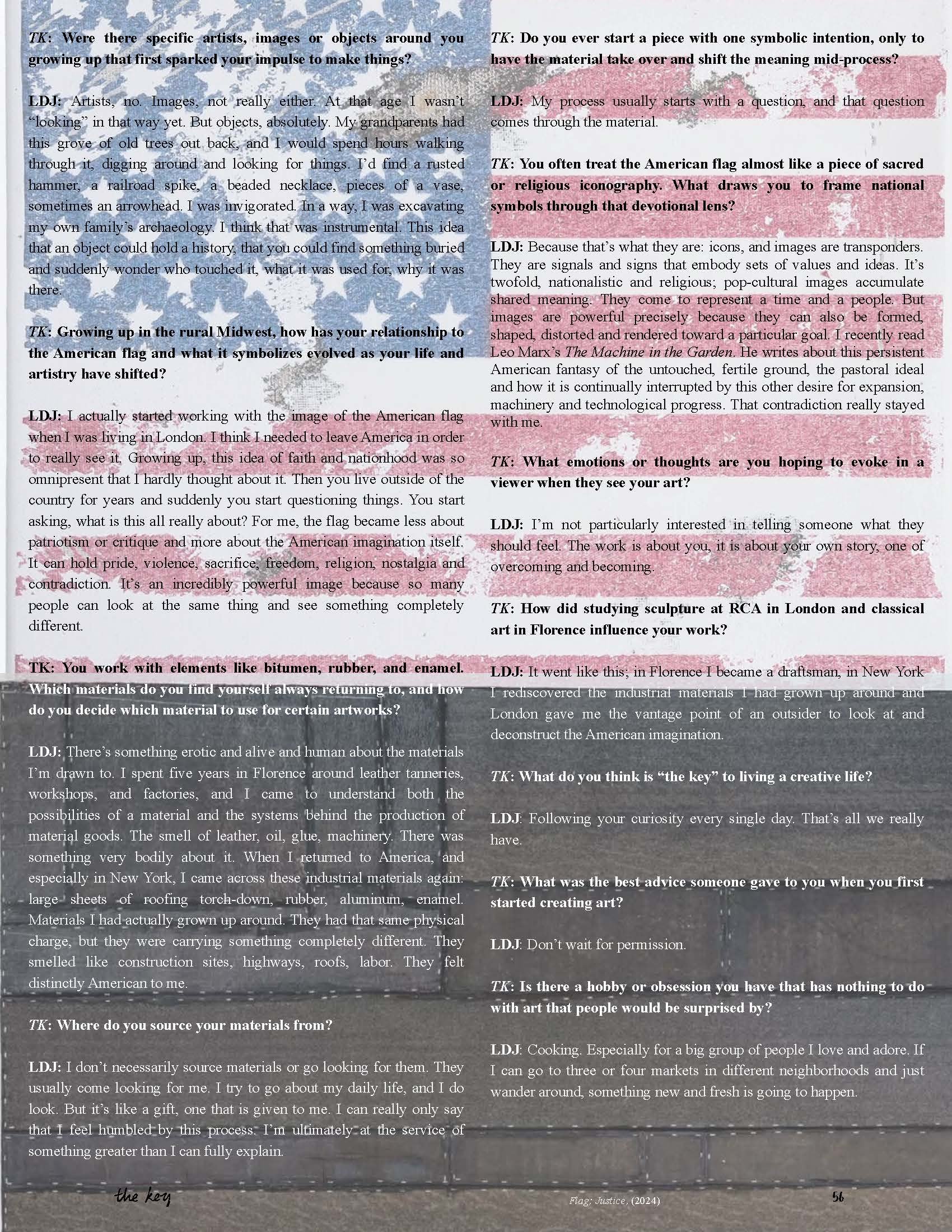
LDJ: I actually started working with the image of the American flag when I was living in London. I think I needed to leave America in order to really see it. Growing up, this idea of faith and nationhood was so omnipresent that I hardly thought about it. Then you live outside of the country for years and suddenly you start questioning things. You start asking, what is this all really about? For me, the flag became less about patriotism or critique and more about the American imagination itself. It can hold pride, violence, sacrifice, freedom, religion, nostalgia and contradiction. It’s an incredibly powerful image because so many people can look at the same thing and see something completely different.
TK: You work with elements like bitumen, rubber, and enamel. Which materials do you find yourself always returning to, and how do you decide which material to use for certain artworks?
LDJ: There’s something erotic and alive and human about the materials I’m drawn to. I spent five years in Florence around leather tanneries, workshops, and factories, and I came to understand both the possibilities of a material and the systems behind the production of material goods. The smell of leather, oil, glue, machinery. There was something very bodily about it. When I returned to America, and especially in New York, I came across these industrial materials again: large sheets of roofing torch-down, rubber, aluminum, enamel. Materials I had actually grown up around. They had that same physical charge, but they were carrying something completely different. They smelled like construction sites, highways, roofs, labor. They felt distinctly American to me.
TK: Where do you source your materials from?
LDJ: I don’t necessarily source materials or go looking for them. They usually come looking for me. I try to go about my daily life, and I do look. But it’s like a gift, one that is given to me. I can really only say that I feel humbled by this process. I’m ultimately at the service of something greater than I can fully explain.
TK: Do you ever start a piece with one symbolic intention, only to have the material take over and shift the meaning mid-process?
LDJ: My process usually starts with a question, and that question comes through the material.
TK: You often treat the American flag almost like a piece of sacred or religious iconography. What draws you to frame national symbols through that devotional lens?
LDJ: Because that’s what they are: icons, and images are transponders. They are signals and signs that embody sets of values and ideas. It’s twofold, nationalistic and religious; pop-cultural images accumulate shared meaning. They come to represent a time and a people. But images are powerful precisely because they can also be formed, shaped, distorted and rendered toward a particular goal. I recently read Leo Marx’s The Machine in the Garden. He writes about this persistent American fantasy of the untouched, fertile ground, the pastoral ideal and how it is continually interrupted by this other desire for expansion, machinery and technological progress. That contradiction really stayed with me.
TK: What emotions or thoughts are you hoping to evoke in a viewer when they see your art?
LDJ: I’m not particularly interested in telling someone what they should feel. The work is about you, it is about your own story, one of overcoming and becoming.
TK: How did studying sculpture at RCA in London and classical art in Florence influence your work?
LDJ: It went like this; in Florence I became a draftsman, in New York I rediscovered the industrial materials I had grown up around and London gave me the vantage point of an outsider to look at and deconstruct the American imagination.
TK: What do you think is “the key” to living a creative life?
LDJ: Following your curiosity every single day. That’s all we really have.
TK: What was the best advice someone gave to you when you first started creating art?
LDJ: Don’t wait for permission.
TK: Is there a hobby or obsession you have that has nothing to do with art that people would be surprised by?
LDJ: Cooking. Especially for a big group of people I love and adore. If I can go to three or four markets in different neighborhoods and just wander around, something new and fresh is going to happen.
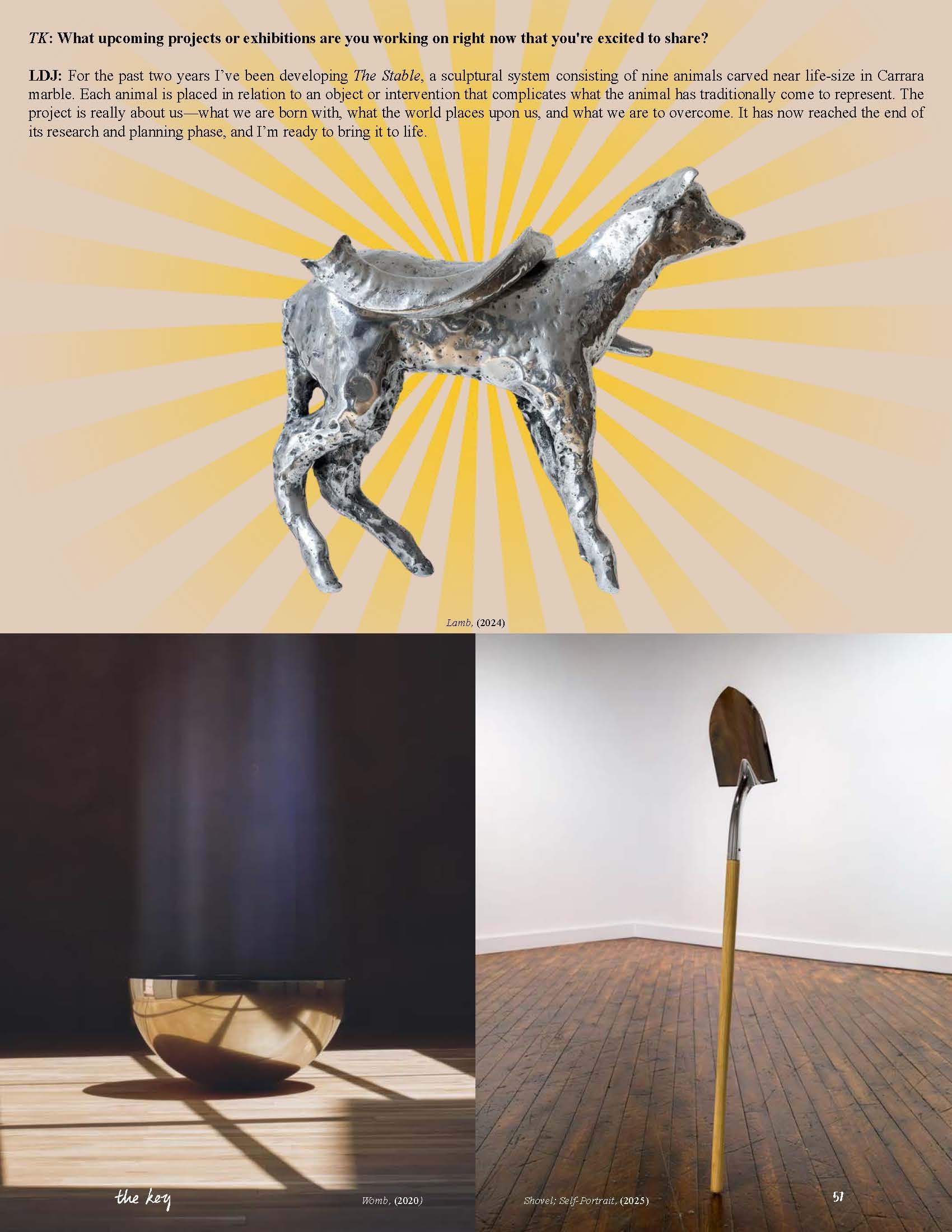
TK: What upcoming projects or exhibitions are you working on right now that you're excited to share?
LDJ: For the past two years I’ve been developing The Stable, a sculptural system consisting of nine animals carved near life-size in Carrara marble. Each animal is placed in relation to an object or intervention that complicates what the animal has traditionally come to represent. The project is really about us―what we are born with, what the world places upon us, and what we are to overcome. It has now reached the end of its research and planning phase, and I’m ready to bring it to life.