
Minter Maxing
Minter Maxing
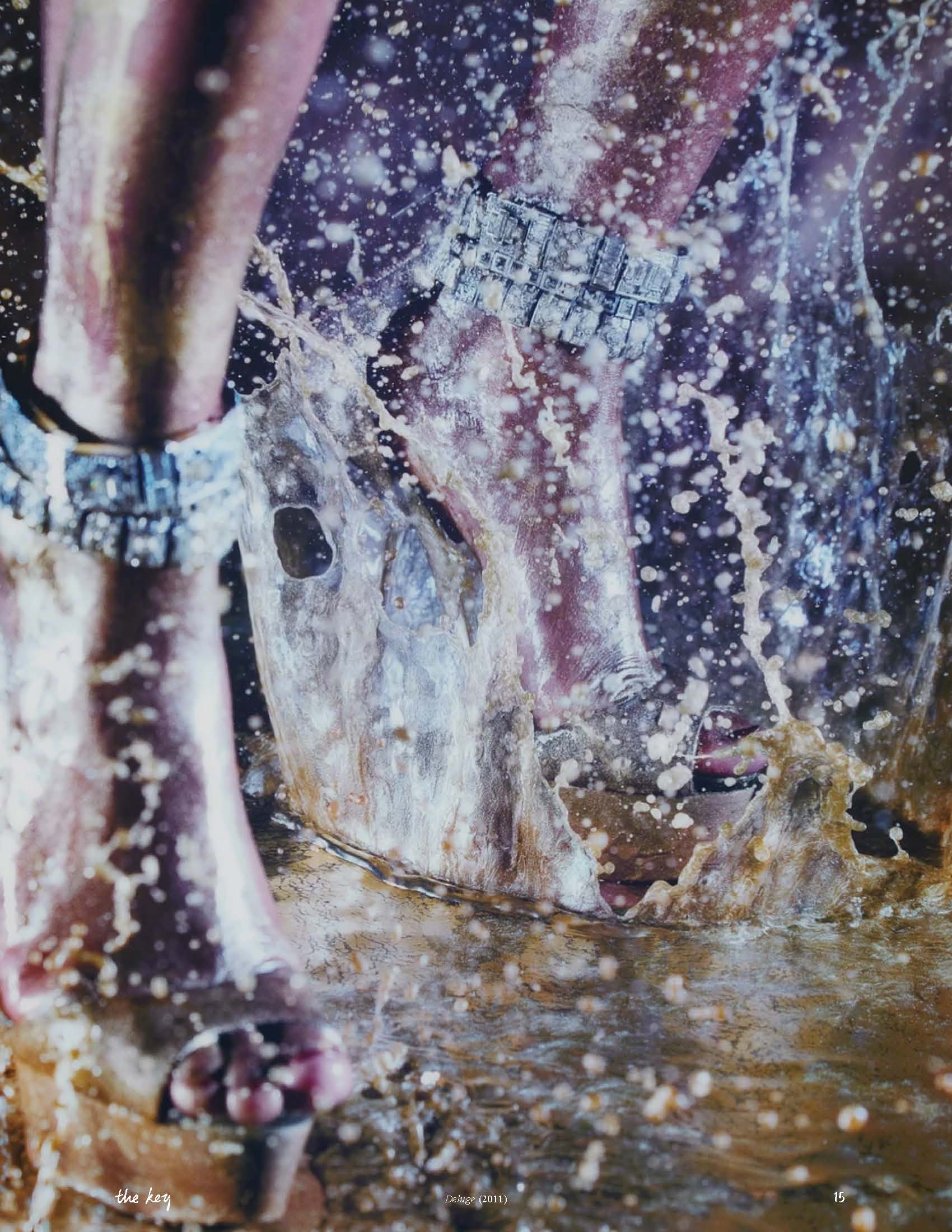
“My job as an artist is to make a picture of things you know exist, but you have never seen before. I want to make these paintings really beautiful even though I’m painting a string of spit, or sweat, or dirt, but I’m gonna make it gorgeous.”
— Marilyn Minter
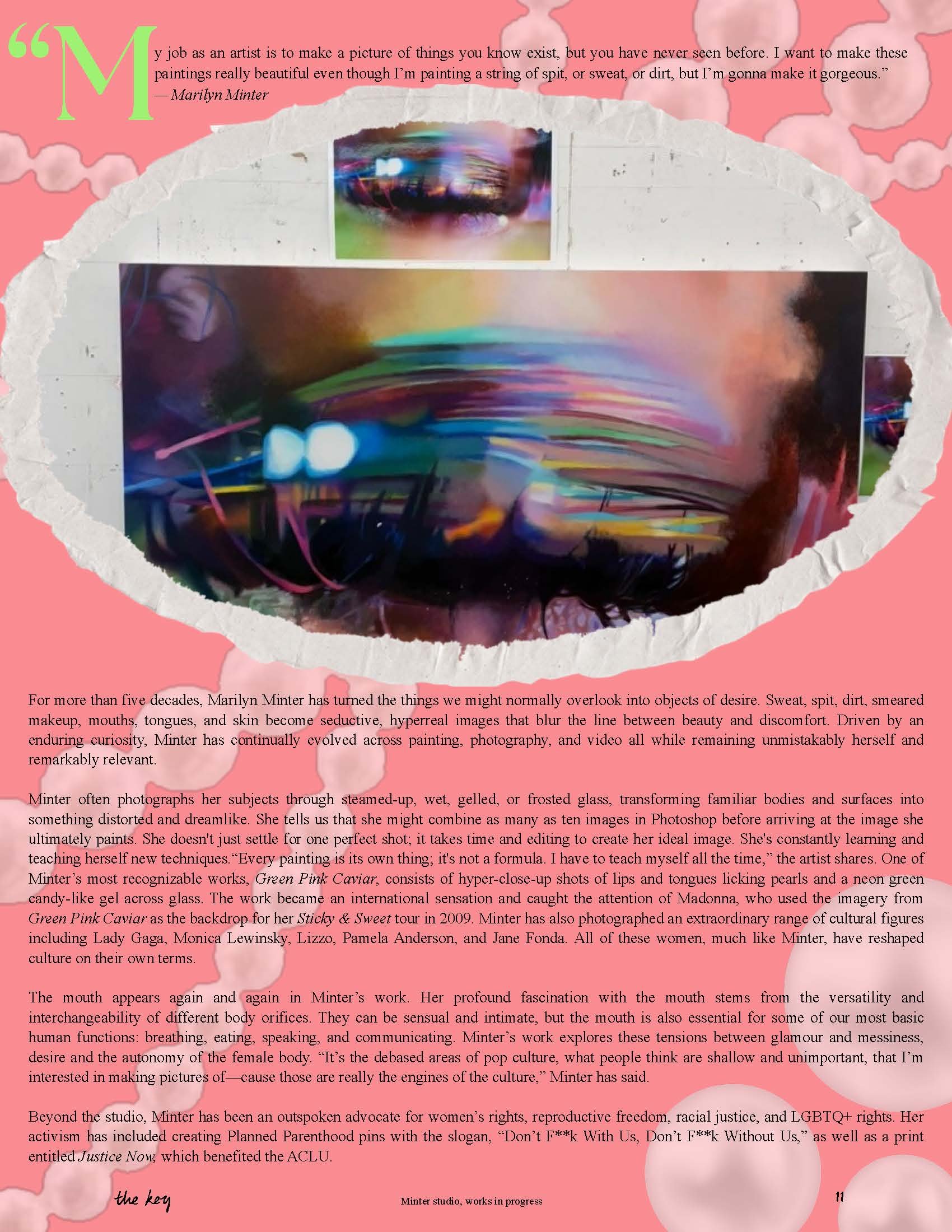
For more than five decades, Marilyn Minter has turned the things we might normally overlook into objects of desire. Sweat, spit, dirt, smeared makeup, mouths, tongues, and skin become seductive, hyperreal images that blur the line between beauty and discomfort. Driven by an enduring curiosity, Minter has continually evolved across painting, photography, and video all while remaining unmistakably herself and remarkably relevant.
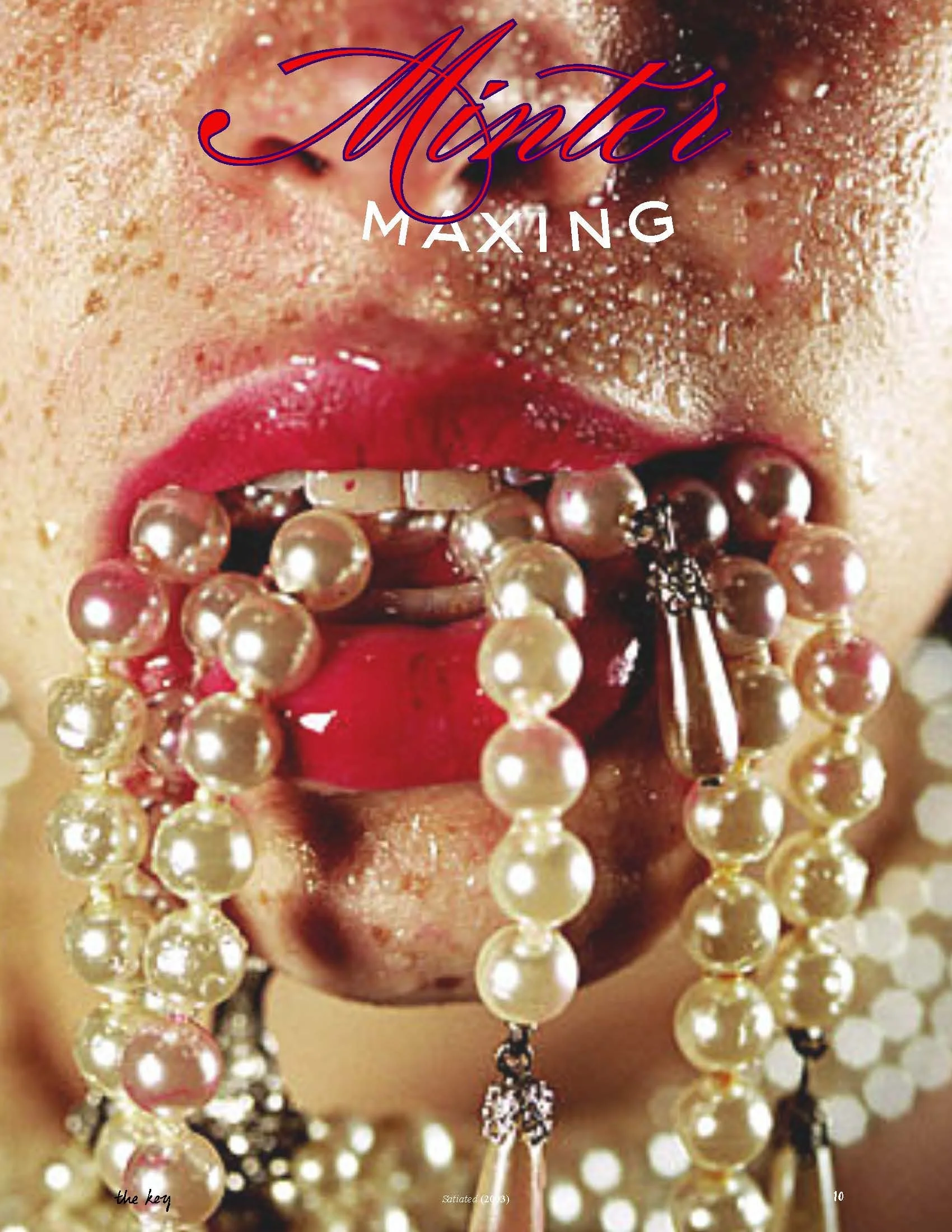
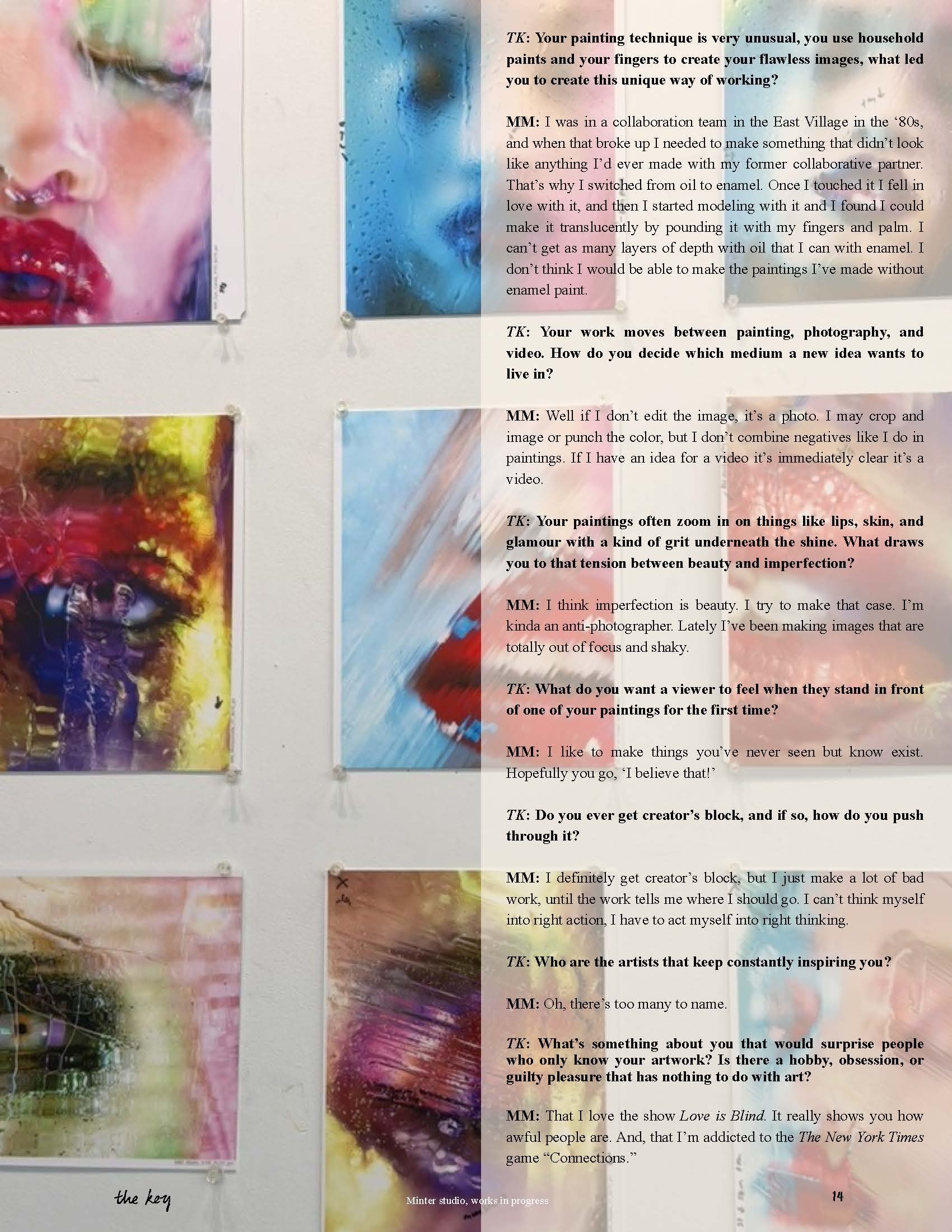
Minter often photographs her subjects through steamed-up, wet, gelled, or frosted glass, transforming familiar bodies and surfaces into something distorted and dreamlike. She tells us that she might combine as many as ten images in Photoshop before arriving at the image she ultimately paints. She doesn't just settle for one perfect shot; it takes time and editing to create her ideal image. She's constantly learning and teaching herself new techniques.“Every painting is its own thing; it's not a formula. I have to teach myself all the time,” the artist shares. One of Minter’s most recognizable works, Green Pink Caviar, consists of hyper-close-up shots of lips and tongues licking pearls and a neon green candy-like gel across glass. The work became an international sensation and caught the attention of Madonna, who used the imagery from Green Pink Caviar as the backdrop for her Sticky & Sweet tour in 2009. Minter has also photographed an extraordinary range of cultural figures including Lady Gaga, Monica Lewinsky, Lizzo, Pamela Anderson, and Jane Fonda. All of these women, much like Minter, have reshaped culture on their own terms.
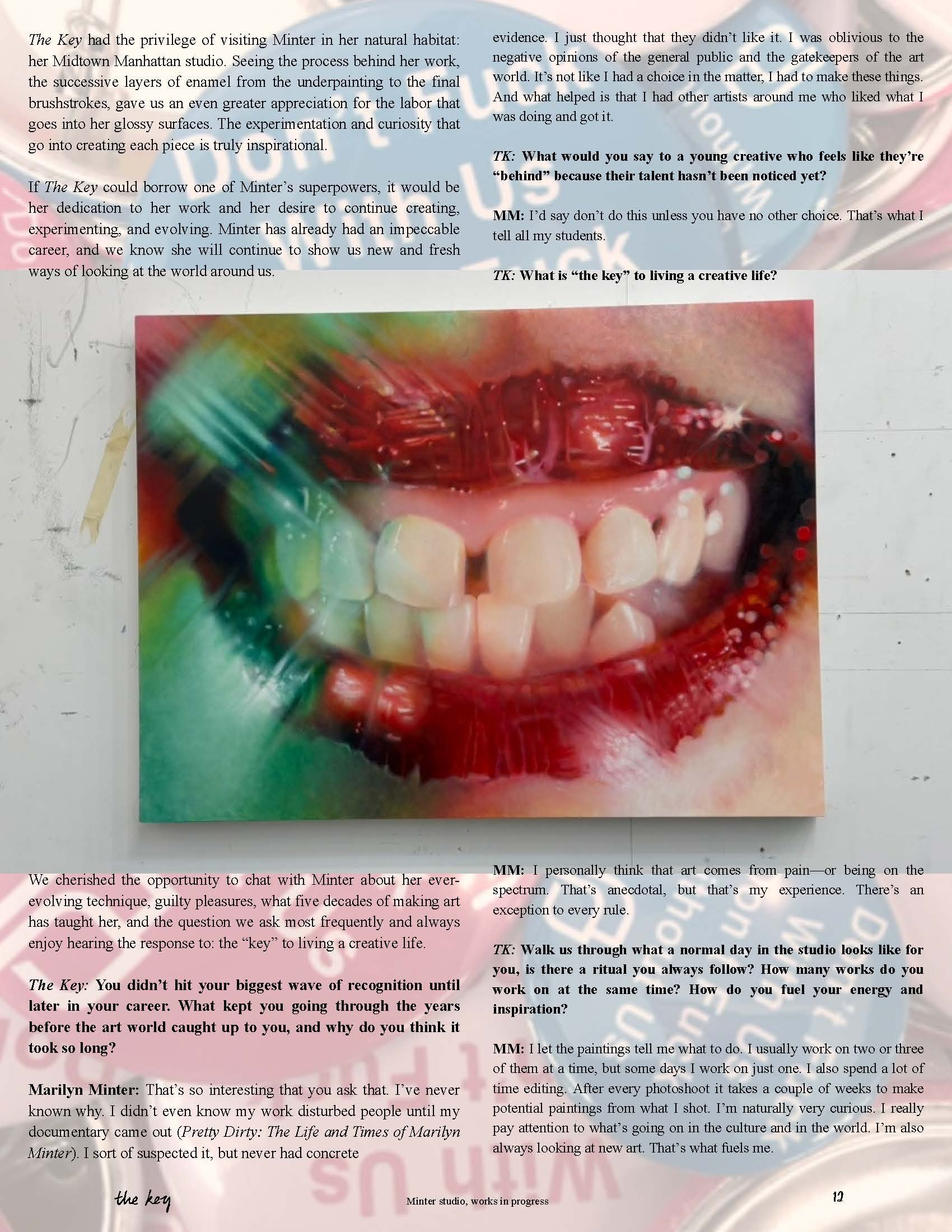
The mouth appears again and again in Minter’s work. Her profound fascination with the mouth stems from the versatility and interchangeability of different body orifices. They can be sensual and intimate, but the mouth is also essential for some of our most basic human functions: breathing, eating, speaking, and communicating. Minter’s work explores these tensions between glamour and messiness, desire and the autonomy of the female body. “It’s the debased areas of pop culture, what people think are shallow and unimportant, that I’m interested in making pictures of—cause those are really the engines of the culture,” Minter has said.
Beyond the studio, Minter has been an outspoken advocate for women’s rights, reproductive freedom, racial justice, and LGBTQ+ rights. Her activism has included creating Planned Parenthood pins with the slogan, “Don’t F**k With Us, Don’t F**k Without Us,” as well as a print entitled Justice Now, which benefited the ACLU.
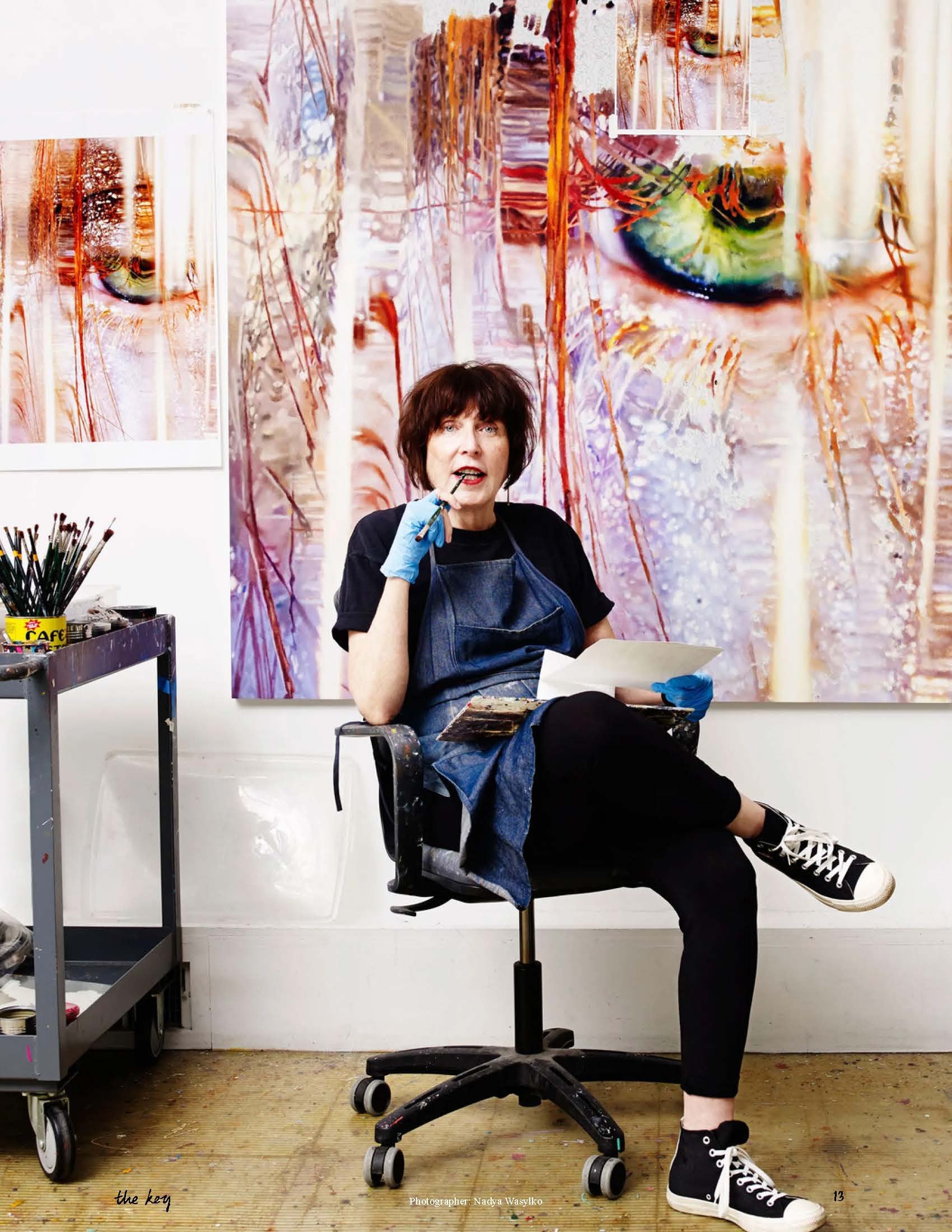
The Key had the privilege of visiting Minter in her natural habitat: her Midtown Manhattan studio. Seeing the process behind her work, the successive layers of enamel from the underpainting to the final brushstrokes, gave us an even greater appreciation for the labor that goes into her glossy surfaces. The experimentation and curiosity that go into creating each piece is truly inspirational.
If The Key could borrow one of Minter’s superpowers, it would be her dedication to her work and her desire to continue creating, experimenting, and evolving. Minter has already had an impeccable career, and we know she will continue to show us new and fresh ways of looking at the world around us.
We cherished the opportunity to chat with Minter about her ever-evolving technique, guilty pleasures, what five decades of making art has taught her, and the question we ask most frequently and always enjoy hearing the response to: the “key” to living a creative life.
The Key: You didn’t hit your biggest wave of recognition until later in your career. What kept you going through the years before the art world caught up to you, and why do you think it took so long?
Marilyn Minter: That’s so interesting that you ask that. I’ve never known why. I didn’t even know my work disturbed people until my documentary came out (Pretty Dirty: The Life and Times of Marilyn Minter). I sort of suspected it, but never had concrete evidence.
I just thought that they didn’t like it. I was oblivious to the negative opinions of the general public and the gatekeepers of the art world. It’s not like I had a choice in the matter, I had to make these things. And what helped is that I had other artists around me who liked what I was doing and got it.
TK: What would you say to a young creative who feels like they’re “behind” because their talent hasn’t been noticed yet?
MM: I’d say don’t do this unless you have no other choice. That’s what I tell all my students.
TK: What is “the key” to living a creative life?
MM: I personally think that art comes from pain—or being on the spectrum. That’s anecdotal, but that’s my experience. There’s an exception to every rule.
TK: Walk us through what a normal day in the studio looks like for you, is there a ritual you always follow? How many works do you work on at the same time? How do you fuel your energy and inspiration?
MM: I let the paintings tell me what to do. I usually work on two or three of them at a time, but some days I work on just one. I also spend a lot of time editing. After every photoshoot it takes a couple of weeks to make potential paintings from what I shot. I’m naturally very curious. I really pay attention to what’s going on in the culture and in the world. I’m also always looking at new art. That’s what fuels me.
TK: Your painting technique is very unusual, you use household paints and your fingers to create your flawless images, what led you to create this unique way of working?
MM: I was in a collaboration team in the East Village in the ‘80s, and when that broke up I needed to make something that didn’t look like anything I’d ever made with my former collaborative partner. That’s why I switched from oil to enamel. Once I touched it I fell in love with it, and then I started modeling with it and I found I could make it translucently by pounding it with my fingers and palm. I can’t get as many layers of depth with oil that I can with enamel. I don’t think I would be able to make the paintings I’ve made without enamel paint.
TK: Your work moves between painting, photography, and video. How do you decide which medium a new idea wants to live in?
MM: Well if I don’t edit the image, it’s a photo. I may crop and image or punch the color, but I don’t combine negatives like I do in paintings. If I have an idea for a video it’s immediately clear it’s a video.
TK: Your paintings often zoom in on things like lips, skin, and glamour with a kind of grit underneath the shine. What draws you to that tension between beauty and imperfection?
MM: I think imperfection is beauty. I try to make that case. I’m kinda an anti-photographer. Lately I’ve been making images that are totally out of focus and shaky.
TK: What do you want a viewer to feel when they stand in front of one of your paintings for the first time?
MM: I like to make things you’ve never seen but know exist. Hopefully you go, ‘I believe that!’
TK: Do you ever get creator’s block, and if so, how do you push through it?
MM: I definitely get creator’s block, but I just make a lot of bad work, until the work tells me where I should go. I can’t think myself into right action, I have to act myself into right thinking.
TK: Who are the artists that keep constantly inspiring you?
MM: Oh, there’s too many to name.
TK: What’s something about you that would surprise people who only know your artwork? Is there a hobby, obsession, or guilty pleasure that has nothing to do with art?
MM: That I love the show Love is Blind. It really shows you how awful people are. And, that I’m addicted to the The New York Times game “Connections.”