
Rachel’s Fate
Rachel’s Fate
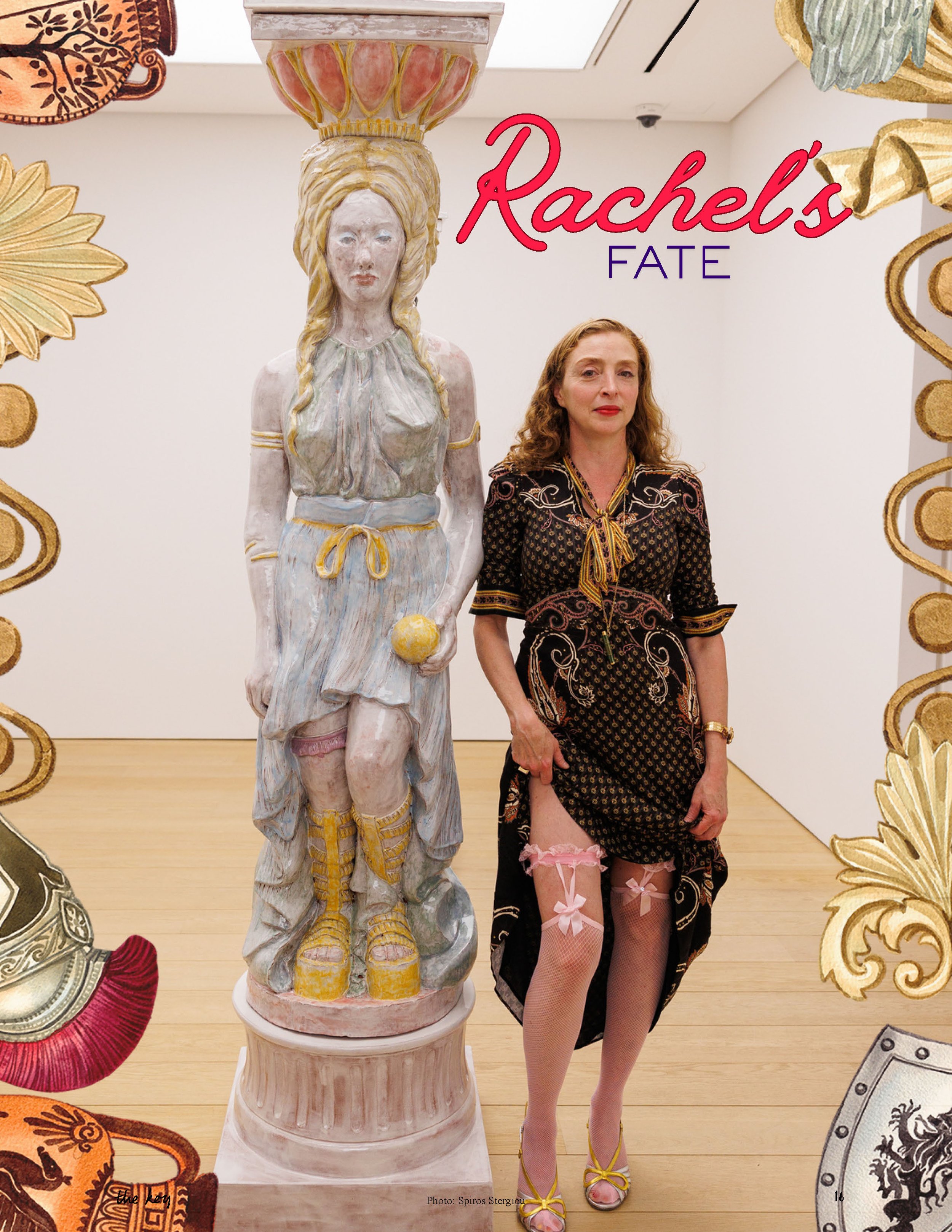
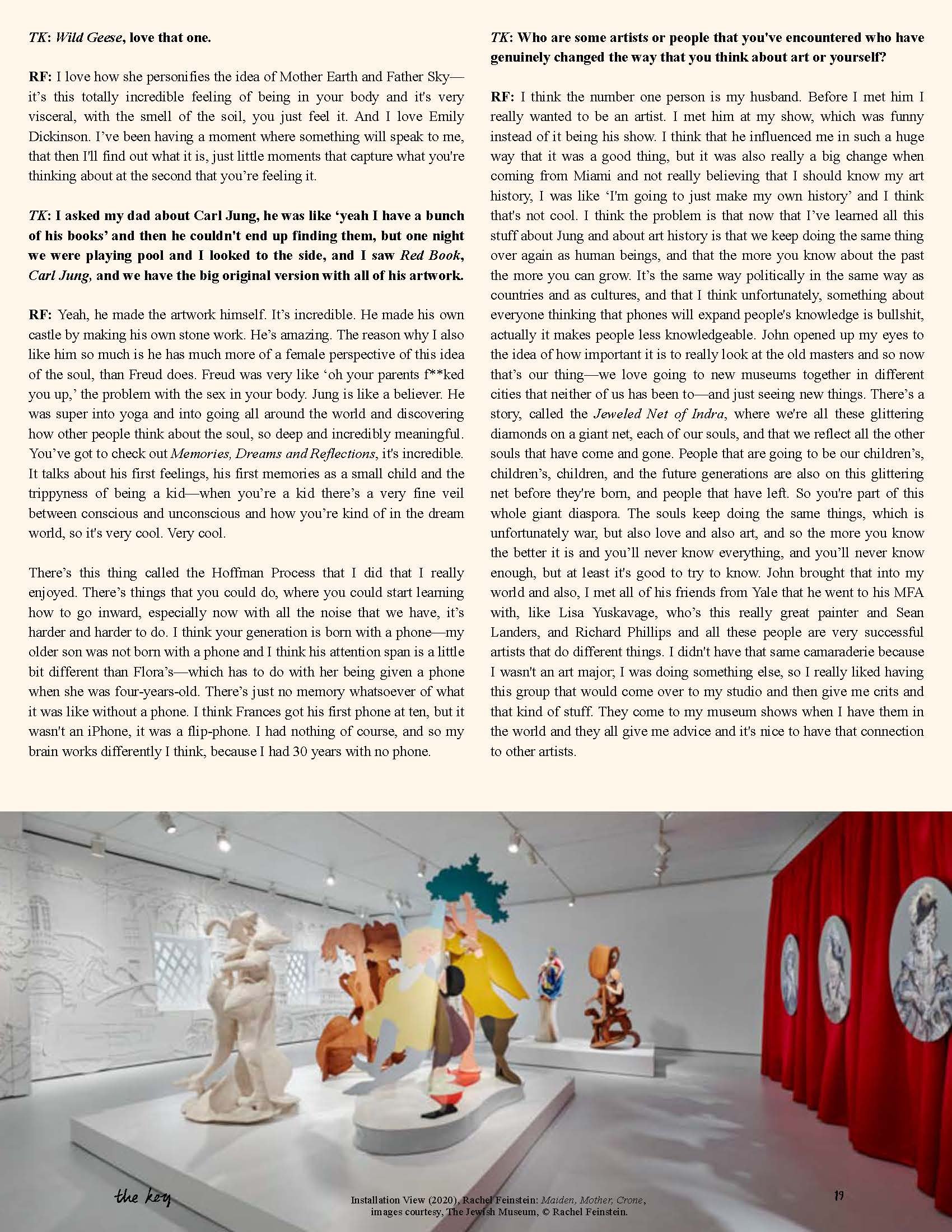
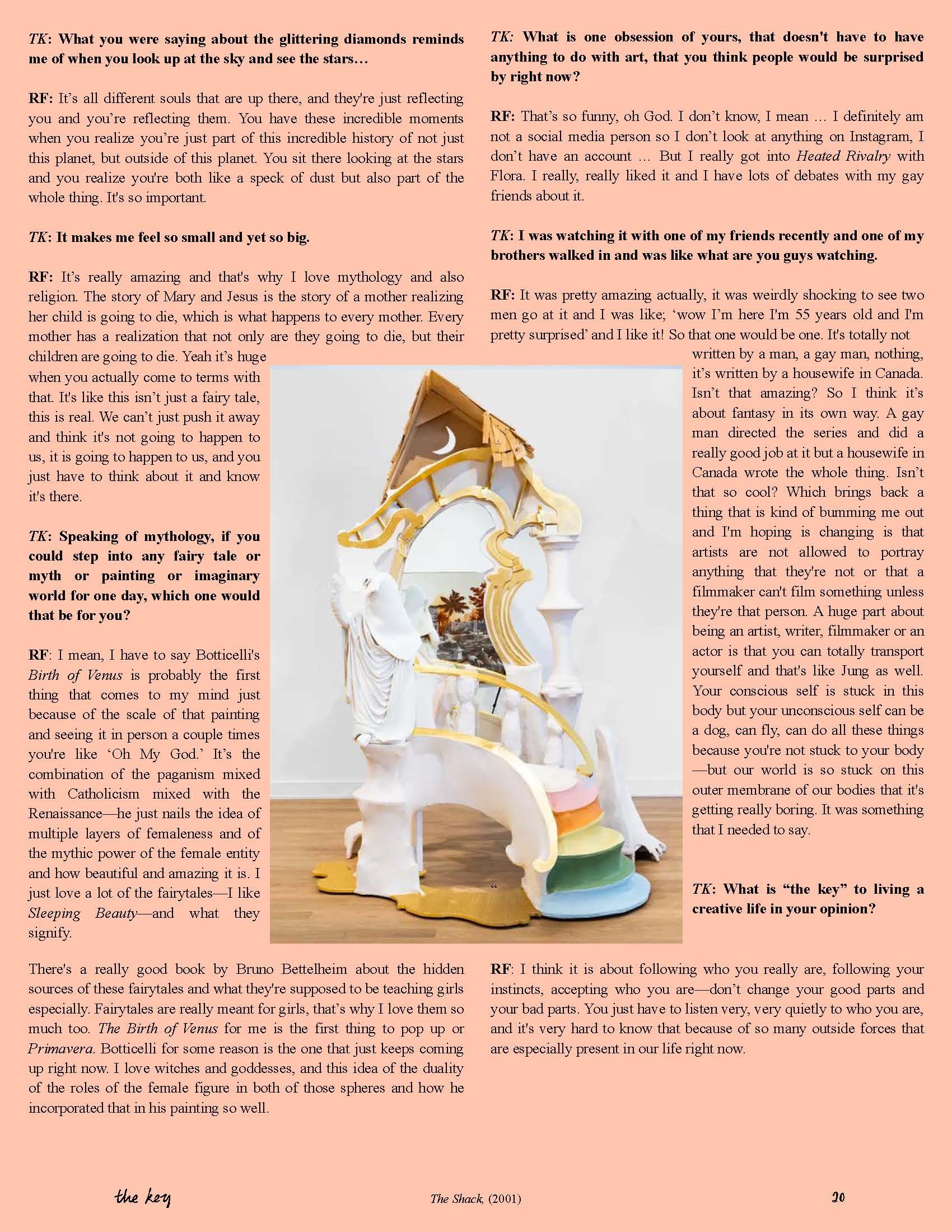
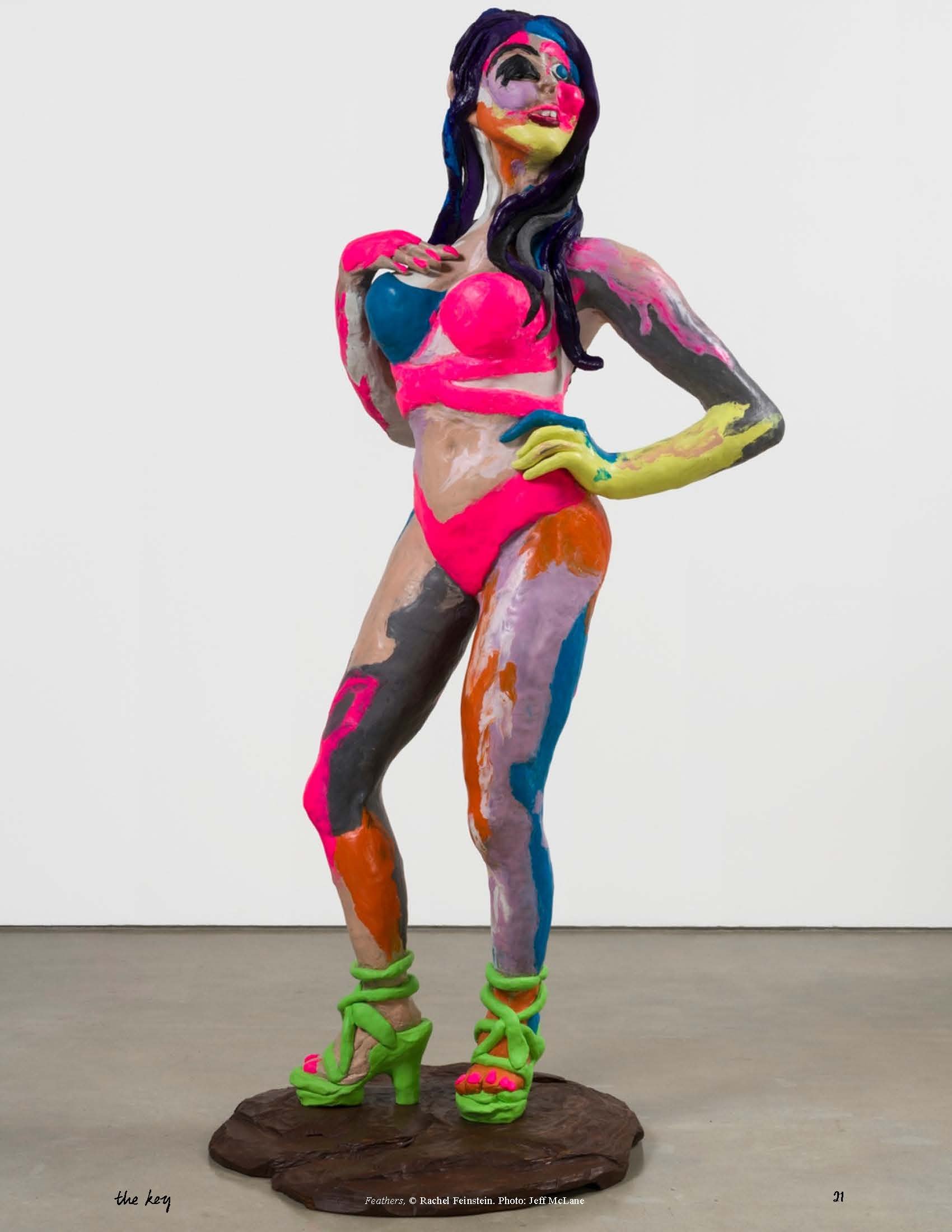
In a world full of powerful women, Rachel Feinstein is undoubtedly one of The Key’s favorites. For more than three decades, Feinstein has carved out a singular place in the art world, creating fantastical sculptures, paintings, and installations. Much of her work draws from fairy tales, mythology, religion, and stories that shape our childhood. Central to Feinstein's work is the way she examines women and the different roles they inhabit. Witches, goddesses, princesses, and mothers appear in her world, becoming vehicles through which she explores ideas about femininity, power, motherhood, and identity. Her work can be playful yet deeply meaningful, simultaneously illustrating that there is always something complicated existing beneath the surface.
Feinstein is married to artist John Currin, whom she met in 1994 at one of her exhibitions in New York. At the time, she had created a life-sized gingerbread version of “Sleeping Beauty’s” house as a performance piece, embodying the role of Sleeping Beauty herself, spending her days and nights inside the structure. While Feinstein has often been described as Currin’s muse, she has built an artistic world that is entirely her own.
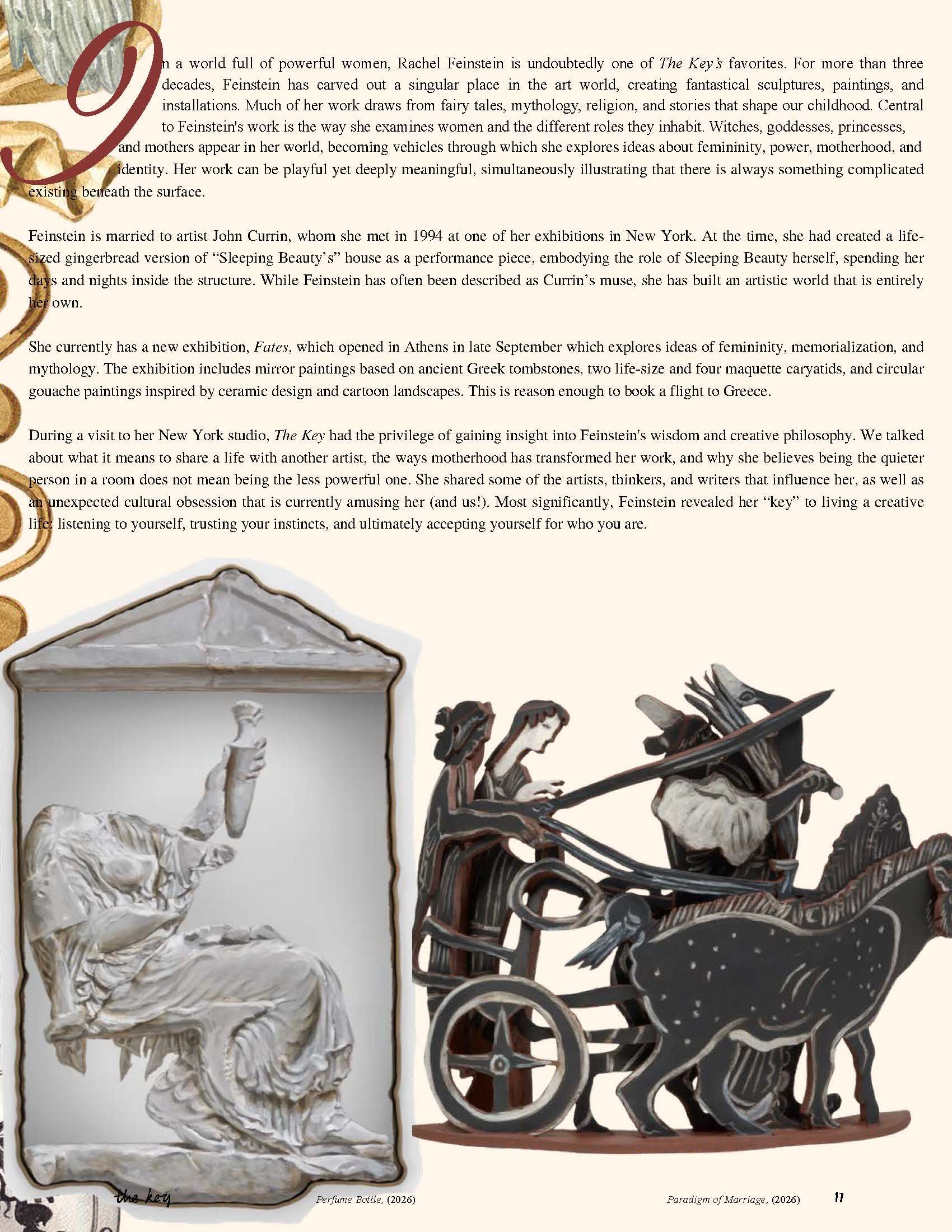
She currently has a new exhibition, Fates, which opened in Athens in late September which explores ideas of femininity, memorialization, and mythology. The exhibition includes mirror paintings based on ancient Greek tombstones, two life-size and four maquette caryatids, and circular gouache paintings inspired by ceramic design and cartoon landscapes. This is reason enough to book a flight to Greece.
During a visit to her New York studio, The Key had the privilege of gaining insight into Feinstein's wisdom and creative philosophy. We talked about what it means to share a life with another artist, the ways motherhood has transformed her work, and why she believes being the quieter person in a room does not mean being the less powerful one. She shared some of the artists, thinkers, and writers that influence her, as well as an unexpected cultural obsession that is currently amusing her (and us!). Most significantly, Feinstein revealed her “key” to living a creative life: listening to yourself, trusting your instincts, and ultimately accepting yourself for who you are.
The Key: You have sometimes been described as John Currin’s muse while building a completely distinct body of work of your own. How has being part of an artist couple shaped your creative life and is there anything about the idea of muse and maker that you wish people saw differently or understood differently?
Rachel Feinstein: I think that it’s about the idea of duality, and that you have to have both sides of the Yin and the Yang to be strong. This doesn't mean that one side, who’s maybe the louder side and the more public side, is necessarily the strong one. The truth is you don't really know behind closed doors. I think the problem with our culture is that so much about social media and TikTok is about whoever is making the biggest noise is the one that people follow or listen to. The problem with that is that then it counterbalances that Yang side, which is the quiet, dark side and the moon side. If you know about the sun and the moon, the moon only shines because of the sun shining on it. You need both equally, you also can't just have the sun. The sun will burn the whole world down, so you need to have both sides, and I think that a very harmonious union between anybody, a mother and a daughter; a husband and a wife; two husbands, two wives; is that both sides feel content in who they are and also feel able to be satisfied. That's a big thing. I think social media makes people feel that maybe because ‘I’m the quiet one, I’m not being heard’ and it's really important to let that person who is the quiet one have a voice in their own way, and not make them have to be loud if that's not who they are.
I think everyone on the surface is dismissive to the woman because they think ‘oh the woman is just the one who's just doing all the housework or something,’ they don't realize it's the most important job and if things are not secure at home, nothing happens—that’s the way the world is in general. I think it’s interesting that women have been very content to be in the secret dark side of the moon because you actually have more power, in the end you can be much more able to assert what you want or what you think will be better for the world, in a more quiet way, rather than having to be the loud one. It's a very complicated thing. Now they’re trying to push women artists and give them shows, sometimes it doesn’t work, because they're trying to push the moon into the bright sun, which is not a good thing either. So it's all about just accepting who the person is and letting them shine on the stage that they need, which might be a dark stage—it might not be a bright stage.
TK: How has being a mother changed the way you make your art and have you incorporated your kids into your art?
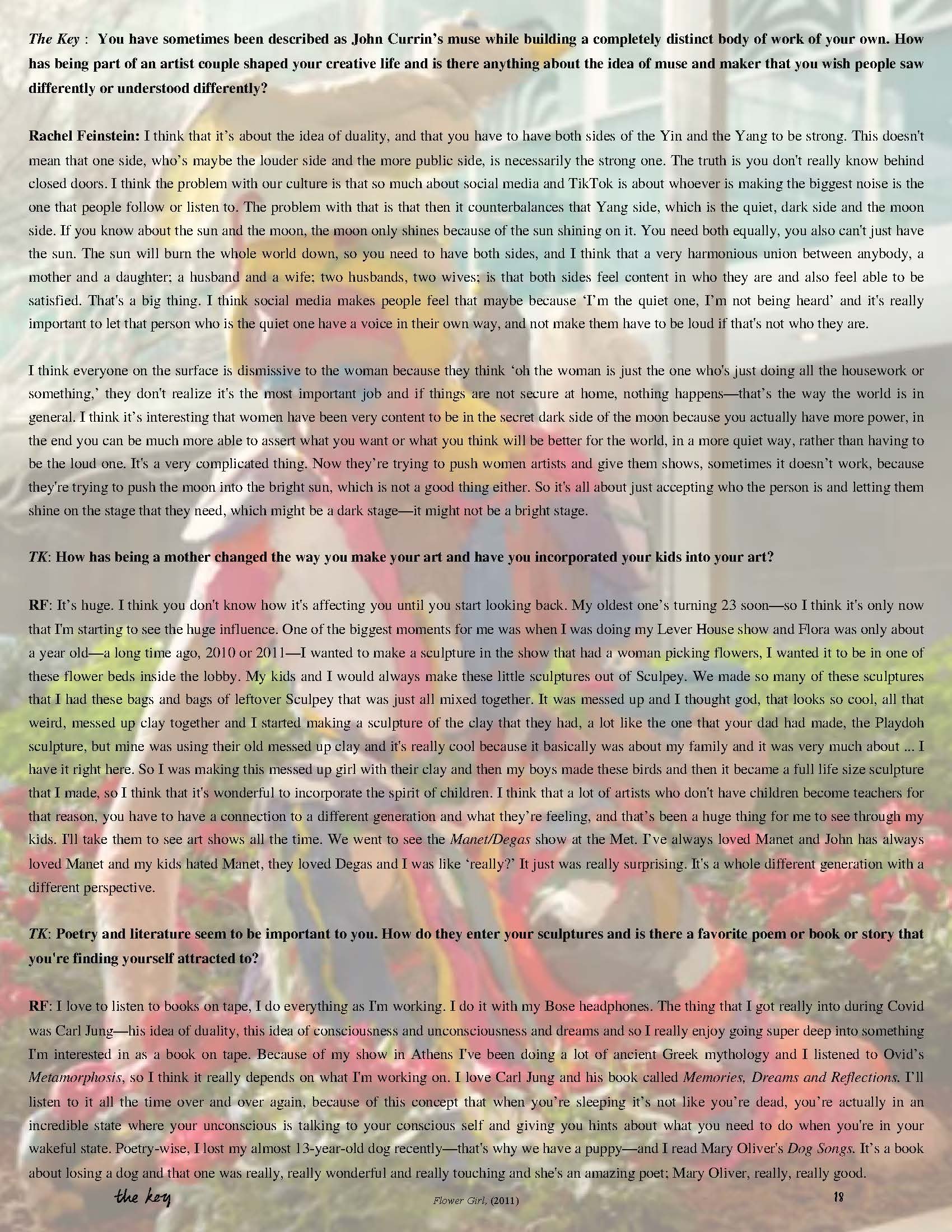
RF: It’s huge. I think you don't know how it's affecting you until you start looking back. My oldest one’s turning 23 soon—so I think it's only now that I'm starting to see the huge influence. One of the biggest moments for me was when I was doing my Lever House show and Flora was only about a year old—a long time ago, 2010 or 2011—I wanted to make a sculpture in the show that had a woman picking flowers, I wanted it to be in one of these flower beds inside the lobby. My kids and I would always make these little sculptures out of Sculpey. We made so many of these sculptures that I had these bags and bags of leftover Sculpey that was just all mixed together. It was messed up and I thought God, that looks so cool, all that weird, messed up clay together and I started making a sculpture of the clay that they had, a lot like the one that your dad had made, the Playdoh sculpture, but mine was using their old messed up clay and it's really cool because it basically was about my family and it was very much about ... I have it right here. So I was making this messed up girl with their clay and then my boys made these birds and then it became a full life size sculpture that I made, so I think that it's wonderful to incorporate the spirit of children. I think that a lot of artists who don't have children become teachers for that reason, you have to have a connection to a different generation and what they’re feeling, and that’s been a huge thing for me to see through my kids. I'll take them to see art shows all the time. We went to see the Manet/Degas show at the Met. I’ve always loved Manet and John has always loved Manet and my kids hated Manet, they loved Degas and I was like ‘really?’ It just was really surprising. It's a whole different generation with a different perspective.
TK: Poetry and literature seem to be important to you. How do they enter your sculptures and is there a favorite poem or book or story that you're finding yourself attracted to?
RF: I love to listen to books on tape, I do everything as I'm working. I do it with my Bose headphones. The thing that I got really into during Covid was Carl Jung—his idea of duality, this idea of consciousness and unconsciousness and dreams and so I really enjoy going super deep into something I'm interested in as a book on tape. Because of my show in Athens I've been doing a lot of ancient Greek mythology and I listened to Ovid’s Metamorphosis, so I think it really depends on what I'm working on. I love Carl Jung and his book called Memories, Dreams and Reflections. I’ll listen to it all the time over and over again, because of this concept that when you’re sleeping it’s not like you’re dead, you’re actually in an incredible state where your unconscious is talking to your conscious self and giving you hints about what you need to do when you're in your wakeful state. Poetry-wise, I lost my almost 13-year-old dog recently—that's why we have a puppy—and I read Mary Oliver's Dog Songs. It’s a book about losing a dog and that one was really, really wonderful and really touching and she's an amazing poet; Mary Oliver, really, really good.
TK: Wild Geese, love that one.
RF: I love how she personifies the idea of Mother Earth and Father Sky— it’s this totally incredible feeling of being in your body and it's very visceral, with the smell of the soil, you just feel it. And I love Emily Dickinson. I’ve been having a moment where something will speak to me, that then I'll find out what it is, just little moments that capture what you're thinking about at the second that you’re feeling it.
TK: I asked my dad about Carl Jung, he was like ‘yeah I have a bunch of his books’ and then he couldn't end up finding them, but one night we were playing pool and I looked to the side, and I saw Red Book, Carl Jung, and we have the big original version with all of his artwork.
RF: Yeah, he made the artwork himself. It’s incredible. He made his own castle by making his own stone work. He’s amazing. The reason why I also like him so much is he has much more of a female perspective of this idea of the soul, than Freud does. Freud was very like ‘oh your parents f**ked you up,’ the problem with the sex in your body. Jung is like a believer. He was super into yoga and into going all around the world and discovering how other people think about the soul, so deep and incredibly meaningful. You’ve got to check out Memories, Dreams and Reflections, it's incredible. It talks about his first feelings, his first memories as a small child and the trippyness of being a kid—when you’re a kid there’s a very fine veil between conscious and unconscious and how you’re kind of in the dream world, so it's very cool. Very cool.
There’s this thing called the Hoffman Process that I did that I really enjoyed. There’s things that you could do, where you could start learning how to go inward, especially now with all the noise that we have, it’s harder and harder to do. I think your generation is born with a phone—my older son was not born with a phone and I think his attention span is a little bit different than Flora’s—which has to do with her being given a phone when she was four-years-old. There’s just no memory whatsoever of what it was like without a phone. I think Frances got his first phone at ten, but it wasn't an iPhone, it was a flip-phone. I had nothing of course, and so my brain works differently I think, because I had 30 years with no phone.
TK: Who are some artists or people that you've encountered who have genuinely changed the way that you think about art or yourself?
RF: I think the number one person is my husband. Before I met him I really wanted to be an artist. I met him at my show, which was funny instead of it being his show. I think that he influenced me in such a huge way that it was a good thing, but it was also really a big change when coming from Miami and not really believing that I should know my art history, I was like ‘I'm going to just make my own history’ and I think that's not cool. I think the problem is that now that I’ve learned all this stuff about Jung and about art history is that we keep doing the same thing over again as human beings, and that the more you know about the past the more you can grow. It’s the same way politically in the same way as countries and as cultures, and that I think unfortunately, something about everyone thinking that phones will expand people's knowledge is bullshit, actually it makes people less knowledgeable. John opened up my eyes to the idea of how important it is to really look at the old masters and so now that’s our thing—we love going to new museums together in different cities that neither of us has been to—and just seeing new things. There’s a story, called the Jeweled Net of Indra, where we're all these glittering diamonds on a giant net, each of our souls, and that we reflect all the other souls that have come and gone. People that are going to be our children’s, children’s, children, and the future generations are also on this glittering net before they're born, and people that have left. So you're part of this whole giant diaspora. The souls keep doing the same things, which is unfortunately war, but also love and also art, and so the more you know the better it is and you’ll never know everything, and you’ll never know enough, but at least it's good to try to know. John brought that into my world and also, I met all of his friends from Yale that he went to his MFA with, like Lisa Yuskavage, who’s this really great painter and Sean Landers, and Richard Phillips and all these people are very successful artists that do different things. I didn't have that same camaraderie because I wasn't an art major; I was doing something else, so I really liked having this group that would come over to my studio and then give me crits and that kind of stuff. They come to my museum shows when I have them in the world and they all give me advice and it's nice to have that connection to other artists.
TK: What you were saying about the glittering diamonds reminds me of when you look up at the sky and see the stars…
RF: It’s all different souls that are up there, and they're just reflecting you and you’re reflecting them. You have these incredible moments when you realize you’re just part of this incredible history of not just this planet, but outside of this planet. You sit there looking at the stars and you realize you're both like a speck of dust but also part of the whole thing. It's so important.
TK: It makes me feel so small and yet so big.
RF: It’s really amazing and that's why I love mythology and also religion. The story of Mary and Jesus is the story of a mother realizing her child is going to die, which is what happens to every mother. Every mother has a realization that not only are they going to die, but their children are going to die. Yeah it’s huge
when you actually come to terms with that. It's like this isn’t just a fairy tale, this is real. We can’t just push it away and think it's not going to happen to us, it is going to happen to us, and you just have to think about it and know it's there.
TK: Speaking of mythology, if you could step into any fairy tale or myth or painting or imaginary world for one day, which one would that be for you?
RF: I mean, I have to say Botticelli's Birth of Venus is probably the first thing that comes to my mind just because of the scale of that painting and seeing it in person a couple times you're like ‘Oh My God.’ It’s the combination of the paganism mixed with Catholicism mixed with the Renaissance—he just nails the idea of multiple layers of femaleness and of the mythic power of the female entity and how beautiful and amazing it is. I just love a lot of the fairytales—I like Sleeping Beauty—and what they signify.
There's a really good book by Bruno Bettelheim about the hidden sources of these fairytales and what they're supposed to be teaching girls especially. Fairytales are really meant for girls, that’s why I love them so much too. The Birth of Venus for me is the first thing to pop up or Primavera. Botticelli for some reason is the one that just keeps coming up right now. I love witches and goddesses, and this idea of the duality of the roles of the female figure in both of those spheres and how he incorporated that in his painting so well.
TK: What is one obsession of yours, that doesn't have to have anything to do with art, that you think people would be surprised by right now?
RF: That’s so funny, oh God. I don’t know, I mean … I definitely am not a social media person so I don’t look at anything on Instagram, I don’t have an account … But I really got into Heated Rivalry with Flora. I really, really liked it and I have lots of debates with my gay friends about it.
TK: I was watching it with one of my friends recently and one of my brothers walked in and was like what are you guys watching?
RF: It was pretty amazing actually, it was weirdly shocking to see two men go at it and I was like; ‘wow I’m here I'm 55 years old and I'm pretty surprised’ and I like it! So that one would be one. It's totally not written by a man, a gay man, nothing, it’s written by a housewife in Canada. Isn’t that amazing? So I think it’s about fantasy in its own way. A gay man directed the series and did a really good job at it but a housewife in Canada wrote the whole thing. Isn’t that so cool? Which brings back a thing that is kind of bumming me out and I'm hoping is changing is that artists are not allowed to portray anything that they're not or that a filmmaker can't film something unless they're that person. A huge part about being an artist, writer, filmmaker or an actor is that you can totally transport yourself and that's like Jung as well. Your conscious self is stuck in this body but your unconscious self can be a dog, can fly, can do all these things because you're not stuck to your body —but our world is so stuck on this outer membrane of our bodies that it's getting really boring. It was something that I needed to say.
TK: What is “the key” to living a creative life in your opinion?
RF: I think it is about following who you really are, following your instincts, accepting who you are—don’t change your good parts and your bad parts. You just have to listen very, very quietly to who you are, and it's very hard to know that because of so many outside forces that are especially present in our life right now.