
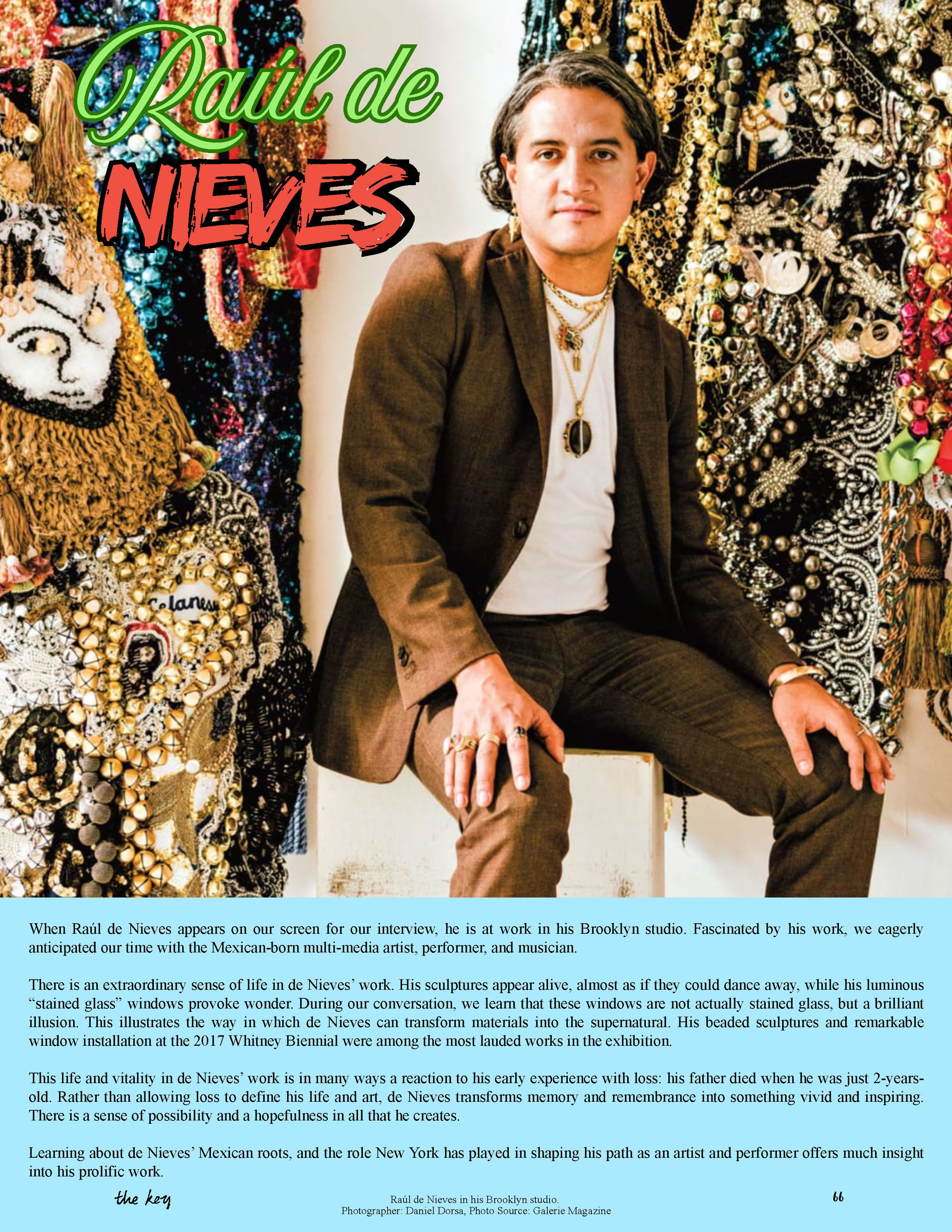
Raúl de Nieves
Raúl de Nieves
When Raúl de Nieves appears on our screen for our interview, he is at work in his Brooklyn studio. Fascinated by his work, we eagerly anticipated our time with the Mexican-born multi-media artist, performer, and musician.
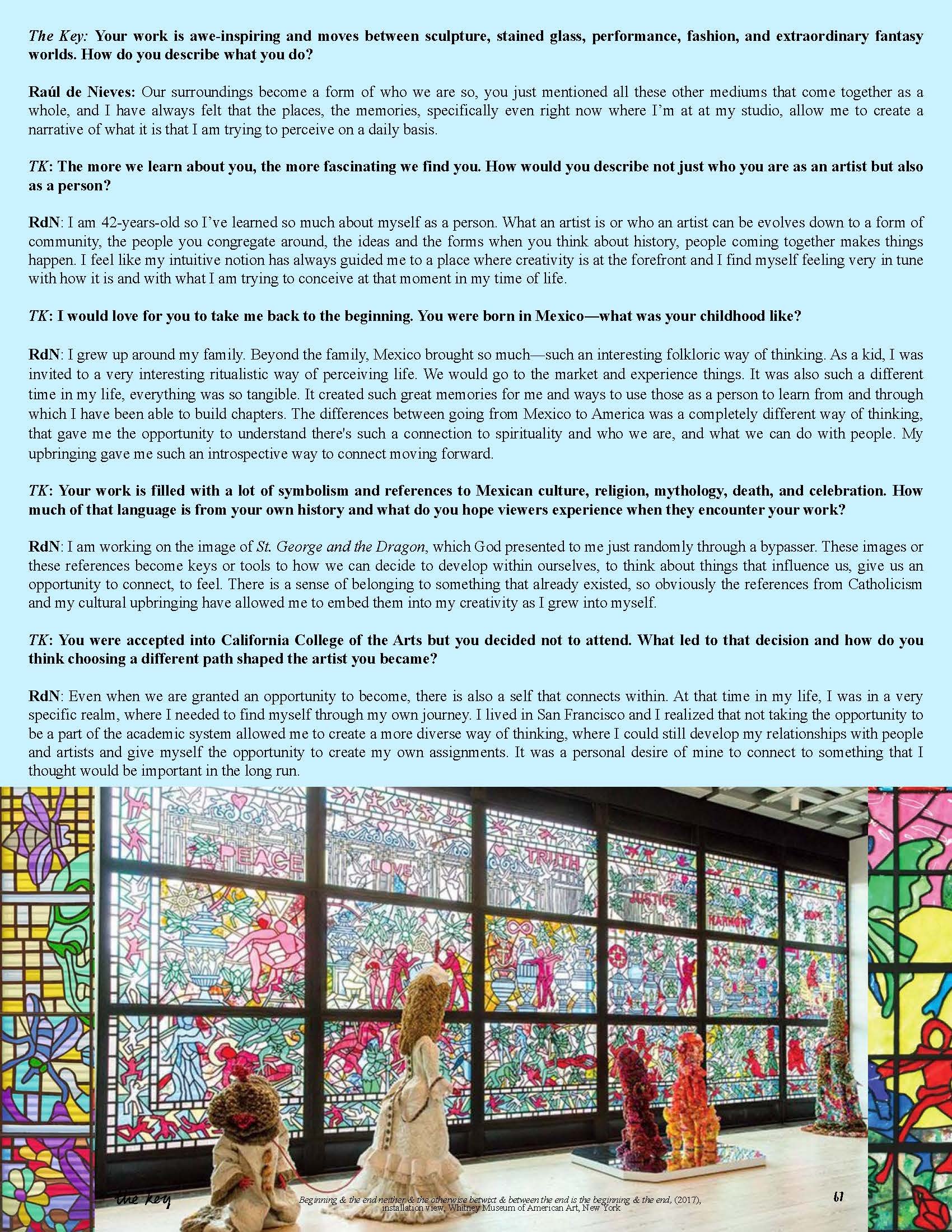
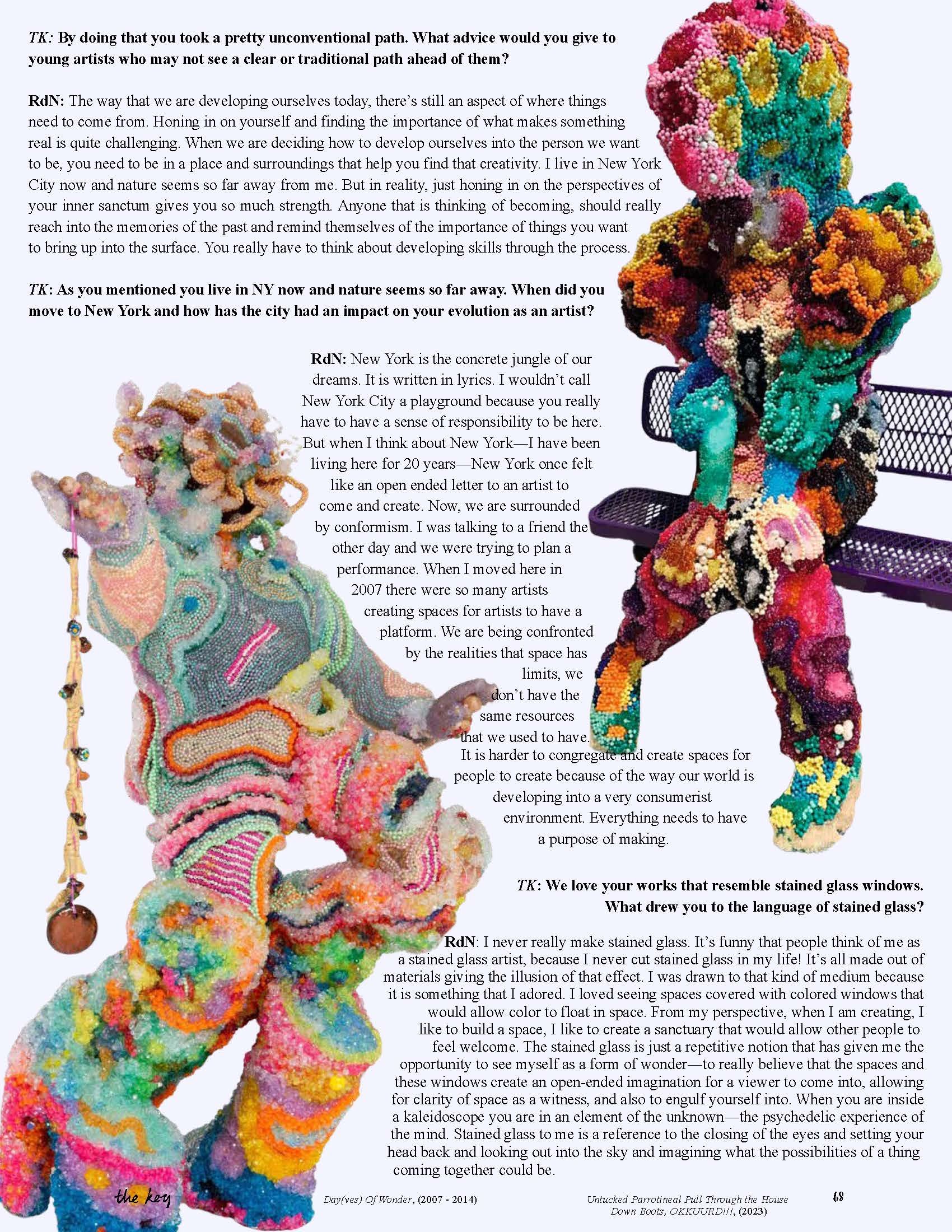
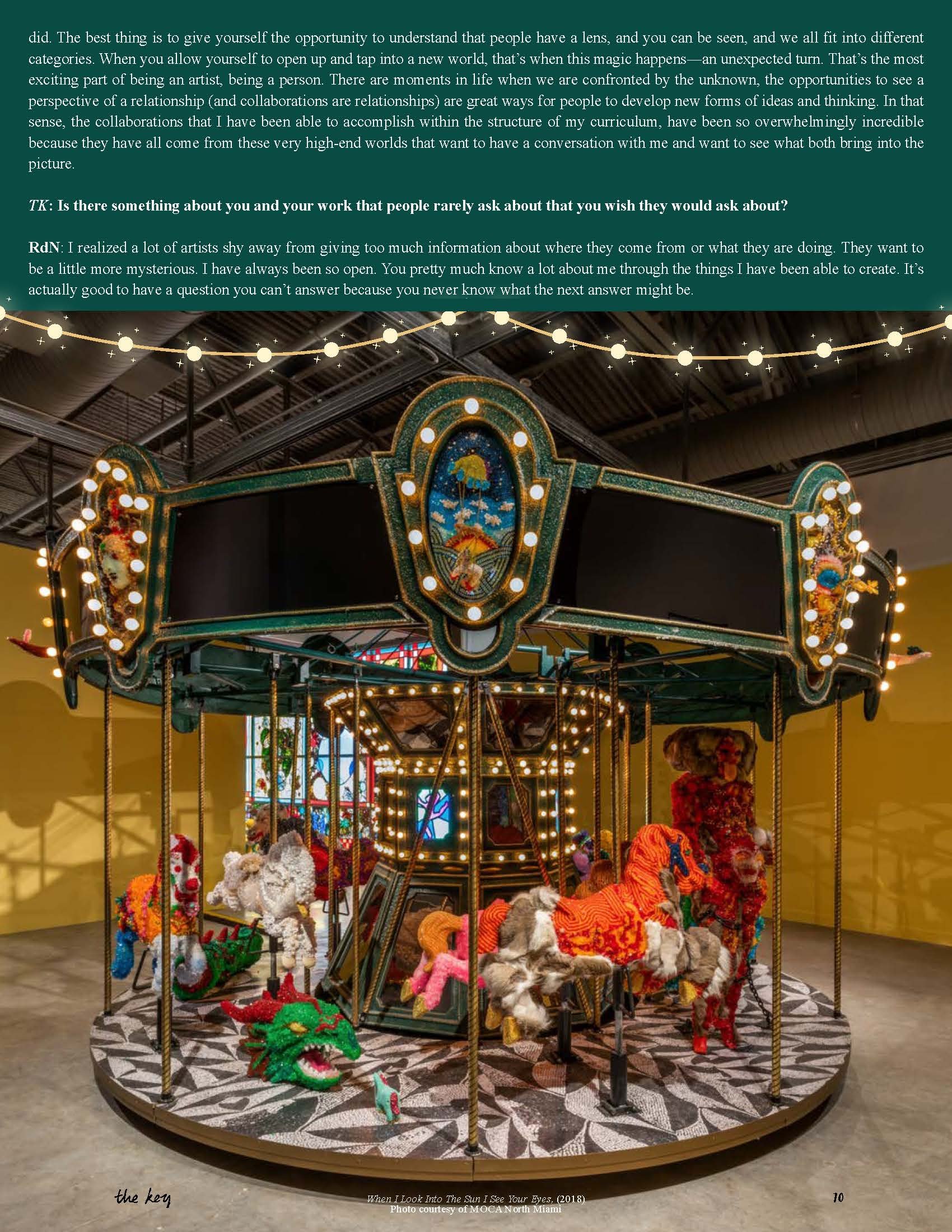
There is an extraordinary sense of life in de Nieves’ work. His sculptures appear alive, almost as if they could dance away, while his luminous “stained glass” windows provoke wonder. During our conversation, we learn that these windows are not actually stained glass, but a brilliant illusion. This illustrates the way in which de Nieves can transform materials into the supernatural. His beaded sculptures and remarkable window installation at the 2017 Whitney Biennial were among the most lauded works in the exhibition.
This life and vitality in de Nieves’ work is in many ways a reaction to his early experience with loss: his father died when he was just 2-years-old. Rather than allowing loss to define his life and art, de Nieves transforms memory and remembrance into something vivid and inspiring. There is a sense of possibility and a hopefulness in all that he creates.
Learning about de Nieves’ Mexican roots, and the role New York has played in shaping his path as an artist and performer offers much insight into his prolific work.
The Key: Your work is awe-inspiring and moves between sculpture, stained glass, performance, fashion, and extraordinary fantasy worlds. How do you describe what you do?
Raúl de Nieves: Our surroundings become a form of who we are so, you just mentioned all these other mediums that come together as a whole, and I have always felt that the places, the memories, specifically even right now where I’m at at my studio, allow me to create a narrative of what it is that I am trying to perceive on a daily basis.
TK: The more we learn about you, the more fascinating we find you. How would you describe not just who you are as an artist but also as a person?
RdN: I am 42-years-old so I’ve learned so much about myself as a person. What an artist is or who an artist can be evolves down to a form of community, the people you congregate around, the ideas and the forms when you think about history, people coming together makes things happen. I feel like my intuitive notion has always guided me to a place where creativity is at the forefront and I find myself feeling very in tune with how it is and with what I am trying to conceive at that moment in my time of life.
TK: I would love for you to take me back to the beginning. You were born in Mexico―what was your childhood like?
RdN: I grew up around my family. Beyond the family, Mexico brought so much―such an interesting folkloric way of thinking. As a kid, I was invited to a very interesting ritualistic way of perceiving life. We would go to the market and experience things. It was also such a different time in my life, everything was so tangible. It created such great memories for me and ways to use those as a person to learn from and through which I have been able to build chapters. The differences between going from Mexico to America was a completely different way of thinking, that gave me the opportunity to understand there's such a connection to spirituality and who we are, and what we can do with people. My upbringing gave me such an introspective way to connect moving forward.
TK: Your work is filled with a lot of symbolism and references to Mexican culture, religion, mythology, death, and celebration. How much of that language is from your own history and what do you hope viewers experience when they encounter your work?
RdN: I am working on the image of St. George and the Dragon, which God presented to me just randomly through a bypasser. These images or these references become keys or tools to how we can decide to develop within ourselves, to think about things that influence us, give us an opportunity to connect, to feel. There is a sense of belonging to something that already existed, so obviously the references from Catholicism and my cultural upbringing have allowed me to embed them into my creativity as I grew into myself.
TK: You were accepted into California College of the Arts but you decided not to attend. What led to that decision and how do you think choosing a different path shaped the artist you became?
RdN: Even when we are granted an opportunity to become, there is also a self that connects within. At that time in my life, I was in a very specific realm, where I needed to find myself through my own journey. I lived in San Francisco and I realized that not taking the opportunity to be a part of the academic system allowed me to create a more diverse way of thinking, where I could still develop my relationships with people and artists and give myself the opportunity to create my own assignments. It was a personal desire of mine to connect to something that I thought would be important in the long run.
TK: By doing that you took a pretty unconventional path. What advice would you give to young artists who may not see a clear or traditional path ahead of them?
RdN: The way that we are developing ourselves today, there’s still an aspect of where things
need to come from. Honing in on yourself and finding the importance of what makes something
real is quite challenging. When we are deciding how to develop ourselves into the person we want
to be, you need to be in a place and surroundings that help you find that creativity. I live in New York City now and nature seems so far away from me. But in reality, just honing in on the perspectives of your inner sanctum gives you so much strength. Anyone that is thinking of becoming, should really reach into the memories of the past and remind themselves of the importance of things you want
to bring up into the surface. You really have to think about developing skills through the process.
TK: As you mentioned you live in NY now and nature seems so far away. When did you move to New York and how has the city had an impact on your evolution as an artist?
RdN: New York is the concrete jungle of our dreams. It is written in lyrics. I wouldn’t call New York City a playground because you really have to have a sense of responsibility to be here. But when I think about New York - I have been living here for 20 years - New York once felt like an open ended letter to an artist to come and create. Now, we are surrounded by conformism. I was talking to a friend the other day and we were trying to plan a performance. When I moved here in 2007 there were so many artists creating spaces for artists to have a platform. We are being confronted by the realities that space has limits, we don’t have the same resources that we used to have. It is harder to congregate and create spaces for people to create because of the way our world is developing into a very consumerist environment. Everything needs to have a purpose of making.
TK: We love your works that resemble stained glass windows. What drew you to the language of stained glass?
RdN: I never really make stained glass. It’s funny that people think of me as a stained glass artist, because I never cut stained glass in my life! It’s all made out of materials giving the illusion of that effect. I was drawn to that kind of medium because it is something that I adored. I loved seeing spaces covered with colored windows that would allow color to float in space. From my perspective, when I am creating, I I like to build a space, I like to create a sanctuary that would allow other people to feel welcome. The stained glass is just a repetitive notion that has given me the opportunity to see myself as a form of wonder―to really believe that the spaces and these windows create an open-ended imagination for a viewer to come into, allowing for clarity of space as a witness, and also to engulf yourself into. When you are inside a kaleidoscope you are in an element of the unknown―the psychedelic experience of the mind. Stained glass to me is a reference to the closing of the eyes and setting your head back and looking out into the sky and imagining what the possibilities of a thing coming together could be.
TK: I read a quote in which you referenced your work doing its own performance―what an incredible concept! What does that mean to you and do you think of your sculptures and installations almost as living with their own identities?
RdN: For sure! When we think of how things are traditionally made, my work confronts those traditions within the structure. The materials that I am constantly working with allow the space to become. These objects and these materials work and perform a function that maybe they weren’t necessarily supposed to, to create a space within the ideas of what imagination and creation can be.
TK: I was also struck by The Interview article where you said, “I grew up in a household of death.” Yet, your work is so vibrant and alive while also being rooted in memory and remembrance. How do you think experiencing loss at such a young age shaped you and your work?
RdN: It’s funny because we are constantly being asked to let go of our old self or things that don’t seem to be fitting within us, but in reality, to lose a person is a very emotional trajectory. You become attached to a life because that is the symbiosis of who we are as people, we connect. Growing up, my father had passed away, my grandma, my grandfather―family members. It gave me an opportunity to believe in a deeper self, to connect more intuitively to my surroundings, to think about space not just as a tangible object but as a feeling. Growing up in a house full of loss has gained me so much more, because it’s given me an opportunity to really believe in space itself―and not just in space, but in myself as a person who connects to something divine―that isn’t necessarily in front of me but is inside of me.
TK: Is there something that you are working on now that feels especially important to you at this moment?
RdN: Right now, I am going back into this trajectory of where I first started, where I chose the image of Saint George and the Dragon that appeared to me when I was going to start school in San Francisco. I am looking at some of the works that I made at that time. They were water color paintings or paintings made using the medium of water and a soluble paint. In a way, it’s almost so romantic to think about
going back into that area and reminding ourselves that life is a flowing wave. We are connected through these experiences, and moments and it’s beautiful for me to remind myself of the simplicity of what inspiration can come from. Thinking about the trajectory of Saint George and the Dragon, the story itself, is that everything has a story. People love to create meaning within a structure, so I am being reminded of this important time in my life right now―which is growth and connection. There are obstacles that I have to continue to get through in order to find myself in a new plane of life, understanding what it is that comes next.
TK: You have accomplished so much! When you look back at your career, what moments, exhibitions or projects feel particularly meaningful?
RdN: This weekend I went to see the last days of the Whitney Biennial and being a New Yorker and having the opportunity to take part in an exhibition that brings a lot of critical effect to the bigger mass is such an honor. Being a part of that legacy within that structure of the academic world and art itself. Beyond the art, my connection to the people around me is what I find to be so moving, because I see my friends and my surroundings and we are all developing and creating. There is a sense of success that allows us all to continue to be inspired by one another, so those moments are some of the most beautiful things; to see the people around you have their dreams come true. It’s a beautiful time to continue to wonder.
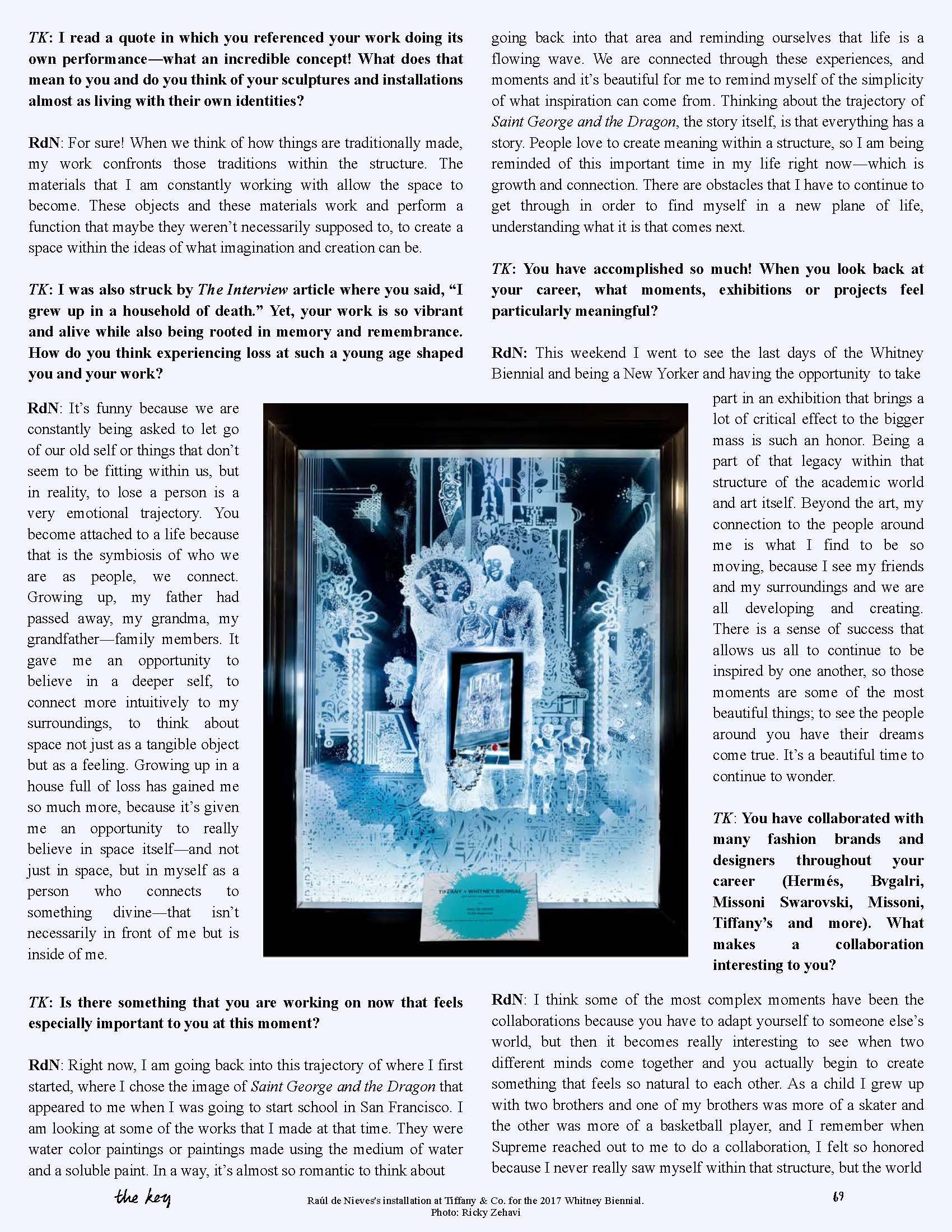
TK: You have collaborated with many fashion brands and designers throughout your career (Hermés, Bvgalri, Missoni Swarovski, Missoni, Tiffany’s and more). What makes a collaboration interesting to you?
RdN: I think some of the most complex moments have been the collaborations because you have to adapt yourself to someone else’s world, but then it becomes really interesting to see when two different minds come together and you actually begin to create something that feels so natural to each other. As a child I grew up with two brothers and one of my brothers was more of a skater and the other was more of a basketball player, and I remember when Supreme reached out to me to do a collaboration, I felt so honored because I never really saw myself within that structure, but the world did. The best thing is to give yourself the opportunity to understand that people have a lens, and you can be seen, and we all fit into different categories. When you allow yourself to open up and tap into a new world, that’s when this magic happens―an unexpected turn. That’s the most exciting part of being an artist, being a person. There are moments in life when we are confronted by the unknown, the opportunities to see a perspective of a relationship (and collaborations are relationships) are great ways for people to develop new forms of ideas and thinking. In that sense, the collaborations that I have been able to accomplish within the structure of my curriculum, have been so overwhelmingly incredible because they have all come from these very high-end worlds that want to have a conversation with me and want to see what both bring into the picture.
TK: Is there something about you and your work that people rarely ask about that you wish they would ask about?
RdN: I realized a lot of artists shy away from giving too much information about where they come from or what they are doing. They want to be a little more mysterious. I have always been so open. You pretty much know a lot about me through the things I have been able to create. It’s actually good to have a question you can’t answer because you never know what the next answer might be.