
Shepard Fairey
Inspiration & Hope
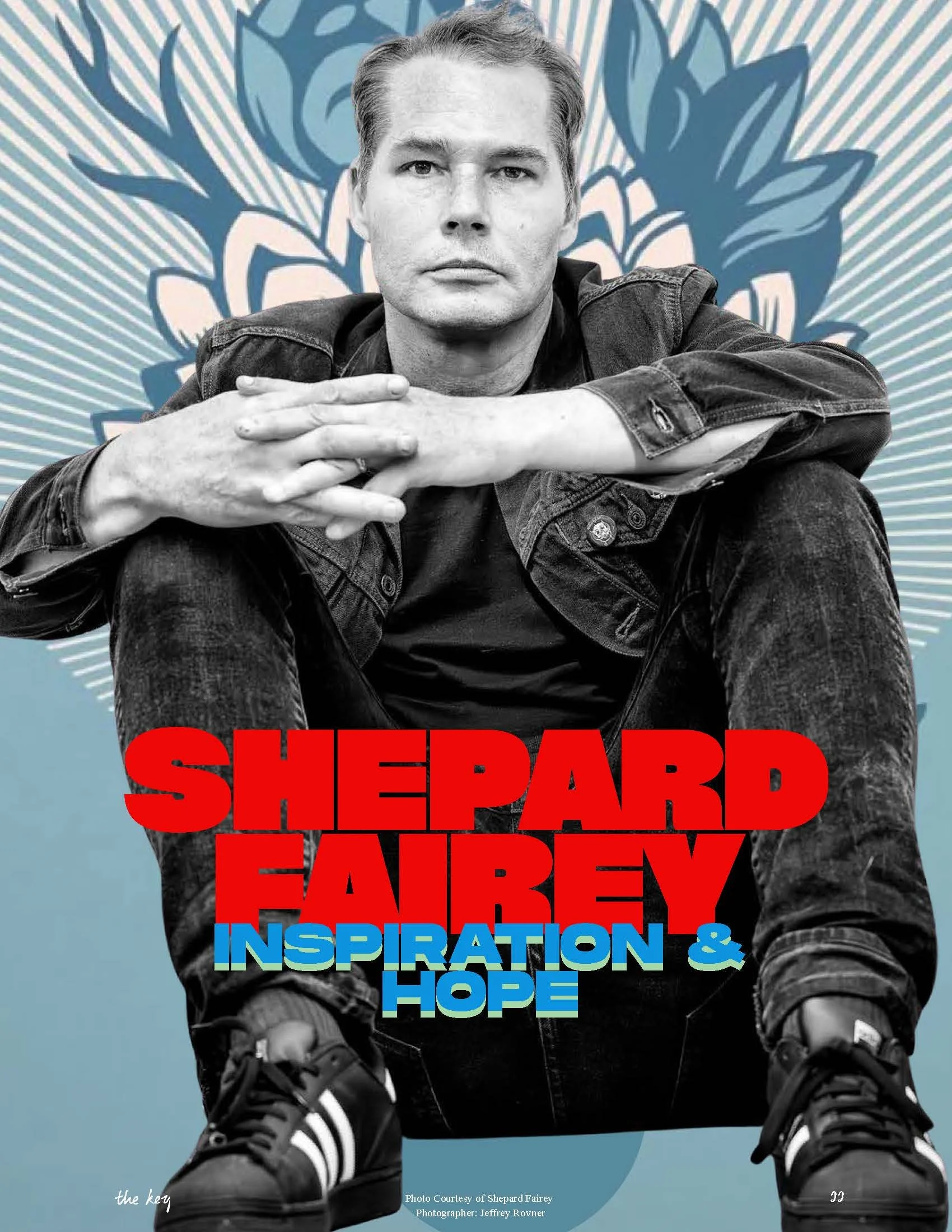
Shepard Fairey
Inspiration & Hope
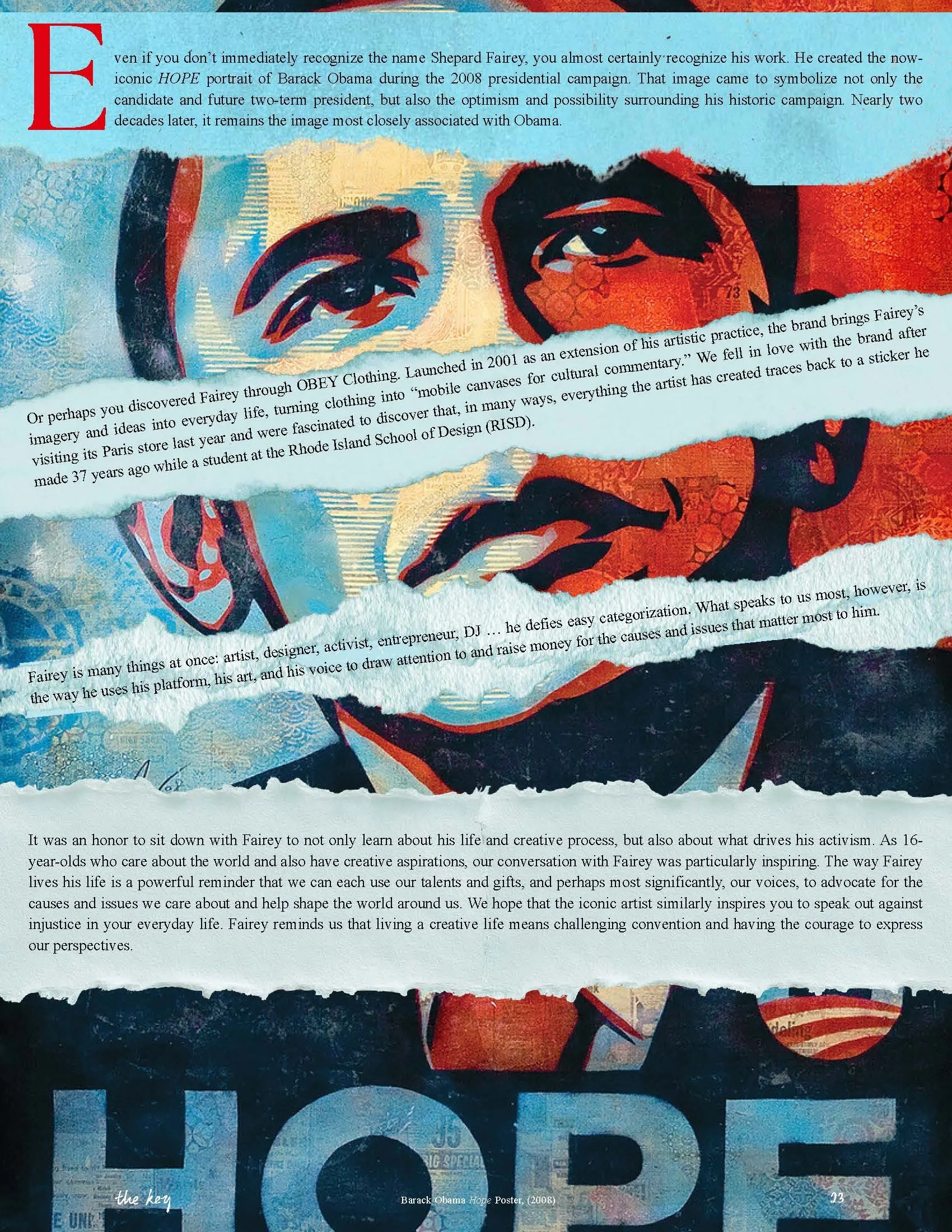
Even if you don’t immediately recognize the name Shepard Fairey, you almost certainly recognize his work. He created the now-iconic HOPE portrait of Barack Obama during the 2008 presidential campaign. That image came to symbolize not only the candidate and future two-term president, but also the optimism and possibility surrounding his historic campaign. Nearly two decades later, it remains the image most closely associated with Obama.
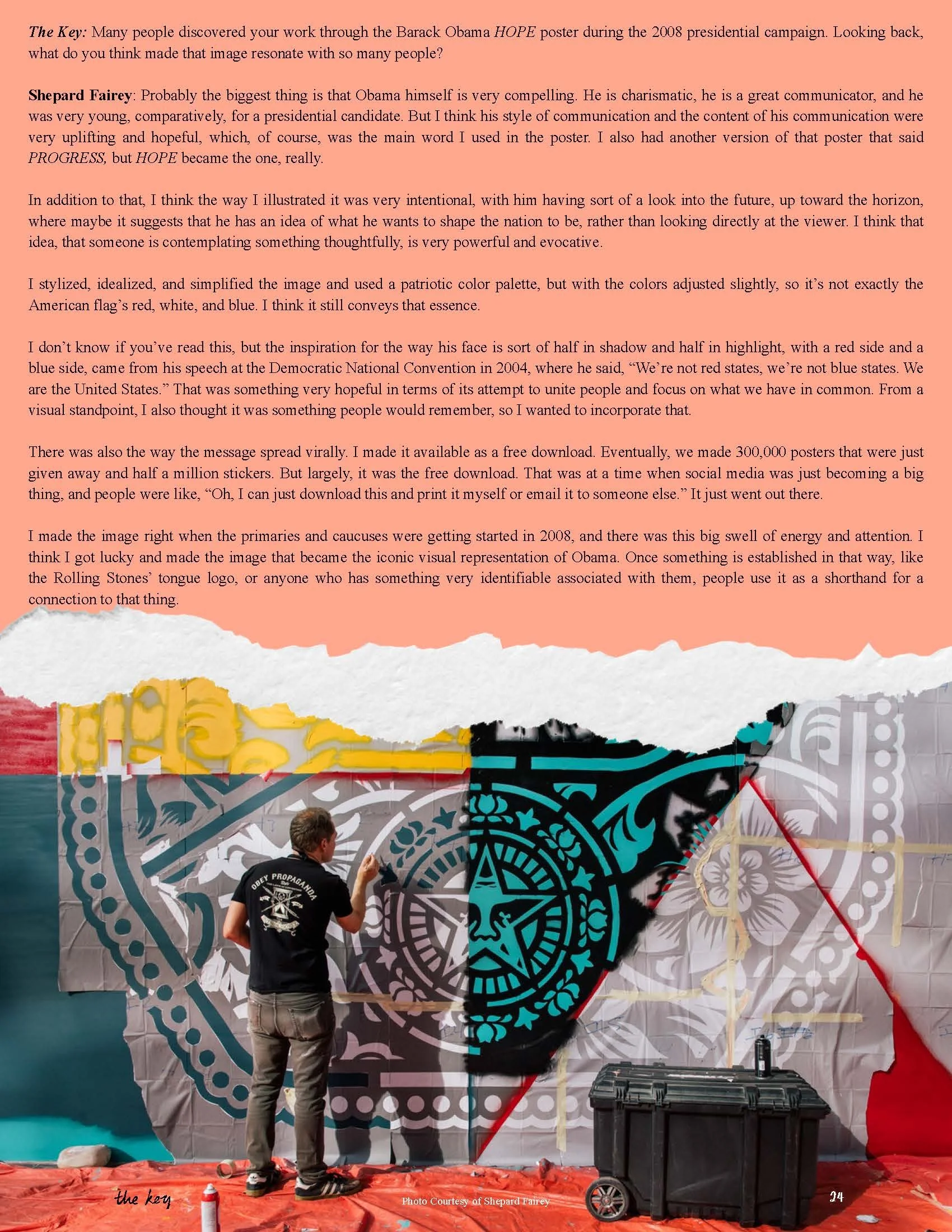
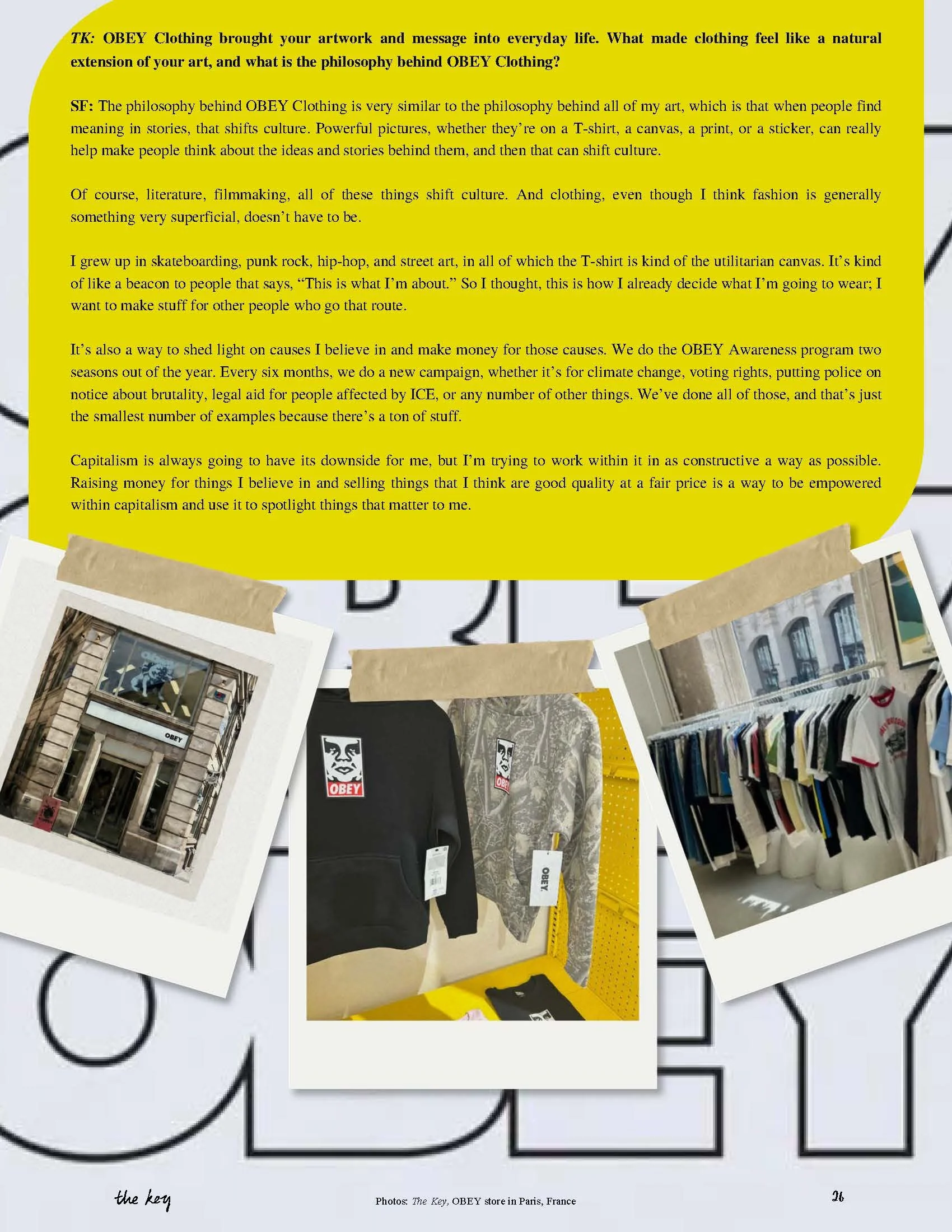
Or perhaps you discovered Fairey through OBEY Clothing. Launched in 2001 as an extension of his artistic practice, the brand brings Fairey’s imagery and ideas into everyday life, turning clothing into “mobile canvases for cultural commentary.” We fell in love with the brand after visiting its Paris store last year and were fascinated to discover that, in many ways, everything the artist has created traces back to a sticker he made 37 years ago while a student at the Rhode Island School of Design (RISD).
Fairey is many things at once: artist, designer, activist, entrepreneur, DJ … he defies easy categorization. What speaks to us most, however, is the way he uses his platform, his art, and his voice to draw attention to and raise money for the causes and issues that matter most to him.
It was an honor to sit down with Fairey to not only learn about his life and creative process, but also about what drives his activism. As 16-year-olds who care about the world and also have creative aspirations, our conversation with Fairey was particularly inspiring. The way Fairey lives his life is a powerful reminder that we can each use our talents and gifts, and perhaps most significantly, our voices, to advocate for the causes and issues we care about and help shape the world around us. We hope that the iconic artist similarly inspires you to speak out against injustice in your everyday life. Fairey reminds us that living a creative life means challenging convention and having the courage to express our perspectives.
The Key: Many people discovered your work through the Barack Obama HOPE poster during the 2008 presidential campaign. Looking back, what do you think made that image resonate with so many people?
Shepard Fairey: Probably the biggest thing is that Obama himself is very compelling. He is charismatic, he is a great communicator, and he was very young, comparatively, for a presidential candidate. But I think his style of communication and the content of his communication were very uplifting and hopeful, which, of course, was the main word I used in the poster. I also had another version of that poster that said PROGRESS, but HOPE became the one, really.
In addition to that, I think the way I illustrated it was very intentional, with him having sort of a look into the future, up toward the horizon, where maybe it suggests that he has an idea of what he wants to shape the nation to be, rather than looking directly at the viewer. I think that idea, that someone is contemplating something thoughtfully, is very powerful and evocative.
I stylized, idealized, and simplified the image and used a patriotic color palette, but with the colors adjusted slightly, so it’s not exactly the American flag’s red, white, and blue. I think it still conveys that essence.
I don’t know if you’ve read this, but the inspiration for the way his face is sort of half in shadow and half in highlight, with a red side and a blue side, came from his speech at the Democratic National Convention in 2004, where he said, “We’re not red states, we’re not blue states. We are the United States.” That was something very hopeful in terms of its attempt to unite people and focus on what we have in common. From a visual standpoint, I also thought it was something people would remember, so I wanted to incorporate that.
There was also the way the message spread virally. I made it available as a free download. Eventually, we made 300,000 posters that were just given away and half a million stickers. But largely, it was the free download. That was at a time when social media was just becoming a big thing, and people were like, “Oh, I can just download this and print it myself or email it to someone else.” It just went out there.
I made the image right when the primaries and caucuses were getting started in 2008, and there was this big swell of energy and attention. I think I got lucky and made the image that became the iconic visual representation of Obama. Once something is established in that way, like the Rolling Stones’ tongue logo, or anyone who has something very identifiable associated with them, people use it as a shorthand for a connection to that thing.
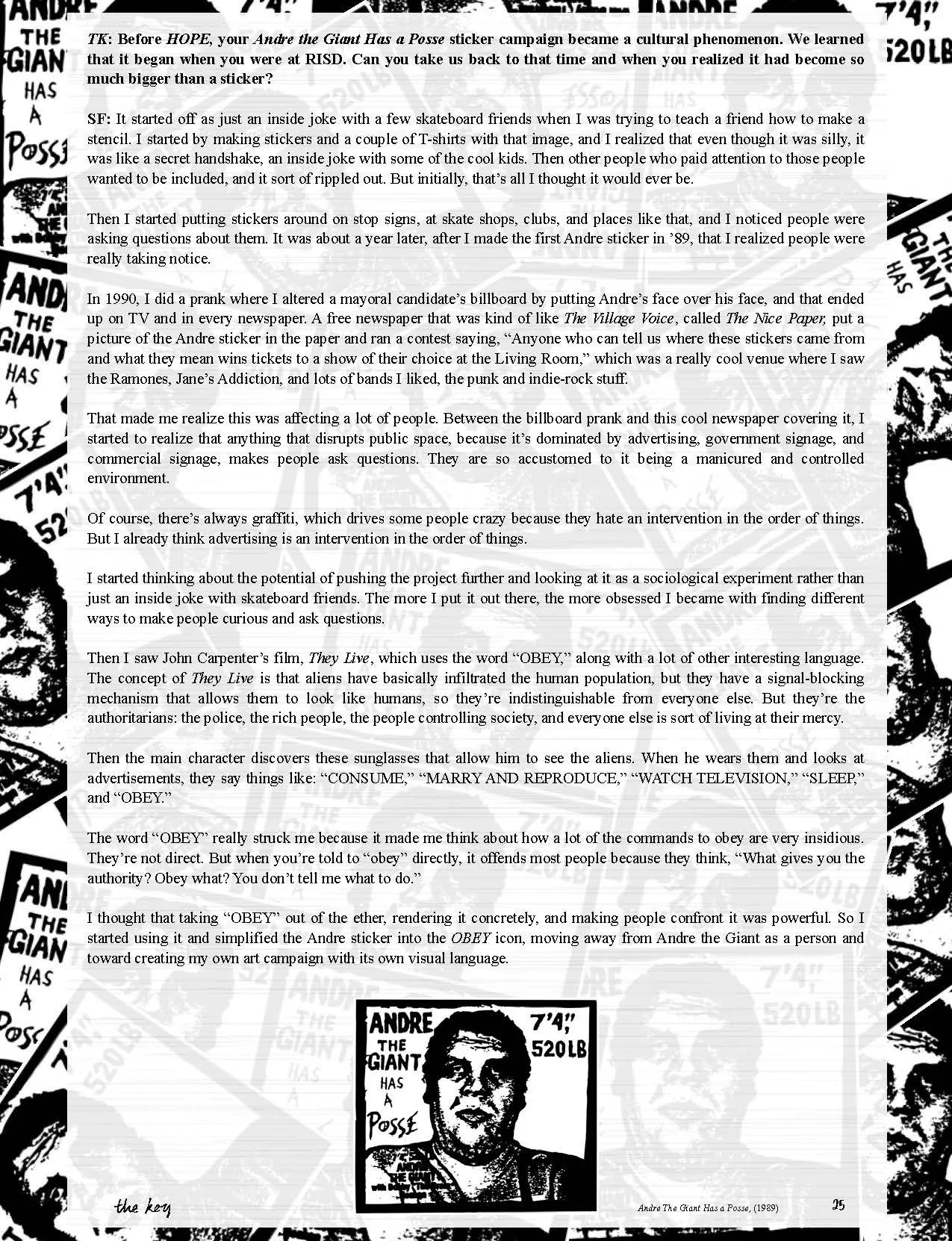
TK: Before HOPE, your Andre the Giant Has a Posse sticker campaign became a cultural phenomenon. We learned that it began when you were at RISD. Can you take us back to that time and when you realized it had become so much bigger than a sticker?
SF: It started off as just an inside joke with a few skateboard friends when I was trying to teach a friend how to make a stencil. I started by making stickers and a couple of T-shirts with that image, and I realized that even though it was silly, it was like a secret handshake, an inside joke with some of the cool kids. Then other people who paid attention to those people wanted to be included, and it sort of rippled out. But initially, that’s all I thought it would ever be.
Then I started putting stickers around on stop signs, at skate shops, clubs, and places like that, and I noticed people were asking questions about them. It was about a year later, after I made the first Andre sticker in ’89, that I realized people were really taking notice.
In 1990, I did a prank where I altered a mayoral candidate’s billboard by putting Andre’s face over his face, and that ended up on TV and in every newspaper. A free newspaper that was kind of like The Village Voice, called The Nice Paper, put a picture of the Andre sticker in the paper and ran a contest saying, “Anyone who can tell us where these stickers came from and what they mean wins tickets to a show of their choice at the Living Room,” which was a really cool venue where I saw the Ramones, Jane’s Addiction, and lots of bands I liked, the punk and indie-rock stuff.
That made me realize this was affecting a lot of people. Between the billboard prank and this cool newspaper covering it, I started to realize that anything that disrupts public space, because it’s dominated by advertising, government signage, and commercial signage, makes people ask questions. They are so accustomed to it being a manicured and controlled environment.
Of course, there’s always graffiti, which drives some people crazy because they hate an intervention in the order of things. But I already think advertising is an intervention in the order of things.
I started thinking about the potential of pushing the project further and looking at it as a sociological experiment rather than just an inside joke with skateboard friends. The more I put it out there, the more obsessed I became with finding different ways to make people curious and ask questions.
Then I saw John Carpenter’s film, They Live, which uses the word “OBEY,” along with a lot of other interesting language. The concept of They Live is that aliens have basically infiltrated the human population, but they have a signal-blocking mechanism that allows them to look like humans, so they’re indistinguishable from everyone else. But they’re the authoritarians: the police, the rich people, the people controlling society, and everyone else is sort of living at their mercy.
Then the main character discovers these sunglasses that allow him to see the aliens. When he wears them and looks at advertisements, they say things like: “CONSUME,” “MARRY AND REPRODUCE,” “WATCH TELEVISION,” “SLEEP,” and “OBEY.”
The word “OBEY” really struck me because it made me think about how a lot of the commands to obey are very insidious. They’re not direct. But when you’re told to “obey” directly, it offends most people because they think, “What gives you the authority? Obey what? You don’t tell me what to do.”
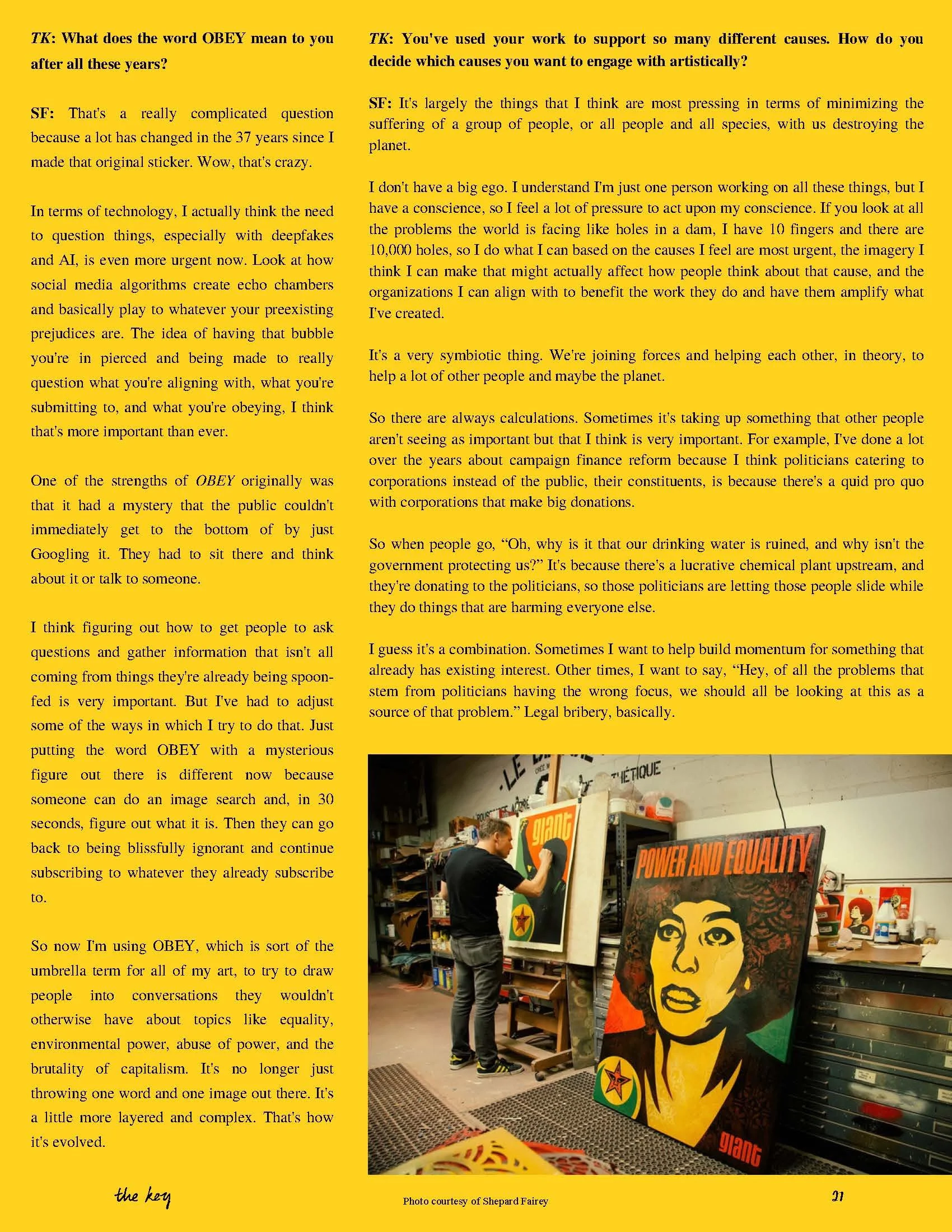
I thought that taking “OBEY” out of the ether, rendering it concretely, and making people confront it was powerful. So I started using it and simplified the Andre sticker into the OBEY icon, moving away from Andre the Giant as a person and toward creating my own art campaign with its own visual language.
TK: OBEY Clothing brought your artwork and message into everyday life. What made clothing feel like a natural extension of your art, and what is the philosophy behind OBEY Clothing?
SF: The philosophy behind OBEY Clothing is very similar to the philosophy behind all of my art, which is that when people find meaning in stories, that shifts culture. Powerful pictures, whether they’re on a T-shirt, a canvas, a print, or a sticker, can really help make people think about the ideas and stories behind them, and then that can shift culture.
Of course, literature, filmmaking, all of these things shift culture. And clothing, even though I think fashion is generally something very superficial, doesn’t have to be.
I grew up in skateboarding, punk rock, hip-hop, and street art, in all of which the T-shirt is kind of the utilitarian canvas. It’s kind of like a beacon to people that says, “This is what I’m about.” So I thought, this is how I already decide what I’m going to wear; I want to make stuff for other people who go that route.
It’s also a way to shed light on causes I believe in and make money for those causes. We do the OBEY Awareness program two seasons out of the year. Every six months, we do a new campaign, whether it’s for climate change, voting rights, putting police on notice about brutality, legal aid for people affected by ICE, or any number of other things. We’ve done all of those, and that’s just the smallest number of examples because there’s a ton of stuff.
Capitalism is always going to have its downside for me, but I’m trying to work within it in as constructive a way as possible. Raising money for things I believe in and selling things that I think are good quality at a fair price is a way to be empowered within capitalism and use it to spotlight things that matter to me.
TK: What does the word OBEY mean to you after all these years?
SF: That's a really complicated question because a lot has changed in the 37 years since I made that original sticker. Wow, that's crazy.
In terms of technology, I actually think the need to question things, especially with deepfakes and AI, is even more urgent now. Look at how social media algorithms create echo chambers and basically play to whatever your preexisting prejudices are. The idea of having that bubble you're in pierced and being made to really question what you're aligning with, what you're submitting to, and what you're obeying, I think that's more important than ever.
One of the strengths of OBEY originally was that it had a mystery that the public couldn't immediately get to the bottom of by just Googling it. They had to sit there and think about it or talk to someone.
I think figuring out how to get people to ask questions and gather information that isn't all coming from things they're already being spoon-fed is very important. But I've had to adjust some of the ways in which I try to do that. Just putting the word OBEY with a mysterious figure out there is different now because someone can do an image search and, in 30 seconds, figure out what it is. Then they can go back to being blissfully ignorant and continue subscribing to whatever they already subscribe to.
So now I'm using OBEY, which is sort of the umbrella term for all of my art, to try to draw people into conversations they wouldn't otherwise have about topics like equality, environmental power, abuse of power, and the brutality of capitalism. It's no longer just throwing one word and one image out there. It's a little more layered and complex. That's how it's evolved.
TK: You've used your work to support so many different causes. How do you decide which causes you want to engage with artistically?
SF: It's largely the things that I think are most pressing in terms of minimizing the suffering of a group of people, or all people and all species, with us destroying the planet.
I don't have a big ego. I understand I'm just one person working on all these things, but I have a conscience, so I feel a lot of pressure to act upon my conscience. If you look at all the problems the world is facing like holes in a dam, I have 10 fingers and there are 10,000 holes, so I do what I can based on the causes I feel are most urgent, the imagery I think I can make that might actually affect how people think about that cause, and the organizations I can align with to benefit the work they do and have them amplify what I've created.
It's a very symbiotic thing. We're joining forces and helping each other, in theory, to help a lot of other people and maybe the planet.
So there are always calculations. Sometimes it's taking up something that other people aren't seeing as important but that I think is very important. For example, I've done a lot over the years about campaign finance reform because I think politicians catering to corporations instead of the public, their constituents, is because there's a quid pro quo with corporations that make big donations.
So when people go, “Oh, why is it that our drinking water is ruined, and why isn't the government protecting us?” It's because there's a lucrative chemical plant upstream, and they're donating to the politicians, so those politicians are letting those people slide while they do things that are harming everyone else.
I guess it's a combination. Sometimes I want to help build momentum for something that already has existing interest. Other times, I want to say, “Hey, of all the problems that stem from politicians having the wrong focus, we should all be looking at this as a source of that problem.” Legal bribery, basically.
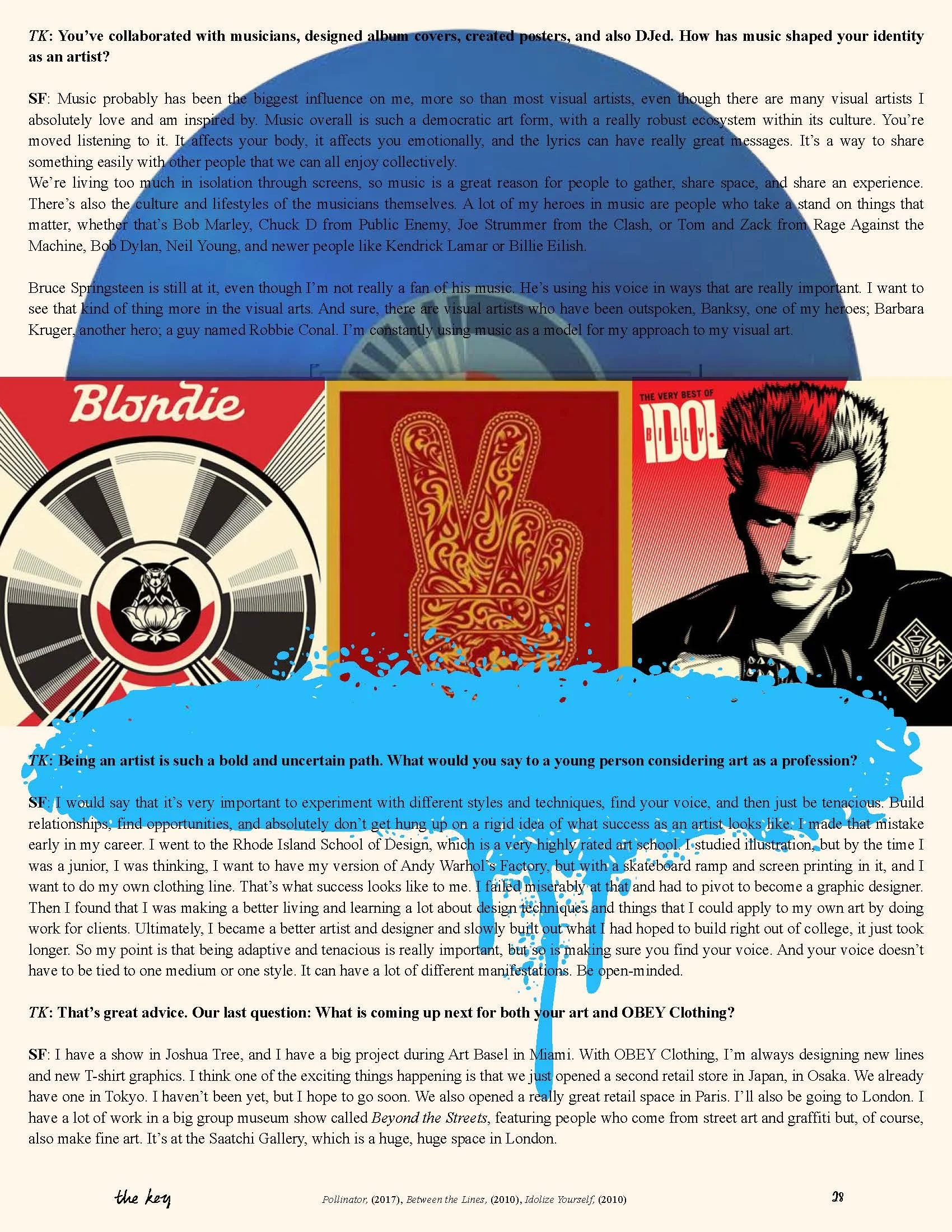
TK: You’ve collaborated with musicians, designed album covers, created posters, and also DJed. How has music shaped your identity as an artist?
SF: Music probably has been the biggest influence on me, more so than most visual artists, even though there are many visual artists I absolutely love and am inspired by. Music overall is such a democratic art form, with a really robust ecosystem within its culture. You’re moved listening to it. It affects your body, it affects you emotionally, and the lyrics can have really great messages. It’s a way to share something easily with other people that we can all enjoy collectively.
We’re living too much in isolation through screens, so music is a great reason for people to gather, share space, and share an experience. There’s also the culture and lifestyles of the musicians themselves. A lot of my heroes in music are people who take a stand on things that matter, whether that’s Bob Marley, Chuck D from Public Enemy, Joe Strummer from the Clash, or Tom and Zack from Rage Against the Machine, Bob Dylan, Neil Young, and newer people like Kendrick Lamar or Billie Eilish.
Bruce Springsteen is still at it, even though I’m not really a fan of his music. He’s using his voice in ways that are really important. I want to see that kind of thing more in the visual arts. And sure, there are visual artists who have been outspoken, Banksy, one of my heroes; Barbara Kruger, another hero; a guy named Robbie Conal. I’m constantly using music as a model for my approach to my visual art.
TK: Being an artist is such a bold and uncertain path. What would you say to a young person considering art as a profession?
SF: I would say that it’s very important to experiment with different styles and techniques, find your voice, and then just be tenacious. Build relationships, find opportunities, and absolutely don’t get hung up on a rigid idea of what success as an artist looks like. I made that mistake early in my career. I went to the Rhode Island School of Design, which is a very highly rated art school. I studied illustration, but by the time I was a junior, I was thinking, I want to have my version of Andy Warhol’s Factory, but with a skateboard ramp and screen printing in it, and I want to do my own clothing line. That’s what success looks like to me. I failed miserably at that and had to pivot to become a graphic designer. Then I found that I was making a better living and learning a lot about design techniques and things that I could apply to my own art by doing work for clients. Ultimately, I became a better artist and designer and slowly built out what I had hoped to build right out of college, it just took longer. So my point is that being adaptive and tenacious is really important, but so is making sure you find your voice. And your voice doesn’t have to be tied to one medium or one style. It can have a lot of different manifestations. Be open-minded.
TK: That’s great advice. Our last question: What is coming up next for both your art and OBEY Clothing?
SF: I have a show in Joshua Tree, and I have a big project during Art Basel in Miami. With OBEY Clothing, I’m always designing new lines and new T-shirt graphics. I think one of the exciting things happening is that we just opened a second retail store in Japan, in Osaka. We already have one in Tokyo. I haven’t been yet, but I hope to go soon. We also opened a really great retail space in Paris. I’ll also be going to London. I have a lot of work in a big group museum show called Beyond the Streets, featuring people who come from street art and graffiti but, of course, also make fine art. It’s at the Saatchi Gallery, which is a huge, huge space in London.