
The Best Friends Behind LUX FEMINAE
Talk ART
The Best Friends Behind LUX FEMINAE
Talk ART
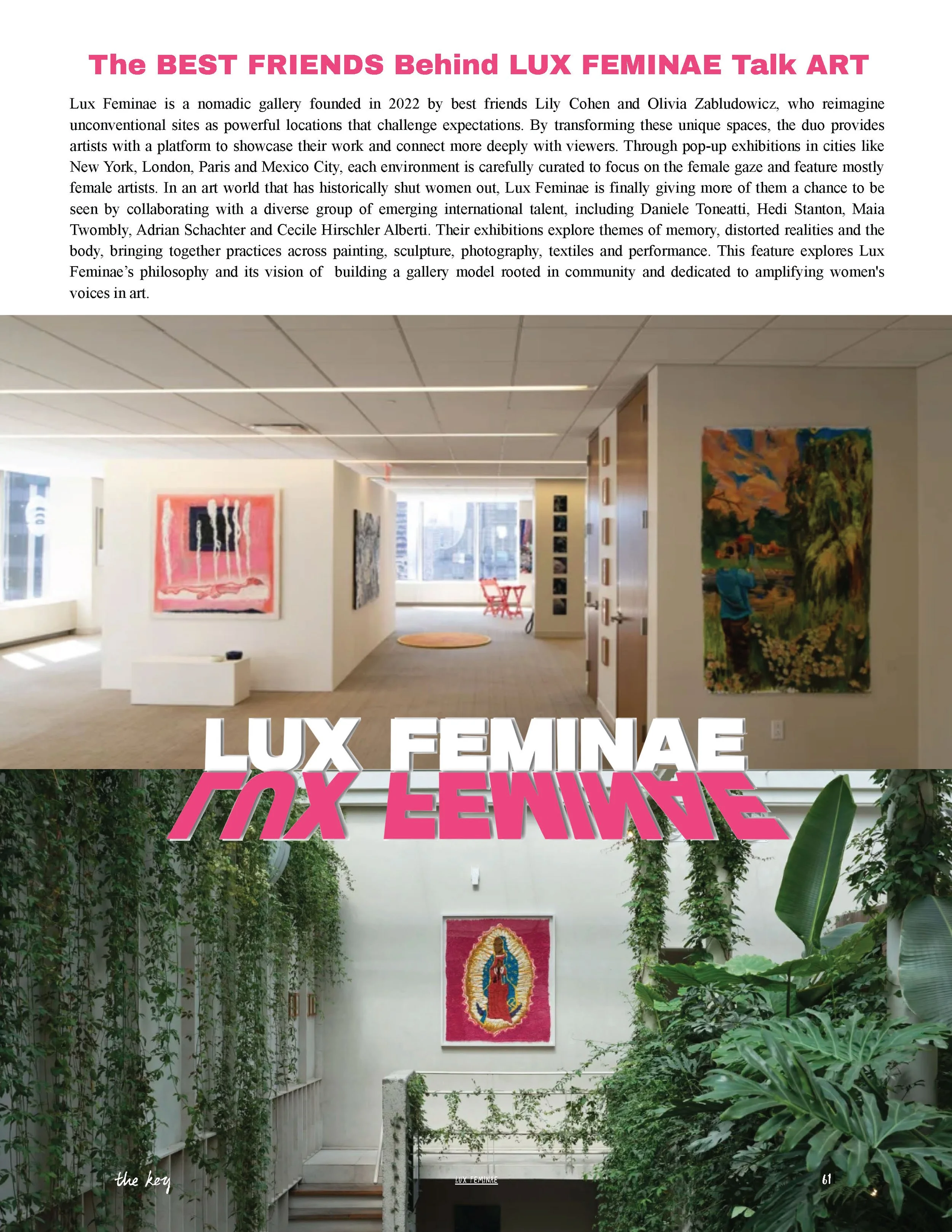
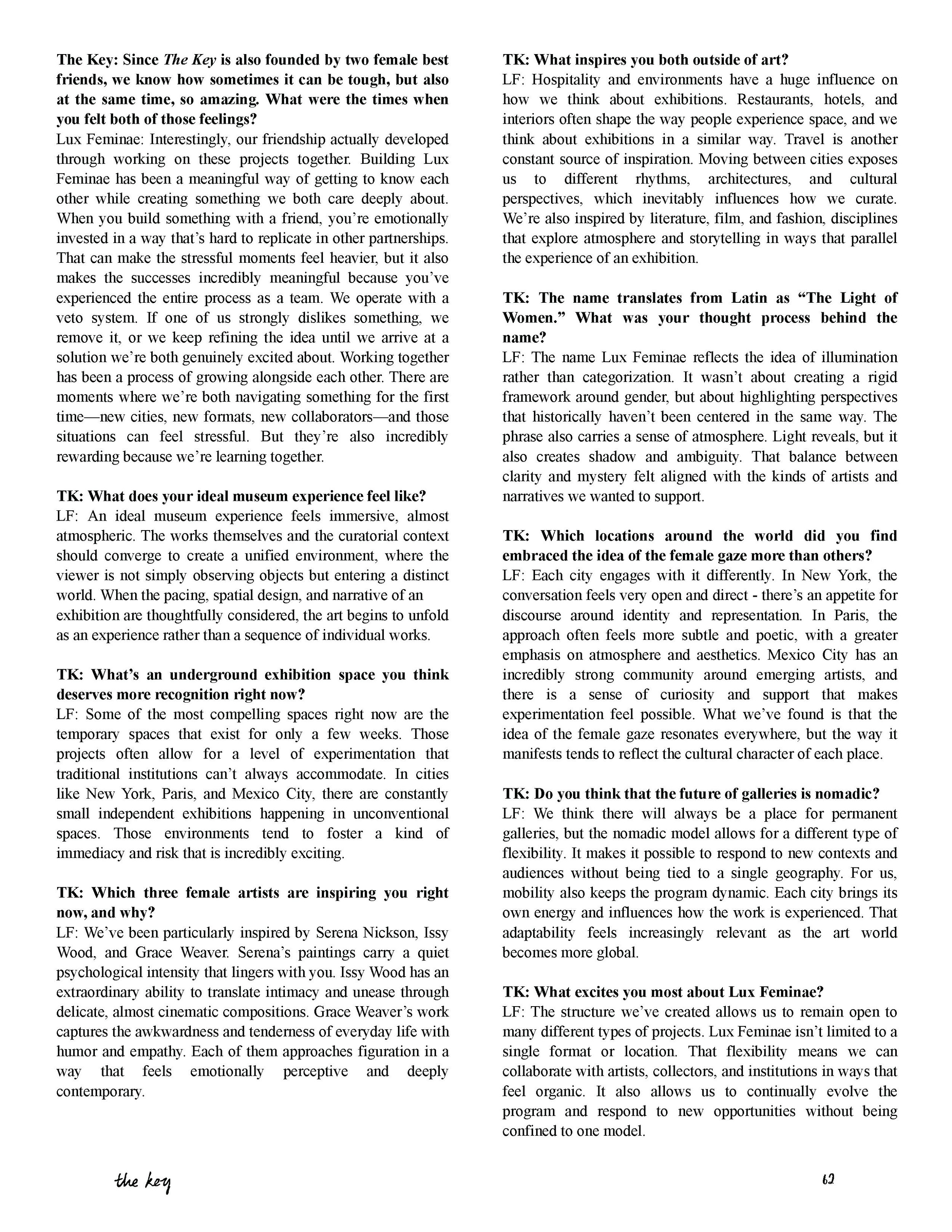
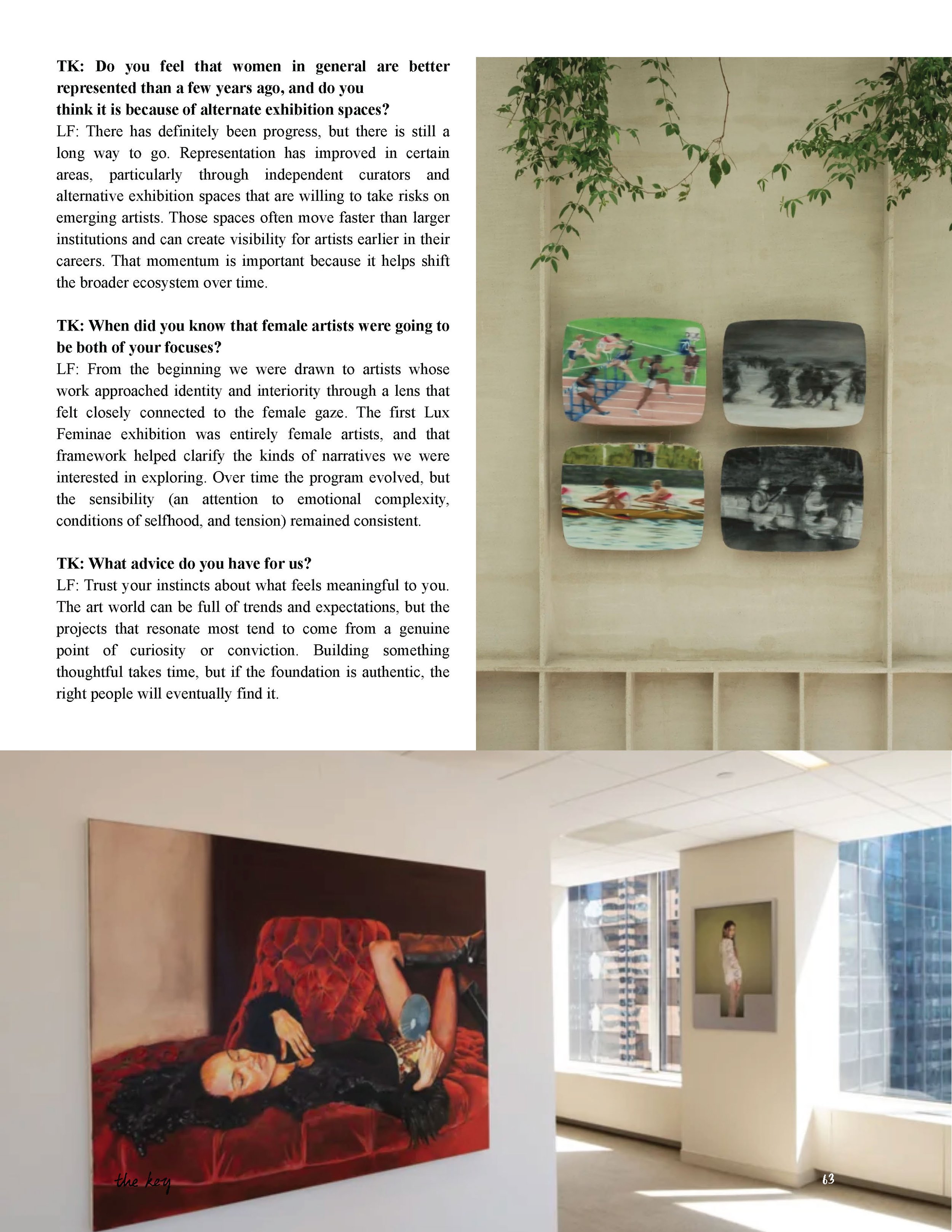
Lux Feminae is a nomadic gallery founded in 2022 by best friends Lily Cohen and Olivia Zabludowicz, who reimagine unconventional sites as powerful locations that challenge expectations. By transforming these unique spaces, the duo provides artists with a platform to showcase their work and connect more deeply with viewers. Through pop-up exhibitions in cities like New York, London, Paris and Mexico City, each environment is carefully curated to focus on the female gaze and feature mostly female artists. In an art world that has historically shut women out, Lux Feminae is finally giving more of them a chance to be seen by collaborating with a diverse group of emerging international talent, including Daniele Toneatti, Hedi Stanton, Maia Twombly, Adrian Schachter and Cecile Hirschler Alberti. Their exhibitions explore themes of memory, distorted realities and the body, bringing together practices across painting, sculpture, photography, textiles and performance. This feature explores Lux Feminae’s philosophy and its vision of building a gallery model rooted in community and dedicated to amplifying women's voices in art.
The Key: Since The Key is also founded by two female best friends, we know how sometimes it can be tough, but also at the same time, so amazing. What were the times when you felt both of those feelings?
Lux Feminae: Interestingly, our friendship actually developed through working on these projects together. Building Lux Feminae has been a meaningful way of getting to know each other while creating something we both care deeply about. When you build something with a friend, you’re emotionally invested in a way that’s hard to replicate in other partnerships. That can make the stressful moments feel heavier, but it also makes the successes incredibly meaningful because you’ve experienced the entire process as a team. We operate with a veto system. If one of us strongly dislikes something, we remove it, or we keep refining the idea until we arrive at a solution we’re both genuinely excited about. Working together has been a process of growing alongside each other. There are moments where we’re both navigating something for the first time—new cities, new formats, new collaborators—and those situations can feel stressful. But they’re also incredibly rewarding because we’re learning together.
TK: What does your ideal museum experience feel like?
LF: An ideal museum experience feels immersive, almost atmospheric. The works themselves and the curatorial context should converge to create a unified environment, where the viewer is not simply observing objects but entering a distinct world. When the pacing, spatial design, and narrative of an exhibition are thoughtfully considered, the art begins to unfold as an experience rather than a sequence of individual works.
TK: What’s an underground exhibition space you think deserves more recognition right now?
LF: Some of the most compelling spaces right now are the temporary spaces that exist for only a few weeks. Those projects often allow for a level of experimentation that traditional institutions can’t always accommodate. In cities like New York, Paris, and Mexico City, there are constantly small independent exhibitions happening in unconventional spaces. Those environments tend to foster a kind of immediacy and risk that is incredibly exciting.
TK: Which three female artists are inspiring you right now, and why?
LF: We’ve been particularly inspired by Serena Nickson, Issy Wood, and Grace Weaver. Serena’s paintings carry a quiet psychological intensity that lingers with you. Issy Wood has an extraordinary ability to translate intimacy and unease through delicate, almost cinematic compositions. Grace Weaver’s work captures the awkwardness and tenderness of everyday life with humor and empathy. Each of them approaches figuration in a way that feels emotionally perceptive and deeply contemporary.
TK: What inspires you both outside of art?
LF: Hospitality and environments have a huge influence on how we think about exhibitions. Restaurants, hotels, and interiors often shape the way people experience space, and we think about exhibitions in a similar way. Travel is another constant source of inspiration. Moving between cities exposes us to different rhythms, architectures, and cultural perspectives, which inevitably influences how we curate. We’re also inspired by literature, film, and fashion, disciplines that explore atmosphere and storytelling in ways that parallel the experience of an exhibition.
TK: The name translates from Latin as “The Light of Women.” What was your thought process behind the name?
LF: The name Lux Feminae reflects the idea of illumination rather than categorization. It wasn’t about creating a rigid framework around gender, but about highlighting perspectives that historically haven’t been centered in the same way. The phrase also carries a sense of atmosphere. Light reveals, but it also creates shadow and ambiguity. That balance between clarity and mystery felt aligned with the kinds of artists and narratives we wanted to support.
TK: Which locations around the world did you find embraced the idea of the female gaze more than others?
LF: Each city engages with it differently. In New York, the conversation feels very open and direct - there’s an appetite for discourse around identity and representation. In Paris, the approach often feels more subtle and poetic, with a greater emphasis on atmosphere and aesthetics. Mexico City has an incredibly strong community around emerging artists, and there is a sense of curiosity and support that makes experimentation feel possible. What we’ve found is that the idea of the female gaze resonates everywhere, but the way it manifests tends to reflect the cultural character of each place.
TK: Do you think that the future of galleries is nomadic?
LF: We think there will always be a place for permanent galleries, but the nomadic model allows for a different type of flexibility. It makes it possible to respond to new contexts and audiences without being tied to a single geography. For us, mobility also keeps the program dynamic. Each city brings its own energy and influences how the work is experienced. That adaptability feels increasingly relevant as the art world becomes more global.
TK: What excites you most about Lux Feminae?
LF: The structure we’ve created allows us to remain open to many different types of projects. Lux Feminae isn’t limited to a single format or location. That flexibility means we can collaborate with artists, collectors, and institutions in ways that feel organic. It also allows us to continually evolve the program and respond to new opportunities without being confined to one model.
TK: Do you feel that women in general are better represented than a few years ago, and do you think it is because of alternate exhibition spaces?
LF: There has definitely been progress, but there is still a long way to go. Representation has improved in certain areas, particularly through independent curators and alternative exhibition spaces that are willing to take risks on emerging artists. Those spaces often move faster than larger institutions and can create visibility for artists earlier in their careers. That momentum is important because it helps shift the broader ecosystem over time.
TK: When did you know that female artists were going to be both of your focuses?
LF: From the beginning we were drawn to artists whose work approached identity and interiority through a lens that felt closely connected to the female gaze. The first Lux Feminae exhibition was entirely female artists, and that framework helped clarify the kinds of narratives we were interested in exploring. Over time the program evolved, but the sensibility (an attention to emotional complexity, conditions of selfhood, and tension) remained consistent.
TK: What advice do you have for us?
LF: Trust your instincts about what feels meaningful to you. The art world can be full of trends and expectations, but the projects that resonate most tend to come from a genuine point of curiosity or conviction. Building something thoughtful takes time, but if the foundation is authentic, the right people will eventually find it.